




01. Edit your form 8879 pe online
Type text, add images, blackout confidential details, add comments, highlights and more.

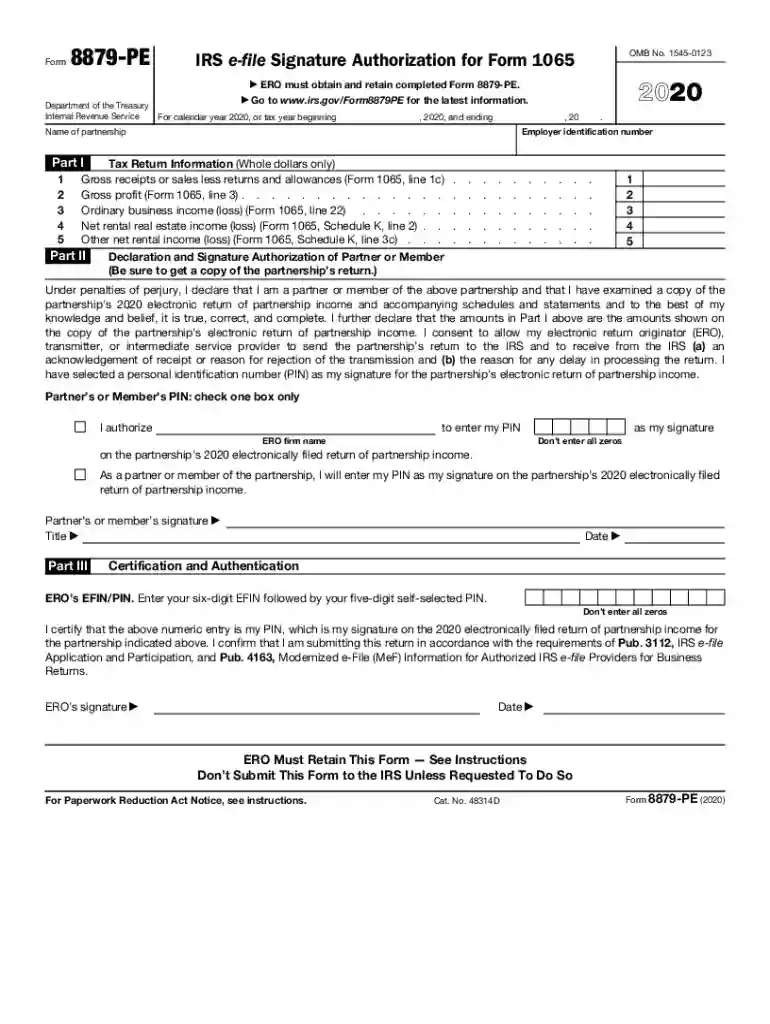
Type text, add images, blackout confidential details, add comments, highlights and more.

Draw your signature, type it, upload its image, or use your mobile device as a signature pad.

Send 8879 pe via email, link, or fax. You can also download it, export it or print it out.
Form 8879-PE is the IRS e-file Signature Authorization used by partners or members of a partnership to electronically sign their partnership's income tax return. It allows for secure signing using a personal identification number (PIN) and outlines responsibilities for both the electronic return originator (ERO) and the partner or member. The form serves as a declaration of the accuracy of the return and is retained by the ERO for record-keeping purposes. It is not submitted to the IRS unless specifically requested, making it vital for compliance and accuracy in electronic filings.
Acquiring Form 8879-PE can be straightforward. Partners or members of a partnership can download the form directly from the IRS website. Once downloaded, it is typically filled out by both the ERO and the partner or member responsible for signing the partnership’s return. Tax professionals may also provide this form to their clients as part of the tax filing process. It is crucial to ensure that the form is the most current version to comply with the latest IRS regulations.
Enter Identifying Information: Fill in the name, employer identification number (EIN), and address of the partnership.
Indicate Return Details: Specify the tax year and form being filed; typically, this would be Form 1065 for partnerships.
Partner or Member Information: Include the name and title of the partner or member responsible for signing.
Assign PIN: The partner or member should select a self-created PIN, used for electronic signature purposes.
ERO Verification: The ERO confirms the accuracy of the return and officially records the partner’s PIN and other details.
Retention of Form: Keep the original form with the tax records. The IRS does not require physical submission unless audited.
Form 8879-PE is essential for securing an electronic signature for a partnership's tax return, ensuring streamlined filing and compliance with IRS regulations. By allowing partners to use a PIN instead of a traditional signature, it facilitates more efficient processing and reduces the need for paper-based record management. It empowers partnerships to adhere to electronic filing mandates while safeguarding sensitive information provided on the return.
The primary users of Form 8879-PE are partnerships that file Form 1065 with the IRS and utilize electronic filing systems. This includes a wide variety of business entities structured as partnerships, such as law firms, accounting groups, real estate investment partnerships, and any other organization that chooses a partnership model. Tax professionals and EROs commonly assist these entities in completing the form during tax season.
Form 8879-PE is legally binding for the purpose it serves: authorizing electronic filing of a partnership's tax return. The form's structure aligns with the regulations provided under the ESIGN Act, allowing electronic signatures to have the same legal standing as handwritten signatures. For legal conformity, each completed form must accurately represent the tax information filed and the authorization granted to the ERO.
The IRS provides specific guidelines for Form 8879-PE usage:
Form 8879-PE should align with the deadlines associated with Form 1065. Generally, Form 1065 is due by the 15th day of the third month following the close of the tax year. In 2023, this deadline would typically be March 15 for calendar-year partnerships. Extensions can be filed using Form 7004, but ensure the 8879-PE is completed with any timely filed extension submissions.
Failing to properly complete or retain Form 8879-PE can result in significant penalties. For partnerships, inaccuracies or the provision of misleading information can lead to penalties for both the partnership and the ERO. In cases where the IRS requests access to the form and it is unavailable, there could be reputational damage, legal implications, and monetary fines. EROs are especially encouraged to maintain diligent records to avoid potential pitfalls associated with electronic tax filing.
We've got more versions of the form 8879 pe form. Select the right form 8879 pe version from the list and start editing it straight away!
| Versions | Form popularity | Fillable & printable |
|---|---|---|
| 2025 | 4.9 Satisfied (45 Votes) | |
| 2024 | 4.1 Satisfied (20 Votes) | |
| 2023 | 4.7 Satisfied (47 Votes) | |
| 2022 | 4.6 Satisfied (49 Votes) | |
| 2021 | 4.8 Satisfied (91 Votes) | |
| 2020 | 4.3 Satisfied (120 Votes) | |
| 2019 | 4.4 Satisfied (75 Votes) | |
| 2018 | 4.3 Satisfied (62 Votes) | |
| 2017 | 4.3 Satisfied (91 Votes) | |
| 2016 | 4.4 Satisfied (90 Votes) | |
| 2015 | 4 Satisfied (53 Votes) | |
| 2014 | 4.4 Satisfied (38 Votes) | |
| 2013 | 4 Satisfied (66 Votes) | |
| 2011 | 4 Satisfied (42 Votes) | |
| 2010 | 4.1 Satisfied (59 Votes) |
At DocHub, your data security is our priority. We follow HIPAA, SOC2, GDPR, and other standards, so you can work on your documents with confidence.
IRS 8879 - PE Form 1-19-12 (2023). Transactional Matter Files. 65. . Download.Read more
Mar 30, 2026 Use this form when the general partner or limited liability company member manager wants to use a personal identification number (PIN) to electronically sign aRead more
by F PUB 1986 Cited by 3 International Standard ISO 8879 was prepared by Technical Committee ISO/TC 97, In formation processing systems. Users should note that all InternationalRead more


