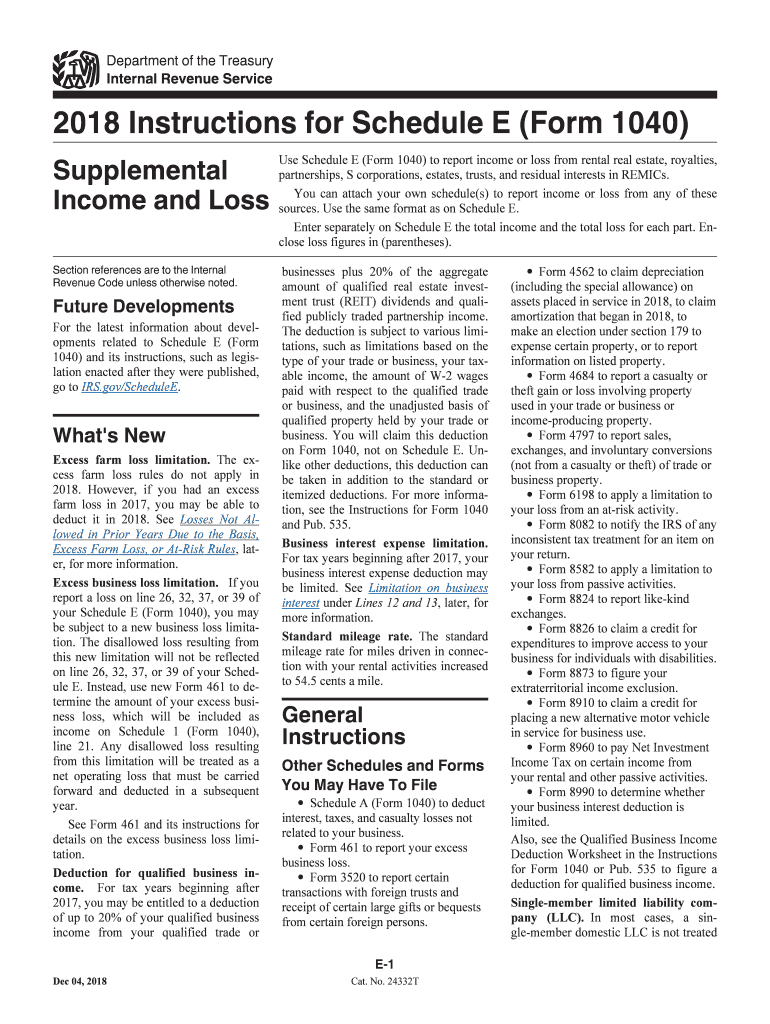







Definition & Purpose of Schedule E (Form 1040)
The IRS 1040 Schedule E Form is a critical tax document used in the United States to report supplemental income or loss that doesn't stem from wages or self-employment. It is primarily designed for individuals needing to declare earnings from rental real estate, royalties, partnerships, S corporations, estates, and trusts. By consolidating various streams of supplemental income, the form facilitates a comprehensive reflection of a filer's financial situation. Understanding its purpose is essential for accurate tax reporting, ensuring compliance with IRS regulations, and optimizing tax liability.
Sources of Income Covered
- Rental Real Estate: Income from properties rented out for residential or commercial purposes.
- Royalties: Regular payments received from intellectual properties like books or patents.
- Partnerships and S Corporations: Distributions received from investments in partnerships or S Corps.
- Estates and Trusts: Earnings passed down from estate distributions or trust assets.
Each income type has specific reporting requirements which are detailed within the form's instructions.
Steps to Complete the IRS 1040 Schedule E Form
Filing Schedule E involves a series of methodical steps to ensure that all income sources are accurately reported and appropriate deductions are correctly applied. Below is a guide that simplifies the process:
- Gather Income Documents: Collect all relevant financial statements, rental income records, royalty payment summaries, and partnership K-1 forms.
- Enter Personal Information: Include your name, taxpayer identification number, and filing year at the top of the form.
- Report Income Section by Section: Carefully enter the income and loss figures for each supplemental source using the respective instructions detailed in the form.
- Deductible Expenses: Identify permissible expenses such as mortgage interest, property taxes, insurance, and repairs that may be deducted to reduce taxable income.
- Calculate Net Income or Loss: Subtract total expenses from the total income to determine net result.
- Transfer Totals to Form 1040: Summarize the computed figures into the appropriate lines on your Form 1040.
Common Mistakes and How to Avoid Them
- Incorrectly Categorizing Income: Ensure income is classified correctly to avoid miscalculations.
- Omitting Expenses: Keep a detailed record to ensure all deductible expenses are claimed.
- Missing Preparer Signatures: If a tax professional is used, both the filer and preparer must sign.
Important Terms Related to the IRS 1040 Schedule E Form
Understanding the terminology used in Schedule E is vital for accurate completion. Here are key terms that frequently appear:
- Passive Activity Losses (PAL): Losses that can only offset income from passive activities, like rental property operations.
- Material Participation: Active involvement in a trade or business necessary for certain favorable tax treatments.
- Qualified Business Income (QBI): Income eligible for a special deduction provided under specific conditions.
- Depreciation: The allowable decrease in asset value that can be deducted over time.
Examples
- Example 1: Calculating PAL in a rental scenario helps determine limitations when total expenses exceed income.
- Example 2: Using QBI when comparing S Corp distributions versus direct earnings impacts the deduction eligibility.
How to Obtain the IRS 1040 Schedule E Form
The IRS 1040 Schedule E Form can be accessed through several convenient methods depending on your preference for digital or paper forms:
- IRS Website: Download the latest PDF version directly from .
- Tax Software: Applications such as TurboTax and H&R Block offer integrated Schedule E forms within their platforms.
- Local IRS Offices: Visit an office to receive a physical copy.
Digital vs. Paper Options
- Digital Version Advantages: Allows for quicker edits and calculations, offers e-filing capabilities.
- Paper Version Benefits: Ideal for those preferring tangible records or traditional mailing.
Key Elements of the IRS 1040 Schedule E Form
Each section within the Schedule E form serves a specific purpose, and understanding these elements streamlines the completion process:
- Part I: Detailed entry of income and loss from rental real estate and royalties.
- Part II: Summation of partnership and S corporation income, breakdown of K-1 form details.
- Part III: Reporting trust and estate income components.
- Part IV: Miscellaneous or supplemental income not covered by the primary sections.
- Part V: Reconciliation of passive activities if applicable.
FAQs on Key Elements
- "What goes into Part I?" Comprehensive listing of rental property income, accompanying expenses, and total net calculation.
- "Why is Part V optional?" Reserved for those engaged in passive activity reconciling, not everyone needs to complete it.
IRS Guidelines for Using Schedule E
In order to ensure compliance and maximize deductions, detailed guidelines are provided by the IRS for Schedule E:
- Eligibility: Anyone with income from the listed sources is eligible to file.
- Deductions and Limitations: Guidelines dictate limitations on passive losses based on material participation.
- Amendments: Procedures for correcting mistakes on previously filed forms are provided within the IRS resources.
Nuances
- Multiple Property Holdings: Special rules apply to those managing several properties, requiring itemization per asset.
Filing Deadlines and Important Dates
Timely filing of Schedule E is crucial to prevent penalties and interest charges:
- Standard Deadline: Aligns with the annual tax filing deadline, typically April 15.
- Extensions: Automatic six-month extensions may be requested if necessary.
Noteworthy Recommendations
- Early Preparation: Begin organizing documents well before deadlines.
- Reminder Systems: Use calendar alerts or software notifications to track important tax dates.