




Definition and Purpose of Schedule E Form
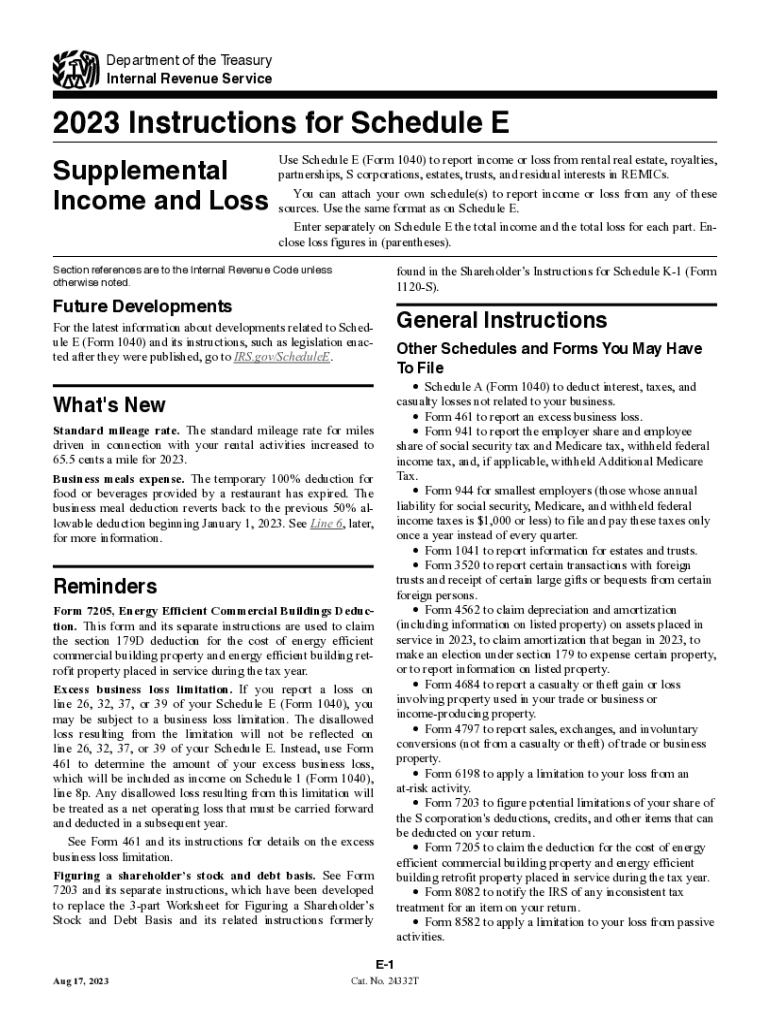
Schedule E (Form 1040) is a pivotal document for landlords in the United States reporting rental income and expenses. This form is integral for detailing income or loss from rental real estate, royalties, partnerships, S corporations, estates, trusts, and residual interests in real estate mortgage investment conduits (REMICs). The information provided in Schedule E is critical for landlords to accurately state their rental income, derive their taxable income, and claim deductions on rental property costs. Understanding the purpose of this form is essential to ensure compliance with IRS requirements and optimize tax benefits.
Detailed Components
- Rental Income: This includes gross rental payments, security deposits retained for non-repayment, and other rental-related revenue.
- Expenses: Deductible expenses such as advertising, cleaning, and repairs, insurance, taxes, mortgage interest, and management fees.
- Depreciation: Calculating the annual depreciation cost of the rental property, adhering to IRS depreciation methods.
- Net Profit/Loss: Understanding how to process income after deductions to report either a profit or a loss for tax purposes.
Steps to Complete the Landlord's Guide to the Rental Income Schedule E Form
Filling out the Schedule E Form accurately is crucial. Start by clearly understanding your financial records and they align with the form requirements.
- Gather Documentation: Compile all receipts, invoices, lease agreements, and tax documents.
- Enter Personal Information: Begin with your name and Social Security Number at the top of the form.
- Input Rental Income: List gross rental income in Part I of Schedule E.
- Detail Expenses: Itemize rental property expenses in the respective sections.
- Calculate Depreciation: Use IRS guidelines to determine allowable depreciation on your property.
- Summarize Totals: Add the total income and subtract total expenses to derive the year’s profit or loss.
- Complete Additional Parts if Necessary: Only required if you have income from royalties or any other listed categories.
Key Elements of the Schedule E Form
Understanding each section of the Schedule E Form helps in accurate completion without overlooking critical details.
- Part I: Rental Real Estate and Royalties: Detailing income and expenses derived from property rentals or royalty sources.
- Part II and III: Income or losses from partnerships and S corporations.
- Part V: Provide additional information about personal use and other property-related details, essential for precise calculations.
IRS Guidelines for Accurate Filing
Adherence to IRS guidelines when filing Schedule E ensures acceptance and decreases the likelihood of penalties.
- Report Honestly: Always provide accurate rental income and genuine expense documentation.
- Comply with IRS Codes: Stay up-to-date with IRS releases each tax year regarding deductible expenses and allowable depreciation.
- Maintain Thorough Records: Keep immaculate records for at least three years in case of an IRS query or audit.
- Seek Professional Advice: When uncertain, consult tax professionals to prevent costly errors.
Important Terms Related to Schedule E Form
Grasping key terminology in Schedule E ensures landlords fill out the form correctly.
- Depreciation: The annual deduction landlords may claim for the decrease in value of the property.
- Passive Activity: The IRS classifies rental activities as passive unless the taxpayer is materially participating.
- At-Risk Rules: These limit the deduction to the amount the taxpayer is financially at risk.
- Qualified Joint Venture: When a married couple operates jointly, each spouse can submit their share of income and expenses.
Filing Deadlines and Important Dates
Landlords must be keenly aware of pertinent deadlines to avoid penalties.
- Regular Filing Deadline: Generally set on April 15 of each year. Adjusted if that date falls on a weekend or holiday.
- Extended Filing: Taxpayers can apply for a six-month extension, pushing the deadline to October 15.
- Quarterly Payments: Essential if computing estimated taxes as the IRS may require estimated taxes to be paid quarterly.
Penalties for Non-Compliance
Failing to adhere to IRS reporting standards on Schedule E can lead to penalties.
- Late Filing Penalty: Usually five percent of the unpaid taxes for each month late, up to a maximum of 25%.
- Underpayment Penalty: If you grossly underreport income or inflate deductions.
- Accuracy-Related Penalty: Applicable if IRS discovers negligence or a misstatement.
Digital vs. Paper Version
Modern filing conveniences have shifted towards digitization for efficiency and accuracy.
- Digital Submission: Preferred by the IRS when using software like TurboTax for automatic calculations.
- Paper Filing: Traditional method, still permissible but less efficient and possibly prone to human errors.
- Software Compatibility: Tools like QuickBooks can align rental income data with IRS submission forms.
Who Typically Uses the Schedule E Form
Schedule E is primarily used by individuals involved in various real estate and income-generating scenarios.
- Real Estate Investors: Reporting passive income and deductions.
- Landlords: Detailing income and expenses from residential or commercial rentals.
- Partnership Members or S Corporation Shareholders: For income, deductions, credits, and other pass-through items from partnerships and S corporations.
These elements ensure landlords can accurately file Schedule E, maximizing their eligible deductions while adhering to IRS regulations and securing compliance.