




01. Edit your form online
Type text, add images, blackout confidential details, add comments, highlights and more.

Type text, add images, blackout confidential details, add comments, highlights and more.

Draw your signature, type it, upload its image, or use your mobile device as a signature pad.

Send it via email, link, or fax. You can also download it, export it or print it out.
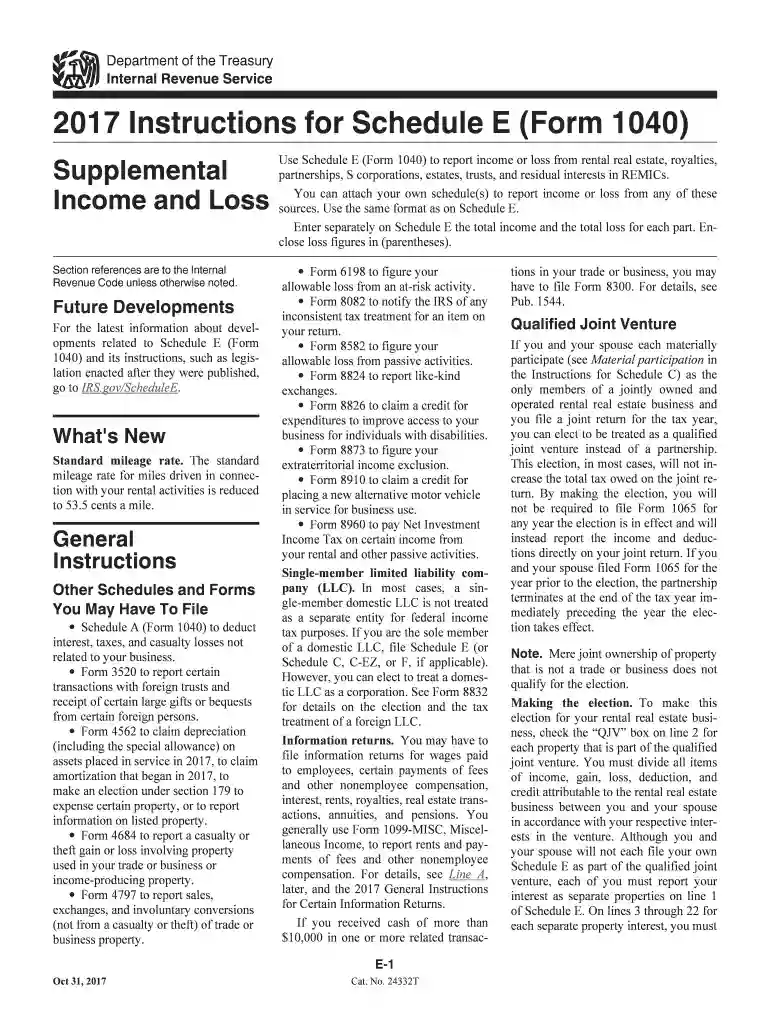
The 2015 instructions schedule form is integral to understanding and completing various tax schedules associated with Form 1040. Primarily, it aids taxpayers in correctly reporting supplemental income, such as rental income, royalties, partnerships, S corporations, estates, trusts, and residual interests in Real Estate Mortgage Investment Conduits (REMICs). By providing standardized instructions, the form ensures compliance with tax regulations and assists individuals in understanding complex tax scenarios and their reporting obligations. Additionally, the instructions guide users in identifying necessary supplemental forms, applying relevant tax credits, and capturing deductions associated with rental and supplemental income activities.
To effectively utilize the 2015 instructions schedule form, taxpayers should follow these specific steps:
Understand the Application Scope: Determine if your income sources require detailed reporting as instructed by the form, especially for rental properties, royalties, and partnership interests.
Identify Necessary Documents: Gather all financial documents related to supplemental income, including income statements, expense records, and transaction documentation.
Follow Section-Specific Instructions: Carefully read each section of the form's instructions to understand reporting requirements, such as income calculations, loss deductions, and credit applications.
Accurate Form Completion: Use the directions to complete Schedule E (Form 1040) accurately, ensuring all fields are filled with precise data to avoid errors that could lead to penalties.
Review Updates: Stay informed about any IRS changes or updates to the tax code that might affect how you apply these 2015 instructions to current filings.
Completing the 2015 instructions schedule form involves a series of distinct stages to ensure accuracy and compliance:
Data Compilation: Collect detailed records of all sources of supplemental income and related expenses for the tax year.
Income Allocation: Follow the instructions to allocate income across various categories, such as rental income and royalties, ensuring each is recorded correctly on Schedule E.
Expense Deduction: Systematically apply allowable deductions as outlined in the form's instructions specific to property management, maintenance costs, and related activities.
At-Risk and Passive Loss Adjustments: Understand and compute any necessary at-risk or passive activity loss adjustments required by the form guidelines.
Verification: Double-check each entry against the form's instructions for accuracy and completeness, considering potential errors and omissions that could impact tax liability.
Submission: Use the chosen form submission method, assuring that all components of the form and additional schedules are properly attached and submitted.
IRS guidelines concerning the 2015 instructions schedule form emphasize several critical areas:
The IRS's emphasis on these guidelines serves to streamline taxpayer compliance and reduce errors in tax submissions.
To complete the 2015 instructions schedule form and its correlated schedules effectively, specific documentation is necessary:
Income Statements: Include W-2s, 1099s, and any supplementary financial records that document income from partnerships, S corporations, and other sources.
Expense Records: Maintain detailed records of expenses related to rental properties, including maintenance, repairs, and property management fees.
Partnership Agreements: For income deriving from partnerships, disclosure of partnership agreements and income distribution documents is crucial.
These documents substantiate claims and deductions made using the form and ensure adherence to IRS requirements.
Taxpayers have multiple options for submitting the schedule form, whether electronically or by traditional mail:
Online Submission: Electronic filing through the IRS's e-filing system or authorized third-party providers enables a streamlined submission process with immediate confirmations.
Mail Submission: Physical submission allows taxpayers to send paper forms directly to the IRS, ensuring receipt through tracked mailing services to confirm delivery.
Each method has specific instructions included in the form on how and where to file, ensuring proper acknowledgment and processing of the tax return.
Failure to comply with the 2015 instructions schedule form can result in penalties or adverse consequences, such as:
Accuracy-Related Penalties: Misreporting income or failing to apply deductions correctly can lead to fines and additional tax liabilities.
Late Filing Penalties: Delayed submission of the schedule form might attract penalties, making timely filing crucial.
Adhering strictly to the form's instructions and compliance requirements helps mitigate the risk of these penalties.
There are instances where variations or different years of the instructions might be applicable:
Updated Versions: Taxpayers should consider using the most current year’s instructions if applicable, ensuring compliance with the latest tax code updates.
Alternative Schedules: In cases where other tax forms or schedules apply better to a taxpayer’s scenario, understanding the interplay between forms ensures accurate annual filings.
Reviewing the precise needs based on personal or business tax circumstances allows for choosing the correct form or version, aligning with evolving tax laws and regulations.
We've got more versions of the 2015 instructions schedule form form. Select the right 2015 instructions schedule form version from the list and start editing it straight away!
| Versions | Form popularity | Fillable & printable |
|---|---|---|
| 2025 | 4.6 Satisfied (48 Votes) | |
| 2024 | 4.4 Satisfied (51 Votes) | |
| 2023 | 4.2 Satisfied (58 Votes) | |
| 2022 | 4.4 Satisfied (36 Votes) | |
| 2021 | 4.8 Satisfied (101 Votes) | |
| 2020 | 4.3 Satisfied (206 Votes) | |
| 2019 | 4.3 Satisfied (29 Votes) | |
| 2018 | 4.3 Satisfied (47 Votes) | |
| 2017 | 4.4 Satisfied (305 Votes) | |
| 2016 | 4.4 Satisfied (614 Votes) | |
| 2015 | 4 Satisfied (55 Votes) | |
| 2011 | 4.2 Satisfied (39 Votes) | |
| 2011 | 4.3 Satisfied (64 Votes) |
At DocHub, your data security is our priority. We follow HIPAA, SOC2, GDPR, and other standards, so you can work on your documents with confidence.
Try our Prior year forms publications search to quickly find and download prior year forms, instructions and publications. To get started, enter keywords
May 2, 2017 For information on completing Forms W-2 and W-3 in this situation, see the Instructions for Schedule H (Form 1040) and section 4 of Pub. 2015Read more
See Pub. 525 and instructions for Schedule D (Form. 1040) for reporting requirements. WEmployer contributions (including amounts the employee elected toRead more


