Instructions for 2017 Alaska Fishery Resource Landing Tax Return-2026

Get Form
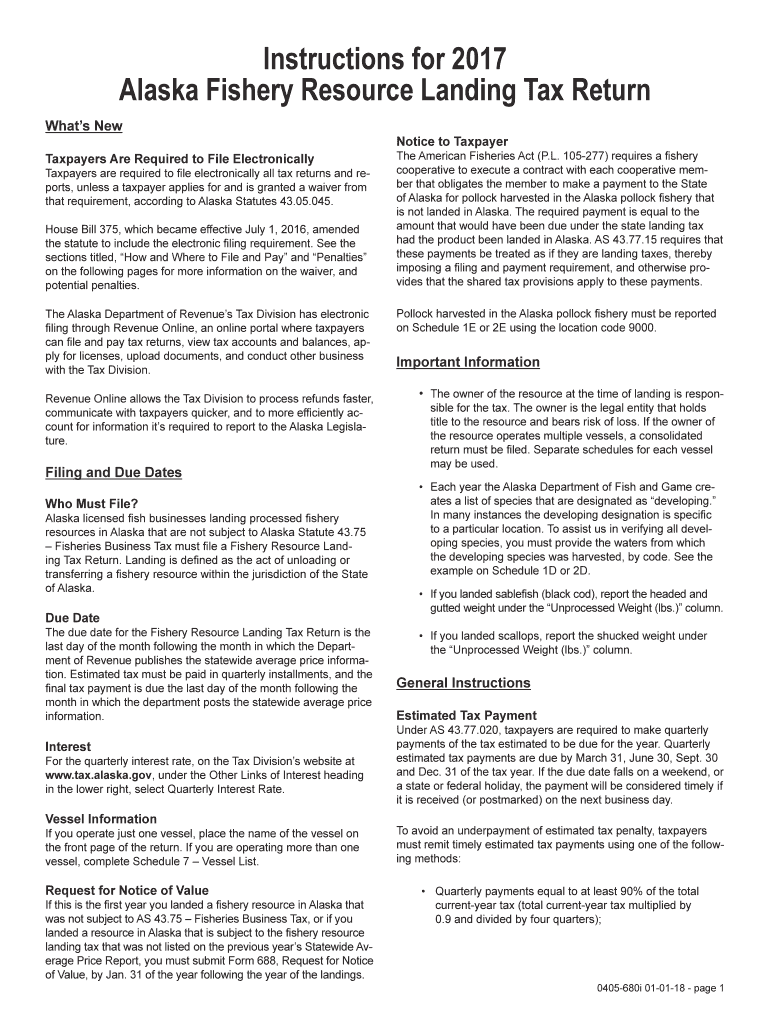
Instructions for 2017 Alaska Fishery Resource Landing Tax Return Preview on Page 1

Here's how it works

01. Edit your form online
Type text, add images, blackout confidential details, add comments, highlights and more.
02. Sign it in a few clicks
Draw your signature, type it, upload its image, or use your mobile device as a signature pad.
03. Share your form with others
Send it via email, link, or fax. You can also download it, export it or print it out.

How to use or fill out Instructions for 2017 Alaska Fishery Resource Landing Tax Return with our platform

Form edit decoration
9.5
Ease of Setup
DocHub User Ratings on G2
9.0
Ease of Use
DocHub User Ratings on G2
  1. Click ‘Get Form’ to open the Instructions for 2017 Alaska Fishery Resource Landing Tax Return in the editor.
  2. Begin by reviewing the 'What’s New' section to understand the electronic filing requirements. Ensure you are prepared to file electronically unless you have a waiver.
  3. Fill in your vessel information on the front page. If operating multiple vessels, complete Schedule 7 – Vessel List as instructed.
  4. Complete the 'Estimated Tax Payment' section by calculating your quarterly payments based on your estimated tax liability. Use the provided methods to ensure accuracy.
  5. Report all fishery resources landed using Schedules 1E and 2E, ensuring to include location codes and species names from the drop-down lists available in our editor.
  6. Review and finalize your entries before submitting. Utilize our platform's features for easy editing and signing of your completed form.

Start using our platform today for free to streamline your tax return process!

See more Instructions for 2017 Alaska Fishery Resource Landing Tax Return versions

We've got more versions of the Instructions for 2017 Alaska Fishery Resource Landing Tax Return form. Select the right Instructions for 2017 Alaska Fishery Resource Landing Tax Return version from the list and start editing it straight away!
Versions Form popularity Fillable & printable
2022 4.3 Satisfied (47 Votes)
2021 4.8 Satisfied (264 Votes)
2020 4.3 Satisfied (66 Votes)
2019 4.4 Satisfied (159 Votes)
2017 3.9 Satisfied (28 Votes)
2015 4.4 Satisfied (160 Votes)
2012 4.4 Satisfied (44 Votes)
be ready to get more

Complete this form in 5 minutes or less

Get form

Got questions?

We have answers to the most popular questions from our customers. If you can't find an answer to your question, please contact us.
Contact us
The price paid to fishermen averaged $1.05 per pound, compared to $. 87 in 2003. Pink salmon brought in 9% of the statewide value at $28.2 million and 40% of the harvest with 40 million fish. Pinks paid out at $0.23 on average, down from $0.38 per pound last year.
The tax is based on whether the fishery is established or developing. Established rates are 5% for floating facilities, 4.5% for Salmon Canneries and 3% for shore based facilities and 3% for developing resources from Floating facilities and 1% for shore-based developing resources.
The Salmon Enhancement Tax is a self-imposed tax elected through a vote of the fishermen. Southeast and Northern Southeast at 3%, and Prince William Sound, Cook Inlet, Kodiak, Chignik, and Yakutat at 2%.
Surplus lines tax: 2.7% for lines other than wet marine and transportation (+ 1% filing fee), . 75% (wet marine and transportation), payable by broker.
Alaska does not have an individual income tax. Alaska has a graduated corporate income tax, with rates ranging from 0.0 percent to 9.4 percent. Alaska does not have a state sales tax but has an average combined state and local sales tax rate of 1.82 percent.

Security and compliance

At DocHub, your data security is our priority. We follow HIPAA, SOC2, GDPR, and other standards, so you can work on your documents with confidence.

Learn more
ccpa2
pci-dss
gdpr-compliance
hipaa
soc-compliance