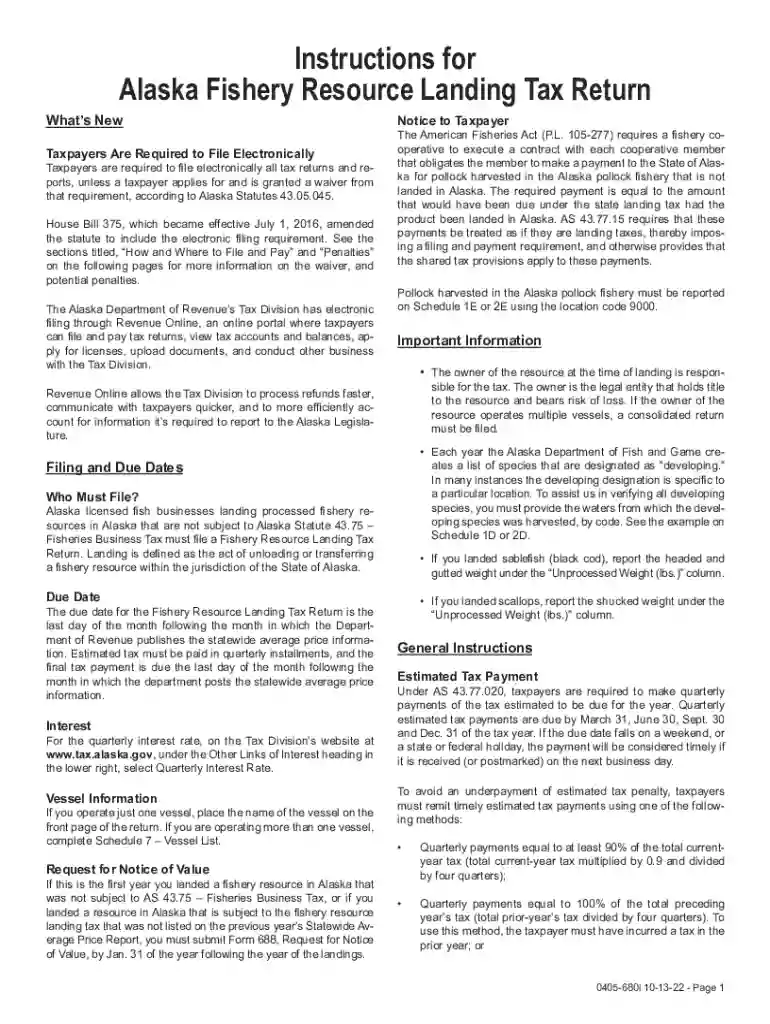
Alaska Fishery Resource Landing Tax Return 2026

Get Form
Alaska Fishery Resource Landing Tax Return Preview on Page 1

Here's how it works

01. Edit your form online
Type text, add images, blackout confidential details, add comments, highlights and more.

02. Sign it in a few clicks
Draw your signature, type it, upload its image, or use your mobile device as a signature pad.

03. Share your form with others
Send it via email, link, or fax. You can also download it, export it or print it out.

Definition and Significance of the Alaska Fishery Resource Landing Tax Return

The Alaska Fishery Resource Landing Tax Return is a crucial document for entities involved in the fishery business within Alaska. Implemented to ensure the correct tax liabilities are met by businesses operating in this sector, the form captures essential data relating to fishery activities. It involves details about the quantity and species of fish harvested, enabling accurate calculation of taxes owed to the state. The tax is levied on fishery resources that are landed in Alaska, encompassing resources harvested outside state waters but processed or first landed in Alaska. The form plays a vital role in supporting the state’s economy by ensuring fair taxation of its natural resources.

Utilizing the Alaska Fishery Resource Landing Tax Return

  1. Understanding the Requirements:

    • Familiarize yourself with the Alaska state tax laws and any specific obligations for fishery activities. Recognize the mandate from House Bill 375 for electronic filing to streamline the process and ensure compliance.
  2. Gathering Information:

    • Collect all necessary data regarding your fishery operations, including species and weight of the catch, to aid the accurate completion of the return. Ensure accuracy to avoid penalties linked to misreporting.
  3. Filing the Form:

    • Use the state's electronic filing system to submit your tax return, ensuring all details are correctly entered as per the guidelines. This method reduces errors and speeds up processing time.

Steps to Complete the Alaska Fishery Resource Landing Tax Return

  1. Compile Required Data:

    • Gather information on all the fish species landed during the tax period, count and weigh them accurately as this forms the basis for tax calculation.
  2. Calculate Tax Obligations:

    • Employ the guidelines to determine your tax dues. Include any applicable credits to reduce the tax liability where applicable.
  3. Submit Electronically:

    • Log into the designated online platform to fill out and submit the form. Check for errors and confirm data accuracy before submission.
  4. Retain Copies:

    • Maintain a copy of your submitted return and related documents for future reference or possible audits.

Penalties for Non-Compliance

Failing to comply with the regulations and filing the Alaska Fishery Resource Landing Tax Return correctly and on time can lead to significant penalties. Such penalties may include fines for late filing or late payments. Moreover, deliberately misreporting information to reduce tax liabilities can result in penalties and interest on the unpaid balance. Understanding these repercussions emphasizes the need for accurate and timely submission of the return to avoid these financial and legal setbacks.

Important Filing Deadlines and Dates

Businesses involved in Alaska’s fishery sector must adhere to strict deadlines. The tax return must be completed and filed by the stipulated dates as specified by the state tax authority. Late submissions can incur penalties, which makes it crucial to keep track of these important dates and prepare submissions in advance to ensure timely compliance.

Required Documents for Filing

To accurately fill out the Alaska Fishery Resource Landing Tax Return, prepare a comprehensive collection of documents:

  • Detailed logs of fish species, weight, and count.
  • Any previously granted credits or documentation of pre-existing settlements.
  • Records of other related financial documents that may influence the tax calculations.

By having all necessary documents ready, you streamline the filing process and ensure accuracy in your tax return.

State-Specific Rules for Compliance

Alaska’s regulations around the Alaska Fishery Resource Landing Tax Return may have specific stipulations that differ from other states:

  • Taxation applies not only to fish harvested within state waters but also to those processed or first landed in the state.
  • Specific classifications of fish species may impact how they are reported and taxed.

Understanding these state-specific rules helps in preparing accurate tax returns and avoiding misinterpretations of what is owed.

Key Elements to Include in the Alaska Fishery Resource Landing Tax Return

A comprehensive tax return should cover several key elements to ensure compliance:

  • Clearly identified information about the taxpayer and their business.
  • Detailed accounting of fish species and their respective weights.
  • Tax calculations which include potential credits and discounts applicable.
  • Proper inline with the electronic filing mandate that emphasizes procedural capability.

Ensuring these elements are adequately addressed simplifies the filing process and reduces the risk of errors.

See more Alaska Fishery Resource Landing Tax Return versions

We've got more versions of the Alaska Fishery Resource Landing Tax Return form. Select the right Alaska Fishery Resource Landing Tax Return version from the list and start editing it straight away!
Versions Form popularity Fillable & printable
2022 4.3 Satisfied (47 Votes)
2021 4.8 Satisfied (264 Votes)
2020 4.3 Satisfied (66 Votes)
2019 4.4 Satisfied (159 Votes)
2017 3.9 Satisfied (28 Votes)
2015 4.4 Satisfied (160 Votes)
2012 4.4 Satisfied (44 Votes)
be ready to get more

Complete this form in 5 minutes or less

Get form

Got questions?

We have answers to the most popular questions from our customers. If you can't find an answer to your question, please contact us.
Contact us
I clicked yes and then a drop down list of states appears. But ALASKA is not on the list, Why?? As DoninGA explains, Alaska isnt listed since it does not have a personal income tax. TurboTax is asking this question to determine how to allocate income on the state tax returns, which should not apply in your case.
Alaska has a graduated corporate income tax, with rates ranging from 0.0 percent to 9.4 percent. Alaska does not have a state sales tax but has an average combined state and local sales tax rate of 1.82 percent. Alaska has a 1.07 percent effective property tax rate on owner-occupied housing value.
Small Corporate Businesses C corporations in the United States are subject to a flat 21% corporate tax rate. Generally there is no minimum income you have to meet before your small corporation is taxed. Every dollar it earns (after deductions and credits are factored in) will be taxed at 21%.
Are both real and personal property taxable in Alaska? Yes. AS 29.45. 010 allows for the assessment and taxation of both real and personal property.
RE: Fishery Business Tax The tax is based on whether the fishery is established or developing. Established rates are 5% for floating facilities, 4.5% for Salmon Canneries and 3% for shore based facilities and 3% for developing resources from Floating facilities and 1% for shore-based developing resources.

Security and compliance

At DocHub, your data security is our priority. We follow HIPAA, SOC2, GDPR, and other standards, so you can work on your documents with confidence.

Learn more
ccpa2
pci-dss
gdpr-compliance
hipaa
soc-compliance

People also ask

If you make $100,000 a year living in the region of Alaska, United States of America, you will be taxed $22,671. That means that your net pay will be $77,329 per year, or $6,444 per month.
The tax is based on whether the fishery is established or developing. Established rates are 5% for floating facilities, 4.5% for Salmon Canneries and 3% for shore based facilities and 3% for developing resources from Floating facilities and 1% for shore-based developing resources.
If youre going to be in the Kenai River and Soldotna, Alaska, area we are happy to help you out with this as we have our own fish processing located there. We offer all of our customers a discounted fish processing rate of $1.50 per pound to portion, vacuum seal, and freeze if you are able to bring it to Soldotna.

Related links