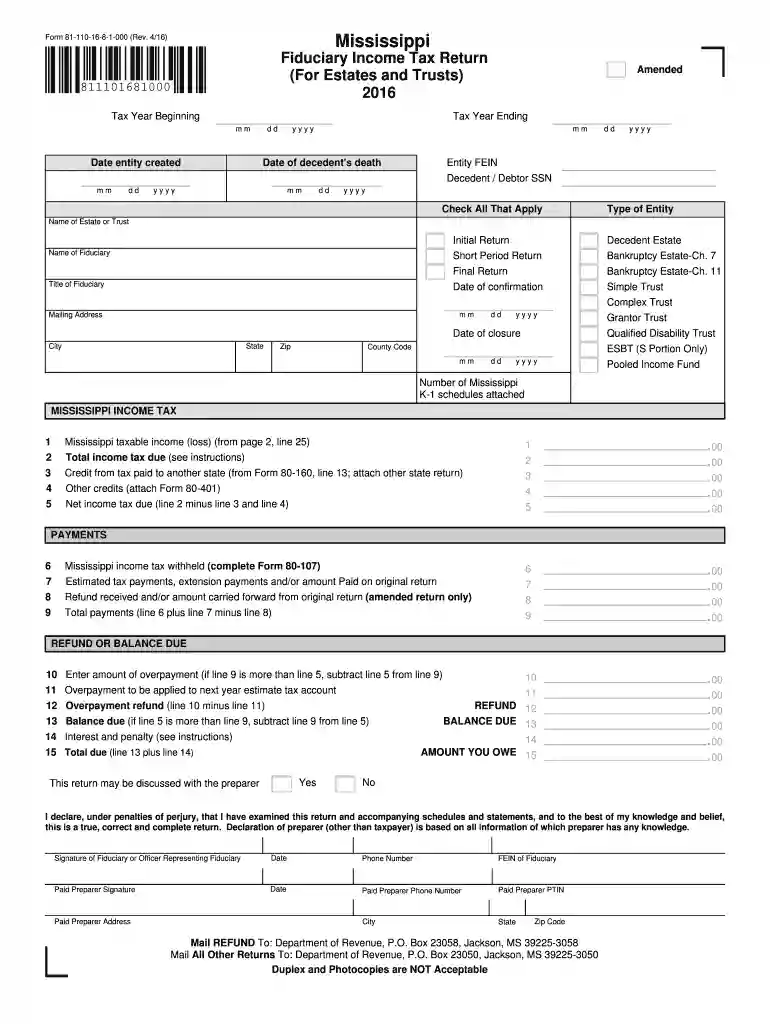
Form 81-110-16-8-1-000 (Rev 2026

Get Form
Form 81-110-16-8-1-000 (Rev Preview on Page 1

Here's how it works

01. Edit your form online
Type text, add images, blackout confidential details, add comments, highlights and more.

02. Sign it in a few clicks
Draw your signature, type it, upload its image, or use your mobile device as a signature pad.

03. Share your form with others
Send it via email, link, or fax. You can also download it, export it or print it out.

How to Use or Fill Out Form 81-110-16-8-1-000 (Rev) with Our Platform

Form edit decoration
9.5
Ease of Setup
DocHub User Ratings on G2
9.0
Ease of Use
DocHub User Ratings on G2
  1. Click ‘Get Form’ to open it in the editor.
  2. Begin by entering the tax year at the top of the form. Specify if this is an amended return and provide the entity's FEIN.
  3. Fill in the decedent's death date and the entity creation date. Ensure all dates are formatted correctly.
  4. Select the type of entity by checking all applicable boxes, such as 'Decedent Estate' or 'Simple Trust'.
  5. Complete the mailing address section, including state, city, and zip code for correspondence.
  6. Proceed to fill out the income tax section. Enter Mississippi taxable income on line 1 and calculate total income tax due on line 2.
  7. Continue through payment sections, ensuring to accurately report any withheld taxes and estimated payments.
  8. Finally, review your entries for accuracy before signing at the bottom of the form. Include your contact information as required.

Start using our platform today to fill out Form 81-110-16-8-1-000 (Rev) easily and for free!

See more Form 81-110-16-8-1-000 (Rev versions

We've got more versions of the Form 81-110-16-8-1-000 (Rev form. Select the right Form 81-110-16-8-1-000 (Rev version from the list and start editing it straight away!
Versions Form popularity Fillable & printable
2023 4.3 Satisfied (60 Votes)
2022 4.3 Satisfied (29 Votes)
2021 4.8 Satisfied (95 Votes)
2020 4.4 Satisfied (134 Votes)
2019 4.2 Satisfied (73 Votes)
2018 4.2 Satisfied (59 Votes)
2017 4.3 Satisfied (240 Votes)
2016 4.3 Satisfied (257 Votes)
2014 4.2 Satisfied (74 Votes)
2012 4.4 Satisfied (404 Votes)
be ready to get more

Complete this form in 5 minutes or less

Get form

Got questions?

We have answers to the most popular questions from our customers. If you can't find an answer to your question, please contact us.
Contact us
For many taxpayers who are involved in a business on only a limited basis the easiest way to avoid the 3.8% tax may be reliance on what was originally intended to be a gotcha rule (referred to as the SIPPA rule) in the passive activity loss regulations designed to prevent taxpayers from converting nonpassive income
To avoid this penalty, taxpayers generally need to pay at least 90% of their current years tax liability or 100% of the prior years tax, depending on adjusted gross income.
We may communicate with you by mail for many reasons, including: to send you a check for your refund or an additional payment; to let you know we adjusted your refund; to request information that supports what you reported on a return; and.
If the Adjusted Gross Income (AGI) on your previous years return is over $150,000 (over $75,000 if you are married filing separately), you must pay the lower of 90% of the tax shown on the current years return or 110% of the tax shown on the return for the previous year.
An estate tax return (Form 706) must be filed if the gross estate of the decedent (who is a U.S. citizen or resident), increased by the decedents adjusted taxable gifts and specific gift tax exemption, is valued at more than the filing threshold for the year of the decedents death, as shown in the table below.

Security and compliance

At DocHub, your data security is our priority. We follow HIPAA, SOC2, GDPR, and other standards, so you can work on your documents with confidence.

Learn more
ccpa2
pci-dss
gdpr-compliance
hipaa
soc-compliance
be ready to get more

Complete this form in 5 minutes or less

Get form

People also ask

Individuals, including sole proprietors, partners, and S corporation shareholders, generally have to make estimated tax payments if they expect to owe tax of $1,000 or more when their return is filed.
The safest option to avoid an underpayment penalty is to aim for 100 percent of your previous years taxes. If your previous years adjusted gross income was more than $150,000 (or $75,000 for those who are married and filing separate returns last year), you will have to pay in 110 percent of your previous years
Youll face an underpayment penalty if you: Didnt pay at least 90% of the tax on your current-year return or 100% of the tax shown on the prior years return.