Mississippi tax trusts form 2026

Get Form
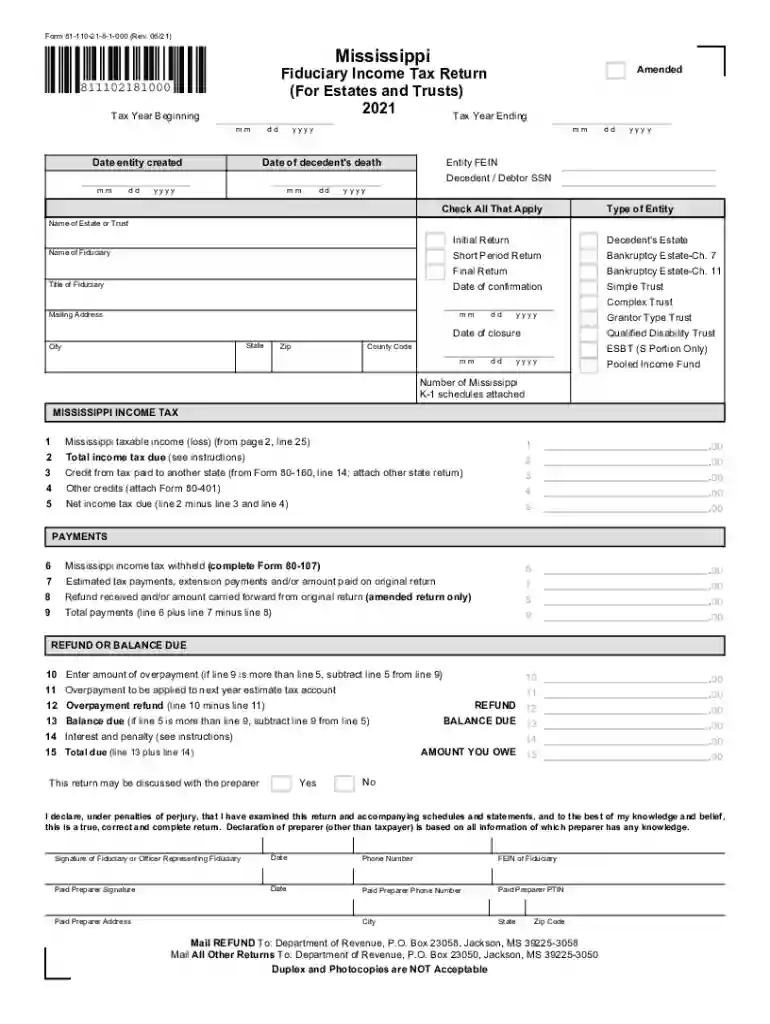
mississippi tax trusts form Preview on Page 1

Here's how it works

01. Edit your form online
Type text, add images, blackout confidential details, add comments, highlights and more.

02. Sign it in a few clicks
Draw your signature, type it, upload its image, or use your mobile device as a signature pad.

03. Share your form with others
Send it via email, link, or fax. You can also download it, export it or print it out.

How to use or fill out Mississippi Tax Trusts Form with DocHub

Form edit decoration
9.5
Ease of Setup
DocHub User Ratings on G2
9.0
Ease of Use
DocHub User Ratings on G2
  1. Click ‘Get Form’ to open the Mississippi Tax Trusts Form in our editor.
  2. Begin by entering the tax year at the top of the form. Fill in the dates for entity creation and decedent's death, ensuring accuracy.
  3. Select the type of entity by checking the appropriate box, such as 'Decedent's Estate' or 'Simple Trust'.
  4. Provide the name and mailing address of the estate or trust, including city, state, and zip code.
  5. Complete the income tax section by entering your Mississippi taxable income and calculating total tax due. Be sure to include any credits from other states.
  6. Fill out payment details, including any withheld taxes and estimated payments. Calculate total payments accurately.
  7. Finally, review all entries for correctness before signing. Use our platform’s signature feature to sign electronically.

Start filling out your Mississippi Tax Trusts Form today for free using our powerful editing tools!

See more mississippi tax trusts form versions

We've got more versions of the mississippi tax trusts form form. Select the right mississippi tax trusts form version from the list and start editing it straight away!
Versions Form popularity Fillable & printable
2023 4.3 Satisfied (60 Votes)
2022 4.3 Satisfied (29 Votes)
2021 4.8 Satisfied (95 Votes)
2020 4.4 Satisfied (134 Votes)
2019 4.2 Satisfied (73 Votes)
2018 4.2 Satisfied (59 Votes)
2017 4.3 Satisfied (240 Votes)
2016 4.3 Satisfied (257 Votes)
2014 4.2 Satisfied (74 Votes)
2012 4.4 Satisfied (404 Votes)
be ready to get more

Complete this form in 5 minutes or less

Get form

Got questions?

We have answers to the most popular questions from our customers. If you can't find an answer to your question, please contact us.
Contact us
Form 1041 is a tax return filed by estates or trusts that generated income after the decedent passed away and before the designated assets were transferred to beneficiaries. The executor, trustee, or personal representative of the estate or trust is responsible for filing Form 1041.
An estate tax return (Form 706) must be filed if the gross estate of the decedent (who is a U.S. citizen or resident), increased by the decedents adjusted taxable gifts and specific gift tax exemption, is valued at more than the filing threshold for the year of the decedents death, as shown in the table below.
Form 706 ensures that estate taxes are adequately assessed for larger estates, while Form 1041 helps report the estates income during the settlement process. By understanding these differences, executors and administrators can better manage estate obligations.
The fiduciary of a domestic decedents estate, trust, or bankruptcy estate files Form 1041 to report: The income, deductions, gains, losses, etc. of the estate or trust.
Report the sale on Schedule D (Form 1040), Capital Gains and Losses and on Form 8949, Sales and Other Dispositions of Capital Assets: If you sell the property for more than your basis, you have a taxable gain.

Security and compliance

At DocHub, your data security is our priority. We follow HIPAA, SOC2, GDPR, and other standards, so you can work on your documents with confidence.

Learn more
ccpa2
pci-dss
gdpr-compliance
hipaa
soc-compliance
be ready to get more

Complete this form in 5 minutes or less

Get form

People also ask

If you need more time to file your Mississippi return, Mississippi will allow you the same time that is allowed by your federal extension. Note, however, that an extension of time to file doesnt extend the time to pay any tax you owe to the state of Mississippi.
Mississippi does not have an inheritance tax nor a gift tax. ExtensionThe executor must complete a 60 Day Notice and Extension Request (form 94-100). Approximate values may be used for the valuation of assets requested on the Notice.
Trusts and Estates must complete Form IL-1041. Computer generated forms from an IDOR-approved software developer are acceptable. 2024 Form IL-1041 is for tax year ending on or after December 31, 2024, and ending before December 31, 2025.

Related links