




01. Edit your form online
Type text, add images, blackout confidential details, add comments, highlights and more.

Type text, add images, blackout confidential details, add comments, highlights and more.

Draw your signature, type it, upload its image, or use your mobile device as a signature pad.

Send it via email, link, or fax. You can also download it, export it or print it out.
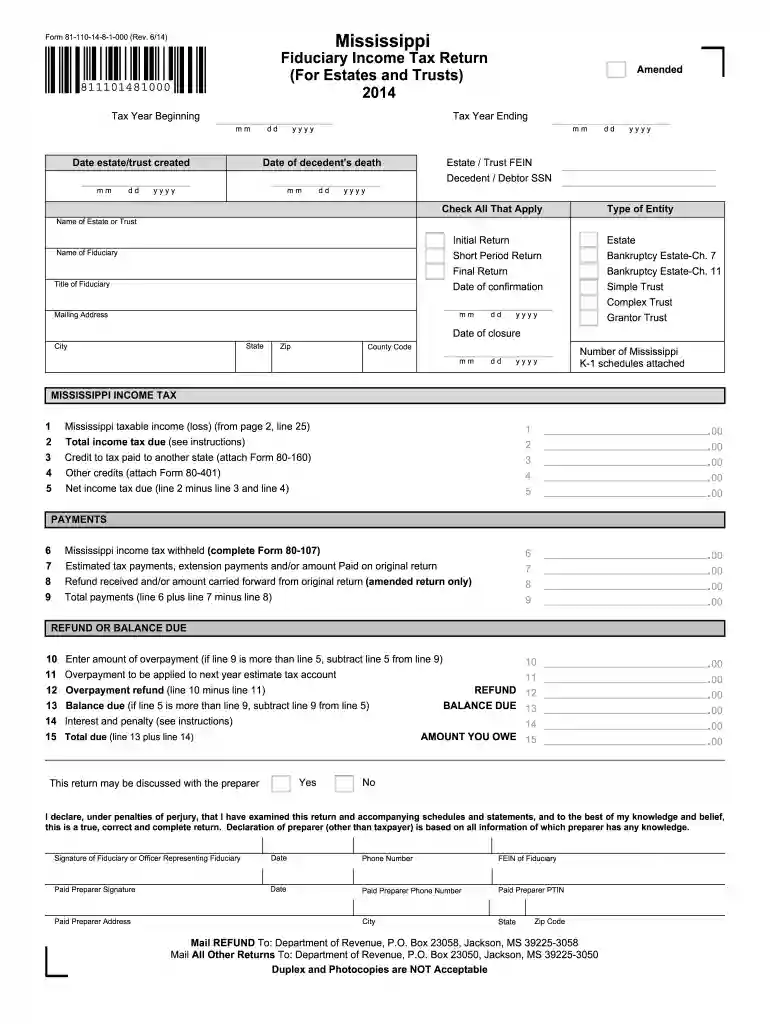
Form 81-110, issued by the Mississippi Department of Revenue, is a fiduciary income tax return designed specifically for estates and trusts in the state of Mississippi. The form aids fiduciaries in reporting income, deductions, and calculating taxes owed by the estate or trust. It plays a critical role in ensuring compliance with state tax regulations for estates and trusts, helping to maintain accurate records of financial activities and obligations during the tax year.
Fiduciary Details: Begin by providing the estate or trust's Federal Employer Identification Number (FEIN) and the full details of the fiduciary, including name and address.
Income Reporting: Enter all relevant income sources for the estate or trust. This includes interest, dividends, rent, and any gains from the sale of assets.
Deductions: List allowable deductions, including administrative expenses and distributions to beneficiaries.
Tax Calculations: Utilize the specific sections provided to compute the total tax due. This involves applying the Mississippi tax rates applicable to the estate or trust’s taxable income.
Sign and Date: Ensure the form is signed and dated by the fiduciary or authorized representative before submission.
Attachments: Include any necessary schedules or additional documentation that supports the income and deductions claimed.
The form requires compliance with Mississippi state laws governing estates and trusts. Fiduciaries need to ensure all provided information is accurate and submitted within the specified deadlines to fulfill legal obligations. Legal use also involves the ethical management of the estate or trust’s financial resources consistent with their fiduciary duties.
The Form 81-110, like most state tax forms, has a strict submission deadline. Typically, it must be filed by the 15th day of the fourth month following the close of the tax year, often April 15 for calendar year filers. Extensions may be available, but require timely application to avoid late penalties.
The form is predominantly used by fiduciaries responsible for managing estates and trusts in Mississippi. This includes executors of estates, trustees, and anyone legally designated to manage the financial dealings of estates or trusts as per the state's fiduciary obligations.


Failure to submit the Form 81-110 by the deadline or providing incorrect information can lead to penalties, including fines and interest on unpaid taxes. In severe cases, it may also result in legal action against the fiduciary, depending on the nature and extent of non-compliance.

Form 81-110 can be completed using various tax software programs like TurboTax and QuickBooks, which provide digital tools for easy form filling and submission to ensure compliance and accuracy.
Mississippi has unique tax rules and rates specific to estates and trusts, influencing the tax calculations and deductions applicable to Form 81-110. Understanding these differences is crucial for accurate compliance with state tax obligations.
While Form 81-110 applies to Mississippi, other states have their own versions of fiduciary income tax forms. These can differ in format, submission methods, and tax calculations, reflecting each state’s distinct tax laws and regulations.
We've got more versions of the Form 81-110 - Mississippi Department of Revenue - dor ms form. Select the right Form 81-110 - Mississippi Department of Revenue - dor ms version from the list and start editing it straight away!
| Versions | Form popularity | Fillable & printable |
|---|---|---|
| 2025 | 4.6 Satisfied (38 Votes) | |
| 2024 | 4.9 Satisfied (59 Votes) | |
| 2023 | 4.3 Satisfied (60 Votes) | |
| 2022 | 4.3 Satisfied (29 Votes) | |
| 2021 | 4.8 Satisfied (95 Votes) | |
| 2020 | 4.4 Satisfied (134 Votes) | |
| 2019 | 4.2 Satisfied (73 Votes) | |
| 2018 | 4.2 Satisfied (59 Votes) | |
| 2017 | 4.3 Satisfied (240 Votes) | |
| 2016 | 4.3 Satisfied (257 Votes) | |
| 2014 | 4.2 Satisfied (74 Votes) | |
| 2012 | 4.4 Satisfied (404 Votes) |
At DocHub, your data security is our priority. We follow HIPAA, SOC2, GDPR, and other standards, so you can work on your documents with confidence.
Provides access to tax forms, 81-110 Individual Income Tax Forms Individual Forms Fiduciary Declaration for E-File 2025
Below is the index from Volume 7 (1861) of The Papers of Jefferson Davis as it appears in the book. For ease of conversion, italics and accent marks have beenRead more


