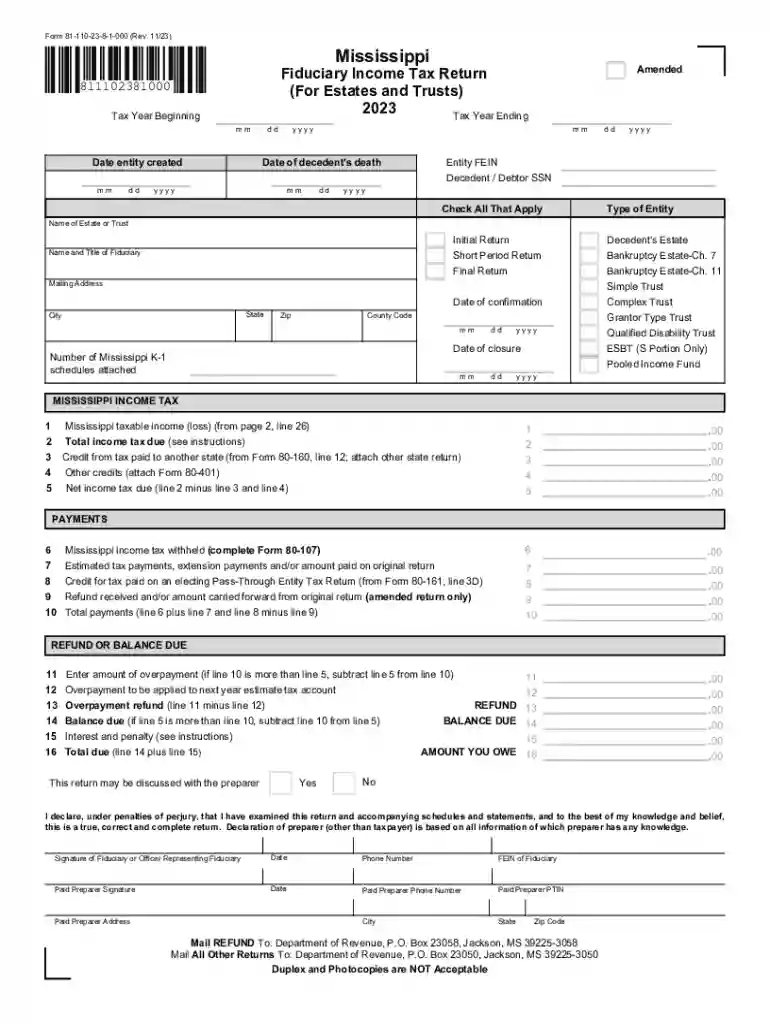
Form 81-110-23-8-1-000 (Rev 2026

Get Form
Form 81-110-23-8-1-000 (Rev Preview on Page 1

Here's how it works

01. Edit your form online
Type text, add images, blackout confidential details, add comments, highlights and more.

02. Sign it in a few clicks
Draw your signature, type it, upload its image, or use your mobile device as a signature pad.

03. Share your form with others
Send it via email, link, or fax. You can also download it, export it or print it out.

How to Use or Fill Out Form 81-110-23-8-1-000 (Rev) with Our Platform

Form edit decoration
9.5
Ease of Setup
DocHub User Ratings on G2
9.0
Ease of Use
DocHub User Ratings on G2
  1. Click ‘Get Form’ to open it in the editor.
  2. Begin by entering the 'Tax Year Beginning' and 'Tax Year Ending' dates in the specified fields. Ensure you use the correct format (mm/dd/yyyy).
  3. Fill in the 'Entity FEIN' and 'Decedent/Debtor SSN' fields accurately, as these are crucial for identification.
  4. Select the appropriate checkboxes under 'Type of Entity' to indicate whether this is an Initial, Short Period, or Final Return.
  5. Complete the sections for Mississippi taxable income, ensuring all calculations are accurate. Input any credits and payments as required.
  6. Review your entries carefully before signing. The declaration at the bottom must be completed by the fiduciary or officer representing the fiduciary.

Start using our platform today to fill out Form 81-110-23-8-1-000 (Rev) easily and for free!

See more Form 81-110-23-8-1-000 (Rev versions

We've got more versions of the Form 81-110-23-8-1-000 (Rev form. Select the right Form 81-110-23-8-1-000 (Rev version from the list and start editing it straight away!
Versions Form popularity Fillable & printable
2023 4.3 Satisfied (60 Votes)
2022 4.3 Satisfied (29 Votes)
2021 4.8 Satisfied (95 Votes)
2020 4.4 Satisfied (134 Votes)
2019 4.2 Satisfied (73 Votes)
2018 4.2 Satisfied (59 Votes)
2017 4.3 Satisfied (240 Votes)
2016 4.3 Satisfied (257 Votes)
2014 4.2 Satisfied (74 Votes)
2012 4.4 Satisfied (404 Votes)
be ready to get more

Complete this form in 5 minutes or less

Get form

Got questions?

We have answers to the most popular questions from our customers. If you can't find an answer to your question, please contact us.
Contact us
If the estate generates more than $600 in annual gross income, you are required to file Form 1041, U.S. Income Tax Return for Estates and Trusts. An estate may also need to pay quarterly estimated taxes. See Form 1041 instructions for information on when to file quarterly estimated taxes.
The fiduciary of a domestic decedents estate, trust, or bankruptcy estate files Form 1041 to report: The income, deductions, gains, losses, etc. of the estate or trust. The income that is either accumulated or held for future distribution or distributed currently to the beneficiaries.
Certain administrative expenses can be claimed as deductions on either Form 706 or Form 1041, but not both. These are often referred to as elective deductions. Simply put, the law allows the estate to claim such expenses as either an estate tax deduction on Form 706 or an estate income tax deduction.
Its also possible for beneficiaries to owe tax if the estate generates more than $600 in gross income during administration, triggering an IRS filing requirement. In such instances, estates may pass that income to beneficiaries via Schedule K-1, which reports the amount each person must include on their tax return.
As executor of an estate, the form youll file for the deceased person is Form 1040 as a final return.

Security and compliance

At DocHub, your data security is our priority. We follow HIPAA, SOC2, GDPR, and other standards, so you can work on your documents with confidence.

Learn more
ccpa2
pci-dss
gdpr-compliance
hipaa
soc-compliance

People also ask

It is used to report income earned by a decedents estate or trust after the estate owners date of death but before assets are distributed to beneficiaries. Just dont confuse Form 1041 with Form 706, which is used for filing an estate tax return.
Form 706 ensures that estate taxes are adequately assessed for larger estates, while Form 1041 helps report the estates income during the settlement process. By understanding these differences, executors and administrators can better manage estate obligations.