






Definition & Meaning
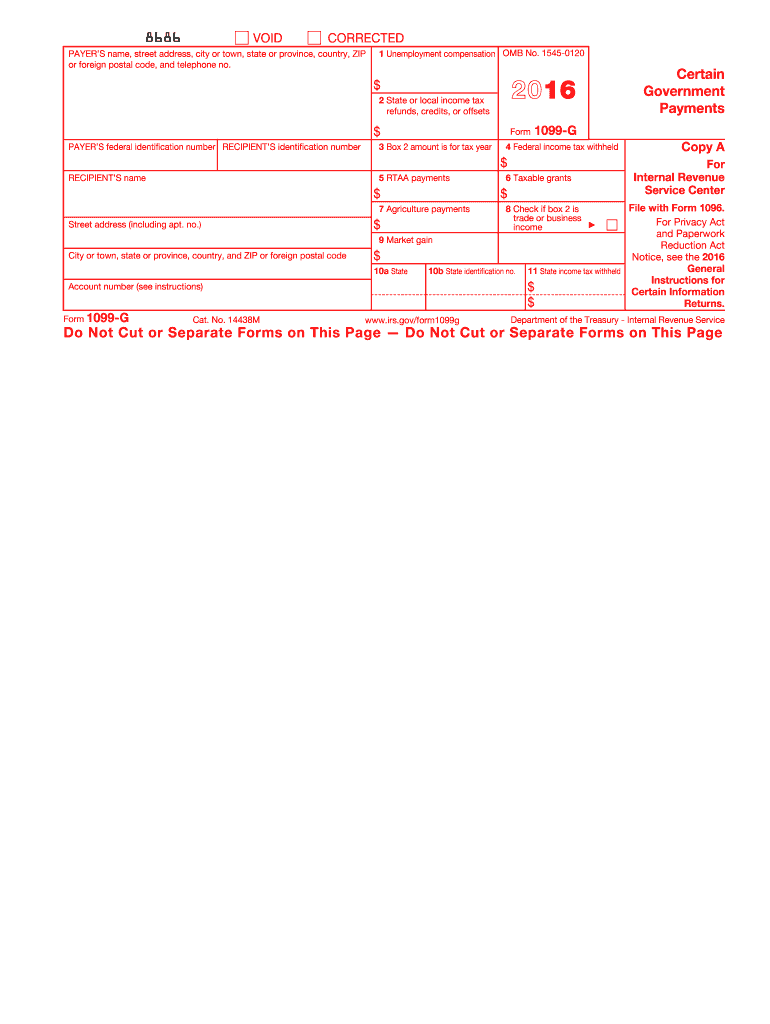
Form 1099-G is an informational tax form used to report certain types of government payments, including unemployment compensation and state or local income tax refunds. For the 2016 tax year, this form was crucial for recipients to adequately report income on their federal tax returns. The IRS uses Form 1099-G to track various payments issued by government agencies, ensuring that recipients report this income correctly.
Key Use Cases
- Unemployment Compensation: Individuals receiving unemployment benefits during 2016 needed to report these payments as income using Form 1099-G.
- State and Local Tax Refunds: Taxpayers who itemized deductions in the previous year might receive this form to report any refunds they received from state or local governments.
How to Obtain the Form 1099-G 2016
Form 1099-G is issued by the government agency responsible for the payment. Typically, recipients do not need to request the form, as it is automatically sent to them by January 31 of the following year. Taxpayers could also access the form online through the issuing agency’s website if it offered electronic distribution.
- Check Online Portals: Many states provide access to Form 1099-G through their website, where taxpayers can download it directly.
- Confirm Contact Details: Ensure that your mailing address and contact information are updated with the relevant agency to receive the form on time.
Steps to Complete the Form 1099-G 2016
Form 1099-G does not require the recipient to complete it; however, it does require careful attention to ensure that all reported information is used correctly during tax filing.
- Review Each Box: Ensure all details, such as the taxpayer's social security number and the amounts in each box, match your records.
- Match with Wages/Income: Cross-verify the amounts received for clarity and accuracy. Any discrepancies should be resolved with the issuing agency promptly.
- Include in Tax Return: Use the form’s information when preparing your federal tax return, typically via a tax filing software or with your tax professional's assistance.
Important Terms Related to Form 1099-G 2016
Several terms are routinely used when discussing Form 1099-G, which are critical for complete understanding:
- Payer’s Identification Number: This is the federal identification number of the agency issuing the form.
- Recipient’s Identification Number: Usually, this is the taxpayer's Social Security Number.
- Unemployment Compensation: This refers to benefits paid by the state unemployment insurance program, reported in Box 1.
IRS Guidelines
The IRS mandates that Form 1099-G is only used for reporting government payments. The issuing agency must also submit a copy to the IRS, which uses their own record-keeping to ensure compliance.
- Incorrect Information: If an error is noted, contact the issuing agency immediately to request a corrected form.
- Filing Requirements: Always include Form 1099-G information in your taxable income if appropriate.
Filing Deadlines / Important Dates
For 2016 payments reported with Form 1099-G:
- Issuance Deadline: The form should be issued to the taxpayer by January 31, 2017.
- Tax Filing Deadline: To report this form's information, taxpayers should adhere to the federal income tax deadline, which for most years is April 15.
State-Specific Rules for Form 1099-G 2016
Regulations regarding the issuance and reporting of Form 1099-G vary by state:
- Varying Reporting Requirements: Some states might have additional reporting requirements beyond those mentioned on the federal form.
- Different Manner of Receipt: Certain states may offer digital-only distribution, impacting how recipients access their forms.
Examples of Using Form 1099-G 2016
Practical scenarios where Form 1099-G is applied include:
- Job Loss: Jen, who was laid off in 2016, received unemployment compensation. She obtained Form 1099-G and ensured it was included in her taxable income.
- Tax Refund: Mark received a state income tax refund; he used Form 1099-G to report this as income since he had itemized deductions the previous tax year.
By understanding the structure and utilization of Form 1099-G, taxpayers can efficiently manage government-related income during their tax filing process.