




01. Edit your file 1040 online
Type text, add images, blackout confidential details, add comments, highlights and more.

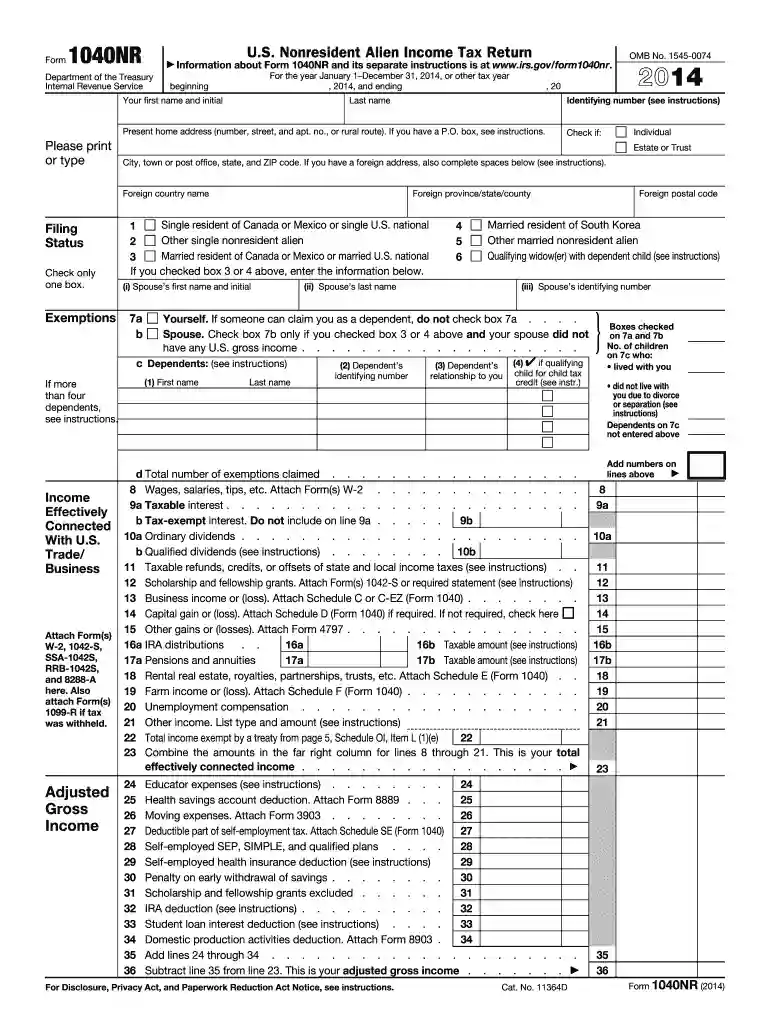
Type text, add images, blackout confidential details, add comments, highlights and more.

Draw your signature, type it, upload its image, or use your mobile device as a signature pad.

Send it via email, link, or fax. You can also download it, export it or print it out.
Form 1040NR for 2014 is the U.S. Nonresident Alien Income Tax Return. This form is vital for nonresident aliens who have income from U.S. sources, requiring them to report earnings and assess potential tax liabilities or refunds. The form captures details like gross income, deductions, exemptions, and credits to calculate the tax obligation of a nonresident alien. It is an essential document for maintaining compliance with U.S. tax laws for individuals who work, invest, or have other taxable activities within the United States but do not qualify as residents.
To determine eligibility for filing Form 1040NR, it is important to understand who qualifies as a nonresident alien. Generally, you are considered a nonresident alien if you do not pass the Green Card Test or the Substantial Presence Test. If you received income from a U.S. source, such as wages connected to a U.S. job, dividends from U.S. stocks, or real estate investments, you should evaluate if you need to file this form. Additionally, certain types of scholarships, fellowships, or grants received by students or scholars may necessitate filing a Form 1040NR.


Securing a copy of the 2014 Form 1040NR is straightforward. The form is available directly from the Internal Revenue Service (IRS) website for download. Tax software like TurboTax may also offer the 1040NR form as part of their service. Additionally, libraries, consulates, or tax assistance sites may have physical copies. If you have a tax professional, they can also provide the form and relevant instructions.
Gather Required Documents: Collect all pertinent U.S. income documents, such as Form W-2, Form 1099, or statements of income from U.S. banks.
Complete Personal Information: Include your name, address, and identifying numbers (such as ITIN).
Report Income and Adjustments: Detail all sources of income connected to the U.S., which can include wages, business income, or interest income.
Claim Deductions and Exemptions: Apply appropriate deductions and exemptions, which could be impacted by a tax treaty between the U.S. and your home country.
Calculate Tax Liability: Utilize the tax tables within the form instructions to determine your final tax owed or refund due.
Review and Sign: Ensure the information is accurate, sign the form, and include your phone number for any potential follow-up.
The IRS provides comprehensive guidelines for correctly completing and filing Form 1040NR. These guidelines cover aspects like dual-status alien rules, tax treaty benefits, and eligible deductions. The IRS also specifies deadlines and procedures for requesting an extension if needed. Taxpayers should consult Publication 519, U.S. Tax Guide for Aliens, for detailed IRS instructions and use this invaluable resource to understand how various international tax aspects impact their filing.
Form 1040NR follows similar deadlines to the U.S. resident tax return, typically due by April 15 following the tax year. However, if you had no wages but had U.S. income, the deadline might be extended to June 15. Taxpayers living outside the U.S. on April 15 can automatically file by June 15 but should attach a statement explaining their situation. Ensure that timely filings are pursued to avoid penalties or interest on unpaid taxes.
To complete Form 1040NR, be sure to gather:
Not filing Form 1040NR on time or paying any taxes owed can lead to significant penalties. The IRS charges late filing and late payment penalties, both as percentages of the tax due. Additionally, failure to file can trigger interest charges on the unpaid amount. In certain severe cases, legal action may take place if there are substantial unpaid taxes or fraudulent filings. Nonresident aliens should ensure an accurate, timely submission to avoid these repercussions.
We've got more versions of the file 1040 form. Select the right file 1040 version from the list and start editing it straight away!
| Versions | Form popularity | Fillable & printable |
|---|---|---|
| 2025 | 4.6 Satisfied (41 Votes) | |
| 2024 | 4.7 Satisfied (30 Votes) | |
| 2023 | 4.7 Satisfied (32 Votes) | |
| 2022 | 4.2 Satisfied (44 Votes) | |
| 2021 | 4.8 Satisfied (99 Votes) | |
| 2020 | 4.2 Satisfied (46 Votes) | |
| 2019 | 4.4 Satisfied (212 Votes) | |
| 2018 | 4.4 Satisfied (80 Votes) | |
| 2017 | 4.3 Satisfied (77 Votes) | |
| 2016 | 4.4 Satisfied (1650 Votes) | |
| 2015 | 4 Satisfied (28 Votes) | |
| 2014 | 4 Satisfied (44 Votes) | |
| 2013 | 4.3 Satisfied (60 Votes) | |
| 2012 | 4 Satisfied (34 Votes) | |
| 2012 | 4.1 Satisfied (31 Votes) |
At DocHub, your data security is our priority. We follow HIPAA, SOC2, GDPR, and other standards, so you can work on your documents with confidence.
Feb 8, 2018 You must report your taxable disability payments as wages on line 7 of Form 1040 or Form. 1040A until you DocHub minimum retirement age. Minimum.Read more
Check only one box. 1. Single nonresident alien. 2. Married nonresident alien. Attach. Form(s).Read more


