




01. Edit your 1040nr 2018 online
Type text, add images, blackout confidential details, add comments, highlights and more.

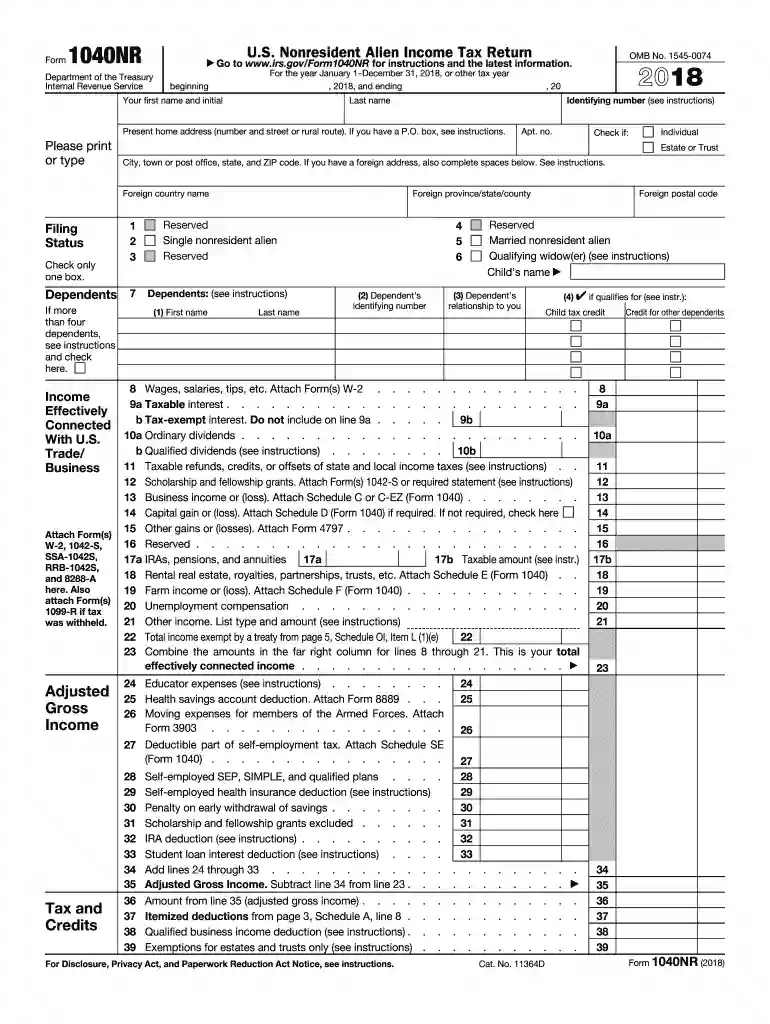
Type text, add images, blackout confidential details, add comments, highlights and more.

Draw your signature, type it, upload its image, or use your mobile device as a signature pad.

Send form 1040nr 2018 via email, link, or fax. You can also download it, export it or print it out.
Form 1040NR, also known as the U.S. Nonresident Alien Income Tax Return, is specifically designed for nonresident aliens who engage in certain business activities within the United States. The form allows these individuals to report their U.S. income, claim any applicable deductions, and calculate their tax liability. It encompasses sections for personal information, income received, and eligible deductions, ensuring compliance with U.S. tax laws.
Personal Information: Requires the tax filer's name, address, taxpayer identification number (TIN), and visa type.
Income Sources: Includes taxable U.S. income from wages, dividends, rental properties, and business income.
Deductions and Credits: Provides sections to claim deductions and credits specific to nonresident aliens, such as treaty benefits and standard deductions.
Tax Calculation: Detailed computation of tax owed, considering reported income and applicable deductions.
Filling out Form 1040NR involves a series of steps that ensure all information is accurately provided, minimizing errors and potential penalties.
Collect Required Information: Gather all necessary documents, including W-2s, 1042-S, and any records of additional income or deductions.
Complete Personal Information: Fill in your name, TIN, address, and visa category.
Document Income Sources: Accurately report all U.S. sourced income including wages and any other earnings received in the tax year.
Input Deductions and Credits: Assess eligible deductions such as student-related expenses and apply any available tax credits or treaty benefits.
Calculate Tax Liability: Use the filled sections to compute the total tax owed or refund due.
Review and Submit: Carefully review the completed form for inaccuracies before submission.
Using platforms like DocHub streamlines the completion and submission process. Its compatibility with PDF fillable forms simplifies on-screen editing, allowing users to digitally input data, apply signatures, and submit the document electronically.
This form is accessible from multiple sources to facilitate the filing process:
IRS Website: The IRS provides downloadable PDF versions of Form 1040NR, ensuring access to the most current forms.
Tax Software: Platforms like TurboTax and QuickBooks offer integrated versions of the form, guiding users through the filling process with prompts and tax tips.
Professional Tax Services: Many accountants and tax professionals also distribute the form, offering expert assistance in preparation and filing.
Online Submission: Utilizing IRS-approved e-file platforms streamlines the filing process, enhancing efficiency and accuracy.
Mail Submission: Paper forms can be printed, signed, and mailed to the IRS. It's essential to confirm the appropriate mailing address, which may vary based on the filer's location.
Understanding the terminology on Form 1040NR ensures accurate completion:
Nonresident Alien: An individual who has foreign nationality and does not possess a Green Card in the U.S. during the tax year.
Treaty Benefits: Special tax provisions available to residents of countries having tax treaties with the U.S.
Withholding Agent: A person or entity responsible for withholding tax from a foreign national's U.S. income.
Tax Year: The fiscal period for which the tax return is filed, usually coinciding with the calendar year ending December 31.
Ensuring timely submission of Form 1040NR is crucial to avoid penalties:
Annual Deadline: Typically due April 15, the same as U.S. citizens unless an extension is requested.
Extensions: Nonresidents can file Form 4868 to request a six-month extension, giving until October 15 to submit the completed form.
Late Filing Penalties: Incurred if the form is not filed by the deadline or extension date, emphasizing the importance of timely filing.
The IRS provides specific guidelines to ensure nonresident aliens accurately complete Form 1040NR:
Tax Residency Status: Criteria to determine if the filer should use Form 1040NR, based on the substantial presence test.
Document Retention: Recommended to keep all tax-related documents and communications for at least three years.
Failing to comply with filing requirements may result in:
Fines: Late filing fees and underpayment penalties.
Denial of Treaty Benefits: Ineligibility for treaty-related deductions or credits without proper documentation.
By following these structured instructions, nonresident aliens can effectively manage their U.S. tax obligations through Form 1040NR.
We've got more versions of the 1040nr 2018 form. Select the right 1040nr 2018 version from the list and start editing it straight away!
| Versions | Form popularity | Fillable & printable |
|---|---|---|
| 2025 | 4.6 Satisfied (41 Votes) | |
| 2024 | 4.7 Satisfied (30 Votes) | |
| 2023 | 4.7 Satisfied (32 Votes) | |
| 2022 | 4.2 Satisfied (44 Votes) | |
| 2021 | 4.8 Satisfied (99 Votes) | |
| 2020 | 4.2 Satisfied (46 Votes) | |
| 2019 | 4.4 Satisfied (212 Votes) | |
| 2018 | 4.4 Satisfied (80 Votes) | |
| 2017 | 4.3 Satisfied (77 Votes) | |
| 2016 | 4.4 Satisfied (1650 Votes) | |
| 2015 | 4 Satisfied (28 Votes) | |
| 2014 | 4 Satisfied (44 Votes) | |
| 2013 | 4.3 Satisfied (60 Votes) | |
| 2012 | 4 Satisfied (34 Votes) | |
| 2012 | 4.1 Satisfied (31 Votes) |
At DocHub, your data security is our priority. We follow HIPAA, SOC2, GDPR, and other standards, so you can work on your documents with confidence.
Dec 16, 2024 Direct File is a permanent option to file individual federal tax returns onlinefor freedirectly and securely with the IRS starting in 2025.Read more
Dec 31, 2018 Include the amount of the adjustment in the total amount reported on line 36 or line 34. Page 2. Form 1040NR. 2018. (Rev. April 2020).Read more


