




01. Edit your form online
Type text, add images, blackout confidential details, add comments, highlights and more.

Type text, add images, blackout confidential details, add comments, highlights and more.

Draw your signature, type it, upload its image, or use your mobile device as a signature pad.

Send it via email, link, or fax. You can also download it, export it or print it out.
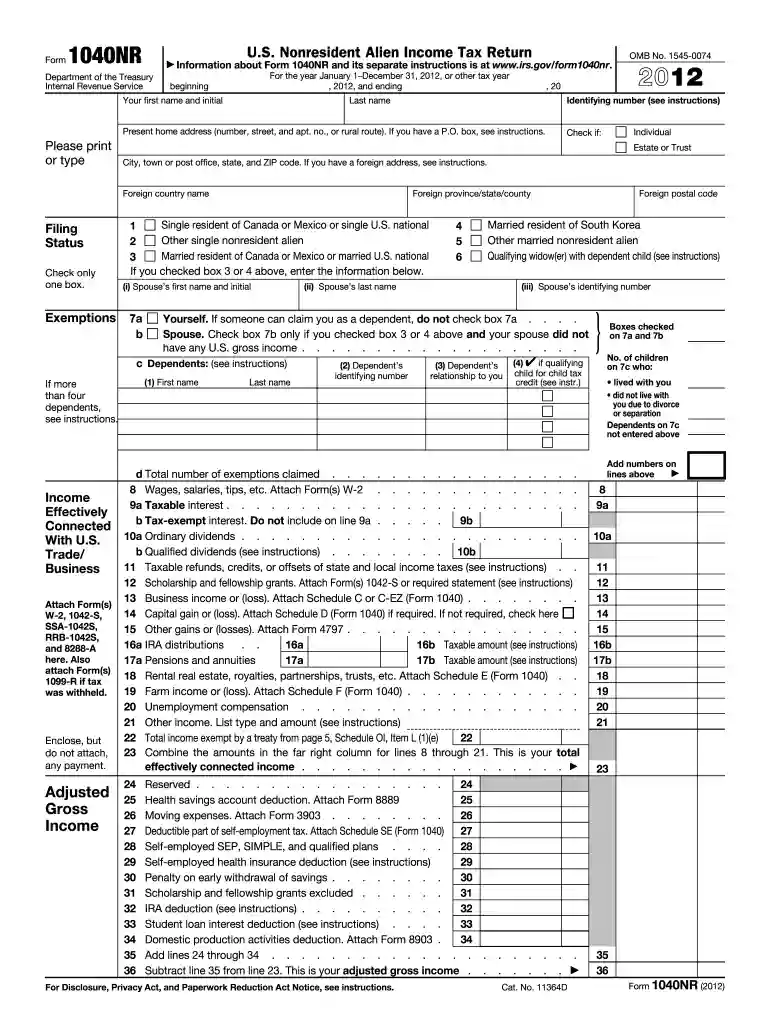
The 2012 Form 1040NR is a specific U.S. tax document primarily designed for nonresident aliens who need to file an income tax return. It serves a vital purpose in ensuring that nonresident aliens report their taxable income accurately, claim any applicable exemptions, and calculate the appropriate taxes owed or potential refunds they may be eligible for. This form is essential for nonresidents who have conducted business or earned income in the United States, allowing the IRS to maintain accurate records of international tax responsibilities.
To utilize the 1040NR Form from 2012 effectively, nonresident aliens should follow several key steps:
Identify Filing Status: Determine their filing status, which may affect the sections of the form that need completion. Possible statuses include single nonresident alien or married nonresident alien.
Report Income: Accurately report all sources of income earned within the U.S., ranging from wages and salaries to any other profits like dividends or rental income.
Calculate Deductions and Exemptions: Make use of applicable deductions and exemptions that can reduce taxable income. This may include student loan interest or state and local taxes paid.
Compute Tax Owed or Refunds Due: Using the form's instructions, calculate the total tax owed, and identify if any refunds are applicable.
These steps need to be followed with precision to ensure compliance with U.S. tax regulations.
Completing the 2012 Form 1040NR involves a structured approach to accurately report and compute tax obligations:
Gather Required Information and Documents: This includes prior tax returns, income statements like W-2 or 1099 forms, and any documentation related to deductions and credits.
Fill Out Personal Information: Input basic details such as name, address, and taxpayer identification number.
Enter Income Details: Report all types of income on the form as per the categorization provided by the IRS instructions.
Apply Exemptions and Deductions: Calculate allowable exemptions and deductions, cross-referencing the form's guidelines to ensure all applicable reductions are included.
Compute and Report Tax Obligation: Use the form's computation sections to derive total taxes owed or refunds due.
Complete Any Additional Attachments or Schedules: Attach necessary supplemental forms that support the information declared on the 1040NR.
Nonresident aliens must meet specific eligibility criteria to file using the 1040NR form. Individuals must:
Understanding and fulfilling these criteria are necessary to file the form appropriately.


Several terms are critical when dealing with the 1040NR form:
These terms help clarify the requirements and processes involved with using this tax document.
The IRS provides comprehensive guidelines for completing the 2012 Form 1040NR. The guidelines help taxpayers:
By following IRS instructions, filers can ensure that their tax returns are completed accurately and consider all relevant tax laws and regulations.
Meeting critical deadlines is essential for taxpayers using the 2012 Form 1040NR:
Being aware of these dates helps ensure timely compliance and avoids potential penalties for late submissions.
Failure to file the 1040NR form or misreport income can lead to severe consequences:
Understanding and adhering to filing requirements can prevent significant financial penalties and legal repercussions.
We've got more versions of the 1040nr 2012 form form. Select the right 1040nr 2012 form version from the list and start editing it straight away!
| Versions | Form popularity | Fillable & printable |
|---|---|---|
| 2025 | 4.6 Satisfied (41 Votes) | |
| 2024 | 4.7 Satisfied (30 Votes) | |
| 2023 | 4.7 Satisfied (32 Votes) | |
| 2022 | 4.2 Satisfied (44 Votes) | |
| 2021 | 4.8 Satisfied (99 Votes) | |
| 2020 | 4.2 Satisfied (46 Votes) | |
| 2019 | 4.4 Satisfied (212 Votes) | |
| 2018 | 4.4 Satisfied (80 Votes) | |
| 2017 | 4.3 Satisfied (77 Votes) | |
| 2016 | 4.4 Satisfied (1650 Votes) | |
| 2015 | 4 Satisfied (28 Votes) | |
| 2014 | 4 Satisfied (44 Votes) | |
| 2013 | 4.3 Satisfied (60 Votes) | |
| 2012 | 4 Satisfied (34 Votes) | |
| 2012 | 4.1 Satisfied (31 Votes) |
At DocHub, your data security is our priority. We follow HIPAA, SOC2, GDPR, and other standards, so you can work on your documents with confidence.
May 2, 2017 Do not use these forms to report wages subject to U.S. income tax withholding. Instead, use Form W-2 to show U.S. income tax withheld. TreatmentRead more
EZ U.S. Income Tax Return for Certain Nonresident Aliens With No Dependents 2012. Information about Form 1040NR-EZ. Wages, salaries, tips, etc. refunds,


