Type text, add images, blackout confidential details, add comments, highlights and more.
02. Sign it in a few clicks
Draw your signature, type it, upload its image, or use your mobile device as a signature pad.
03. Share your form with others
Send bankruptcy in montana via email, link, or fax. You can also download it, export it or print it out.
How to use or fill out Montana Bankruptcy Guide and Forms Package for Chapters 7 or 13 - Montana
Ease of Setup
DocHub User Ratings on G2
Ease of Use
DocHub User Ratings on G2
Click ‘Get Form’ to open it in the editor.
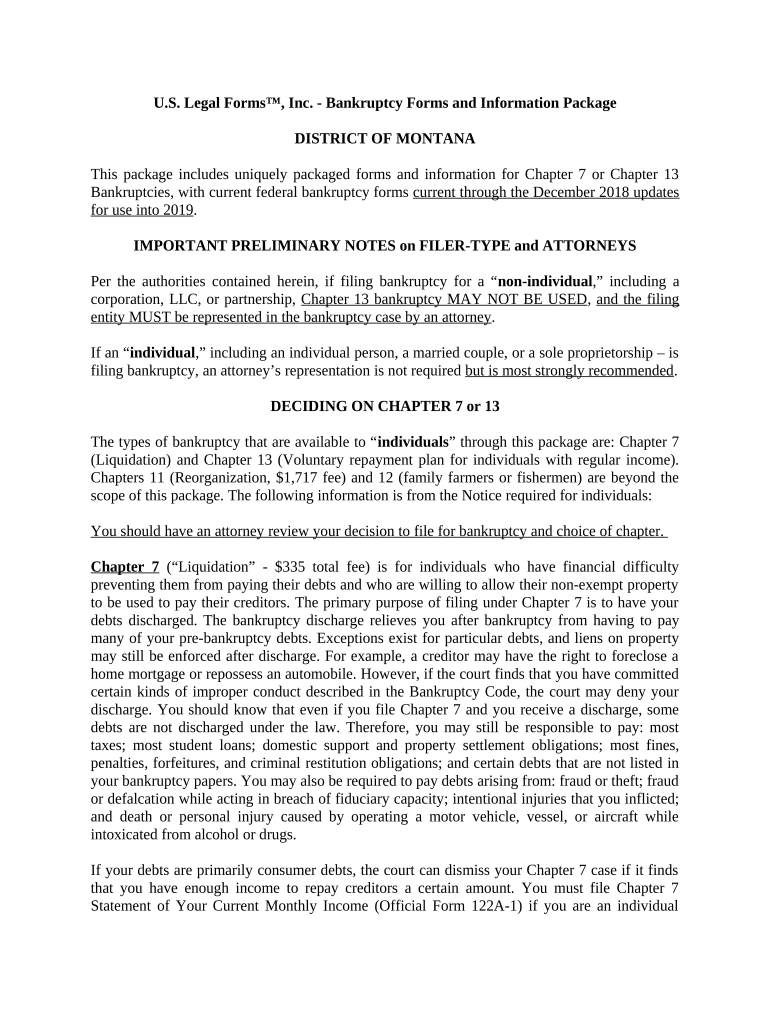
Begin by reviewing the preliminary notes regarding filer types. Ensure you understand whether you are filing as an individual or a non-individual entity.
Decide between Chapter 7 and Chapter 13 based on your financial situation. If opting for Chapter 7, complete the 'Statement of Your Current Monthly Income' (Official Form 122A-1) to determine eligibility.
If your income exceeds the median, proceed to fill out the 'Chapter 7 Means Test Calculation' (Official Form 122A-2). This will help assess your ability to repay debts.
For Chapter 13 filers, draft a repayment plan detailing how you intend to pay creditors over time. Ensure this plan aligns with your income and is within legal limits.
Complete all required forms accurately, ensuring that any exempt property is listed on Schedule C: The Property You Claim as Exempt (Official Form 106C).
Start using our platform today to streamline your bankruptcy form completion process!
Fill out Montana Bankruptcy Guide and Forms Package for Chapters 7 or 13 - Montana online It's free
Other assets that are exempt from bankruptcy can include: Veterans benefits. Retirement accounts. Unemployment benefits. Wages you earn after you file for bankruptcy. Money you receive from alimony and for child support. Social security benefits. Life insurance. Monetary awards from a personal injury case.
What is the downside to filing Chapter 13?
Debts dischargeable in a chapter 13, but not in chapter 7, include debts for willful and malicious injury to property, debts incurred to pay non-dischargeable tax obligations, and debts arising from property settlements in divorce or separation proceedings.
What is one difference between Chapter 7 and chapter 13 bankruptcy?
The biggest difference between Chapter 7 and Chapter 13 is that Chapter 7 focuses on discharging (getting rid of) unsecured debt such as credit cards, personal loans and medical bills while Chapter 13 allows you to catch up on secured debts like your home or your car while also discharging unsecured debt.
Why is Chapter 7 better than 13?
You want to eliminate the bulk of your debts Under Chapter 7, you eliminate most of your debts, but you also stand to lose more of your assets. Under Chapter 13, the repayment requirements are higher, but you may be able to keep more of your property.
How to prepare for chapter 13 bankruptcy?
The debtor must also file a certificate of credit counseling and a copy of any debt repayment plan developed through credit counseling; evidence of payment from employers, if any, received 60 days before filing; a statement of monthly net income and any anticipated increase in income or expenses after filing; and a
Related Searches
Local Bankruptcy FormsBankruptcy Billings MTBankruptcy court missoulaLocal Bankruptcy RulesButte Bankruptcy CourtBankruptcy Court case searchFiling bankruptcy
Security and compliance
At DocHub, your data security is our priority. We follow HIPAA, SOC2, GDPR, and other standards, so you can work on your documents with confidence.
Dec 9, 2024 Guidelines Panel Disclosures. Page 7. NCCN Guidelines Version 2.2024. Survivorship. Version 2.2024, 12/09/24 2024 National ComprehensiveRead more
Electronic Self-Representation (eSR) | District of Montana
Individuals who wish to file a chapter 7 bankruptcy petition and who live in the District of Montana may use eSR. eSR is not available for chapter 13 filings.Read more
by D MacDonald IV 1982 Cited by 9 9 Through the information contained in this arti- cle, Montana attorneys will be able to evaluate intelligently the advantages and disadvantages of a Chapter 11Read more
Cookie consent notice
This site uses cookies to enhance site navigation and personalize your experience.
By using this site you agree to our use of cookies as described in our Privacy Notice.
You can modify your selections by visiting our Cookie and Advertising Notice.