




01. Edit your 2020 form 941 online
Type text, add images, blackout confidential details, add comments, highlights and more.

Type text, add images, blackout confidential details, add comments, highlights and more.

Draw your signature, type it, upload its image, or use your mobile device as a signature pad.

Send form 941 for 2020 via email, link, or fax. You can also download it, export it or print it out.
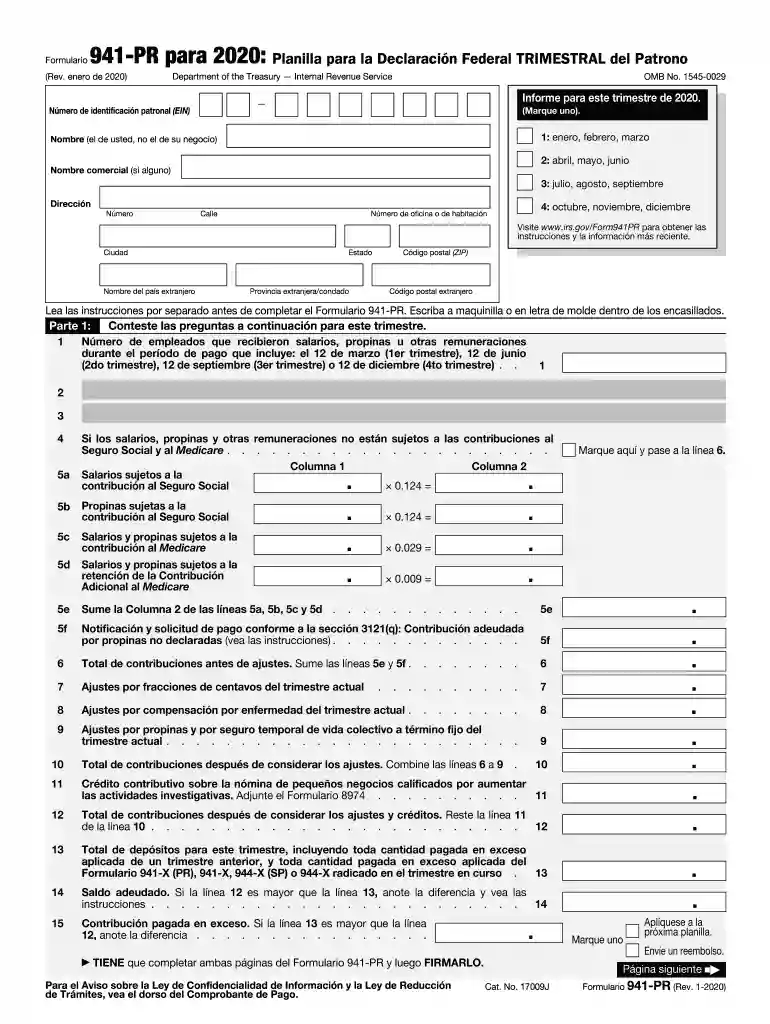
The 941 Form for 2020 is a quarterly tax return used by employers in the United States to report wages paid to employees, along with employee and employer contributions to Social Security and Medicare taxes. It's a critical document for ensuring compliance with federal tax obligations related to payroll. This form captures details about withheld federal income taxes, as well as the employer's share of Social Security and Medicare taxes. Proper completion and timely submission are essential to avoid penalties and ensure accurate tax records.
Using the 941 Form involves several steps that require careful attention to detail. Employers should gather all payroll information from the specific quarter before beginning. This includes total wages, taxable wages, federal income tax withheld, and the employer and employee portions of Social Security and Medicare taxes. The form has multiple sections, each of which requires precise information. The main sections include employee counts, wages paid, tax liabilities, and adjustments for sick pay or fringe benefits. Employers must complete each section accurately and verify all totals before submission to avoid discrepancies.
Filling out the 941 Form requires careful calculation and reporting:
The 941 Form must be filed quarterly. The deadlines are typically the end of the month following the end of the quarter:
Employers with employees subject to income tax withholding, Social Security, and Medicare taxes are required to file the 941 Form. This includes corporations, non-profits, limited liability companies, and partnerships engaging workers who receive regular compensation. Self-employed individuals may need to use different forms, such as the 1040-ES, for estimated taxes.


The IRS provides detailed instructions for completing the 941 Form to minimize errors. Employers must ensure they follow the provided guidelines, which cover everything from calculating tax liability to the proper method for reporting adjustments. The instructions emphasize accuracy in reporting figures and provide tips for avoiding common mistakes, such as transposing numbers or miscalculating tip allocations.
Failure to file the 941 Form on time or underpaying taxes can result in penalties. The IRS imposes fines based on the delay length or the payment shortfall. To mitigate these risks, employers should maintain accurate records and consider using reliable accounting software to track payroll taxes.
For convenience, many businesses use software like TurboTax or QuickBooks to assist with completing and filing the 941 Form. These platforms streamline the data entry and calculation process and often include e-filing options. They offer built-in reminders for deadlines, automatic error checking, and detailed guides, supporting compliance and accuracy.
There are two main ways to file the 941 Form: electronically via the IRS e-file system or by mail using the paper form. Digital submission is generally faster, enabling quicker processing and receipt confirmation. In contrast, paper filings may take longer to process and require manual checks. Electronic filing is highly recommended for businesses looking to simplify their tax processes.
Consider a business with ten employees paying $50,000 in wages for a quarter. Using the 941 Form, the business would report the total wages and calculate applicable Social Security and Medicare taxes. They'd then declare federal tax withholdings and deduct any previous tax deposits to determine any due balance. Data from preceding closing months would be used to ensure accuracy, and the completed form would offer a clear view of the business's payroll tax responsibility for that period.
We've got more versions of the 2020 form 941 form. Select the right 2020 form 941 version from the list and start editing it straight away!
| Versions | Form popularity | Fillable & printable |
|---|---|---|
| 2023 | 4.7 Satisfied (57 Votes) | |
| 2022 | 4.6 Satisfied (34 Votes) | |
| 2022 | 4.8 Satisfied (105 Votes) | |
| 2022 | 4.8 Satisfied (66 Votes) | |
| 2021 | 4 Satisfied (29 Votes) | |
| 2021 | 4.1 Satisfied (61 Votes) | |
| 2020 | 4.3 Satisfied (106 Votes) | |
| 2020 | 4.3 Satisfied (105 Votes) | |
| 2019 | 4.4 Satisfied (73 Votes) | |
| 2018 | 4.4 Satisfied (136 Votes) | |
| 2017 | 4.4 Satisfied (85 Votes) | |
| 2016 | 4.4 Satisfied (425 Votes) | |
| 2015 | 4.3 Satisfied (116 Votes) | |
| 2014 | 4.2 Satisfied (53 Votes) | |
| 2003 | 4 Satisfied (40 Votes) |
At DocHub, your data security is our priority. We follow HIPAA, SOC2, GDPR, and other standards, so you can work on your documents with confidence.
The Form 941, Employers Quarterly Federal Tax Return, is used to perform a reconciliation (e.g. true-up) of the total federal tax payments made by an employerRead more
Form 941 for 2020: (Rev. July 2020). Employers QUARTERLY Federal Tax Return EIN, Form 941, and the tax period (1st Quarter 2020,. 2nd QuarterRead more
Feb 20, 2025 This article discusses sample extraction methods for each typical sample matrix (high level water, low level water, soil and tissue) as well asRead more


