




01. Edit your turbotax amend 2019 online
Type text, add images, blackout confidential details, add comments, highlights and more.

Type text, add images, blackout confidential details, add comments, highlights and more.

Draw your signature, type it, upload its image, or use your mobile device as a signature pad.

Send 2019 form 1040x instructions via email, link, or fax. You can also download it, export it or print it out.
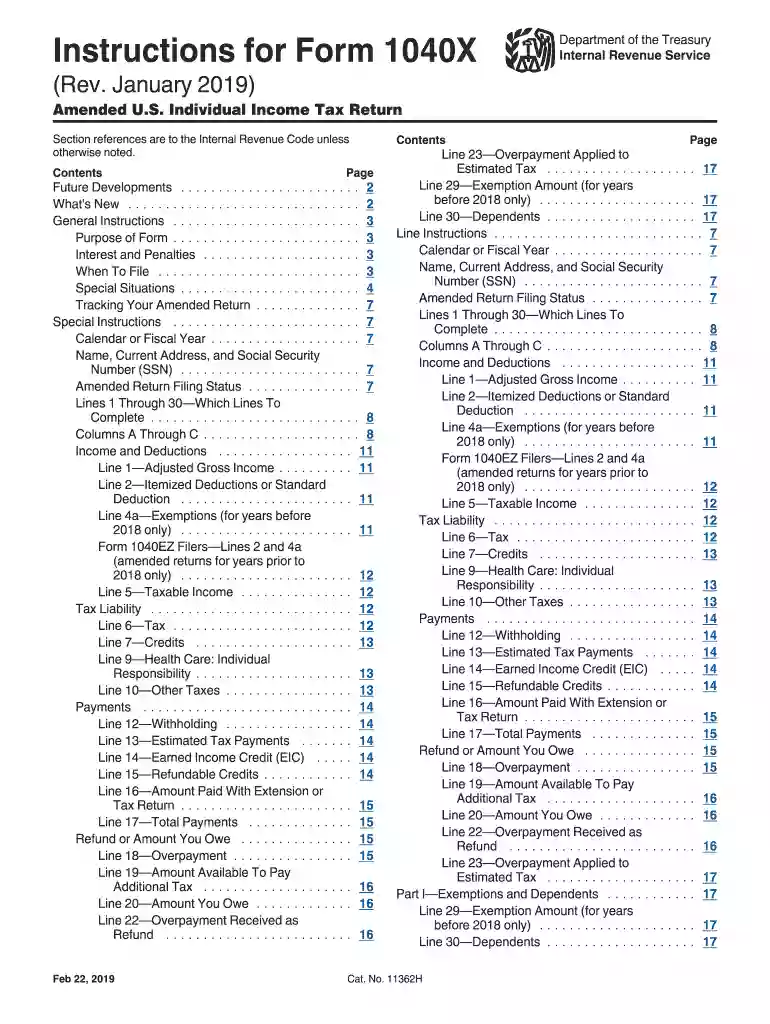
Form 1040X, officially termed the Amended U.S. Individual Income Tax Return, is used to make corrections to previously filed Forms 1040, 1040A, 1040EZ, 1040NR, or 1040NR-EZ. This form serves multiple purposes including:
Correction of Errors: If you've discovered mathematical errors or omitted information that impacts the amount of tax you owe or your refund.
Claiming or Modifying Tax Credits: Update your claim on credits like the Earned Income Tax Credit or Child Tax Credit.
Changes in Circumstances: Situations like changed marital status, additional dependents, or adjusted income sources.
Inclusion of Additional Income or Deductions: Amendments needed when additional income or allowable deductions were not included in the original return.
Understanding the importance of form 1040X can prevent penalties and ensure accurate tax obligations.
Completing Form 1040X involves several detailed steps to ensure accuracy:
Get a Copy of Your Original Return: Have your original return available for reference.
Download Form 1040X: Access the form and instructions from the IRS website or reliable tax preparation software.
Fill in the Identifying Information: Include your name, current address, and Social Security number.
Detail the Changes: Use Part I to explain each change and provide reasons and documentation for each.
Complete Part II, Tax Liability, and Payment Changes: Adjust income, deductions, and credits, resulting in a corrected tax calculation.
Attach Necessary Schedules and Forms: Any supporting documents or schedules affected by the amendments should accompany the 1040X.
Verify and Sign the Form: Ensure all information is accurate before signing.
Filing an accurate 1040X avoids delays and possible issues with the IRS.
Form 1040X and its instructions can be obtained via several channels:
IRS Website: Download the form and instructions directly from the IRS.gov site.
Tax Preparation Software: Applications such as TurboTax and H&R Block typically include access to amend prior year returns.
Local IRS Offices: Visit an IRS office for paper forms and guidance.
Having access to the 1040X form and instructions ensures compliance and accurate amendments.
Legal adherence regarding Form 1040X is essential:
Timeliness: The amended return must generally be filed within three years after the date you filed your original return or within two years after you paid the tax, whichever is later.
Accuracy: Providing false information or omitting required details can result in penalties or legal action by the IRS.
Documentation: Retain all supporting documents and copies of the original and amended returns for at least three years.
Compliance ensures no legal repercussions and aligns with IRS standards.
The IRS provides specific guidance and requirements for filing Form 1040X:
Eligible Applicants: Any taxpayer who filed a 1040-series return can use 1040X to amend their returns.
Documentation: Submit copies of any schedule or forms relevant to the adjustments made (e.g., W-2 forms, receipts).
Dual Filings: If amending more than one tax year, submit separate 1040X forms for each year.
Extensions: If the amendment results in a refund, file within specified deadlines to claim the refund.
Following IRS guidelines ensures smooth processing of amended returns.
Filing deadlines for Form 1040X are crucial for timely processing:
Three-Year Rule: File within three years after the original return or two years after paying the tax, whichever is later, to claim a refund.
Extensions: While 1040X can be filed any time, refunds have strict timing limitations beyond which claims are disallowed.
Tax Day: Synchronize any tax year changes with the broader April 15 deadline, which may affect initial filings or other adjustments.
Meeting these deadlines is vital to claim any refunds or ensure accurate tax compliance.
Avoid common pitfalls when filing Form 1040X:
Incorrect Personal Information: Ensure your name and Social Security number are correct and match your original return.
Failure to Attach Supporting Documents: Include all necessary schedules, forms, or receipts that substantiate changes.
Mathematical Errors: Double-check your figures to prevent miscalculations leading to potential delays or rejections.
Incomplete Explanations: Clearly describe each change and the reason for the amendment in Part III of the 1040X.
Careful attention to these aspects ensures a successful amendment process.
Leveraging technology for 1040X filings:
Software Programs: Utilize tax software like TurboTax, which supports amendments and guides you through the process.
Electronic Filing: As of the recent years, the IRS permits certain amended returns to be filed electronically, streamlining the process.
IRS e-File System: The digital option is an efficient, accurate alternative to manual submissions.
Digital solutions offer convenience and enhanced accuracy in tax filing processes.
Non-compliance with Form 1040X regulations entails serious consequences:
Fines and Interest: Late payments or submitting incorrect returns can result in financial penalties.
Legal Actions: Severe cases of repeated or significant fraud could lead to legal actions.
Loss of Refunds: Missing the amendment period for refund claims results in forfeited financial restitution.
Adhering to 1040X regulations avoids these penalties and promotes fair tax practices.
We've got more versions of the turbotax amend 2019 form. Select the right turbotax amend 2019 version from the list and start editing it straight away!
| Versions | Form popularity | Fillable & printable |
|---|---|---|
| 2024 | 4.8 Satisfied (31 Votes) | |
| 2023 | 4.5 Satisfied (23 Votes) | |
| 2021 | 4.8 Satisfied (61 Votes) | |
| 2020 | 4.4 Satisfied (147 Votes) | |
| 2019 | 4.4 Satisfied (228 Votes) | |
| 2018 | 4.1 Satisfied (74 Votes) | |
| 2017 | 4.3 Satisfied (66 Votes) | |
| 2016 | 4.3 Satisfied (55 Votes) | |
| 2014 | 4 Satisfied (54 Votes) | |
| 2013 | 4.2 Satisfied (69 Votes) | |
| 2011 | 4.4 Satisfied (83 Votes) | |
| 1992 | 4 Satisfied (52 Votes) |
At DocHub, your data security is our priority. We follow HIPAA, SOC2, GDPR, and other standards, so you can work on your documents with confidence.
Feb 8, 2018 2018 ABLE account changes on IRS.gov. This publication is for use in preparing your 2017 returns. For changes affecting your 2018 returnRead more
Jan 1, 2018 File either Form 1040X or Form. 1045 to apply for a refund based on either an overpayment of tax due to a claim of right adjustment underRead more


