
Use columns log easily




How to Use columns log and save your time
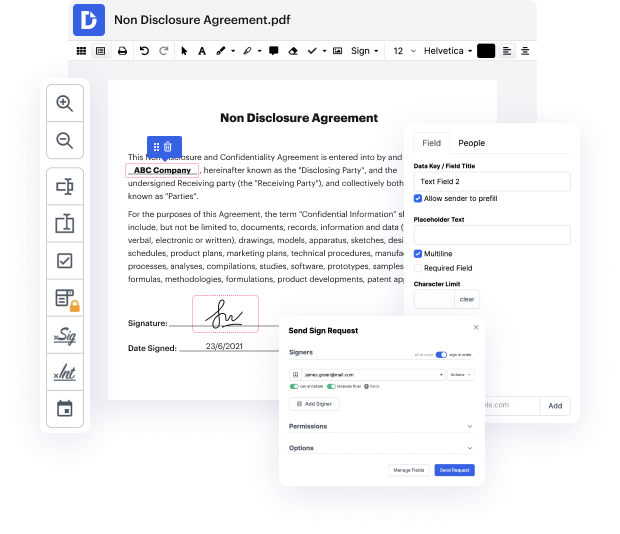
You realize you are using the right file editor when such a basic job as Use columns log does not take more time than it should. Modifying documents is now an integral part of a lot of working operations in various professional fields, which is the reason convenience and straightforwardness are essential for editing resources. If you find yourself researching guides or searching for tips on how to Use columns log, you may want to get a more intuitive solution to save time on theoretical learning. And this is where DocHub shines. No training is needed. Simply open the editor, which will guide you through its main functions and features.
Kickstart your editing flows in several simple steps.
- Open the DocHub site and hit the Sign up button.
- Provide your account information for the signup or go for the fast signup using your existing email account.
- Once you see the Dashboard, you are all set. Click on the New Document button to upload the file in which you need to Use columns log.
- Add it from your gadget as a drag and drop or use a hyperlink to the cloud where it is stored.
- Open the file in the editing mode and utilize the intuitive toolbar to apply the changes needed.
- Save the file in your account or download it on your gadget instantly.
A workflow becomes smoother with DocHub. Take advantage of this instrument to complete the files you need in short time and take your efficiency to the next level!
PDF editing simplified with DocHub






Drive efficiency with the DocHub add-on for Google Workspace
How to use columns log
one of the ways we record data about sedimentary rocks is by using a stratigraphic column so its a graphical representation of the rocks and so we have a vertical axis which is the scale and so this is the thickness of the rock unit so for example in this image over here the pen is 15 centimeters long approximately and so if I was going to draw this rock or graphically represented at the same scale I might go from 0 here to something like 15 centimeters up here if you are measuring much thicker rocks youd change the scale for that and then across the x-axis here we have the grain size so what this does is it allows us to record the grain size graphically with the thickness of the rock and also within this layer will draw the beds relative for the grain size and will also include the sedimentary structures that are present so as an example I am going to I dont know exactly what the grain size is in this image but Im going to say basically this whole area in through here is very fin

Got questions?
How do I log in to pandas column?
How do you write natural log in Python?
How do I log a column in pandas?
How do I log a column in pandas?
How do I apply a column to a function in pandas?
How do you use columns in a data frame?
How to get all values of a column in pandas?
What does a log transformation do?
How do I extract data from a specific column in Python?
How do you find the natural log in R?
See why our customers choose DocHub


Security and compliance
At DocHub, your data security is our priority. We follow HIPAA, SOC2, GDPR, and other standards, so you can work on your documents with confidence.
Learn more




