


Restore dot in csv smoothly

Note: Some features described here aren't available yet. Contact us at support@dochub.com if you're interested.
Aug 6th, 2022
forms filled out
0
forms filled out
forms signed
0
forms signed
forms sent
0
forms sent
Service screenshot
01. Upload a document from your computer or cloud storage.
Service screenshot
02. Add text, images, drawings, shapes, and more.
Service screenshot
03. Sign your document online in a few clicks.
Service screenshot
04. Send, export, fax, download, or print out your document.

How to Restore dot in Csv files anytime from anyplace

Form edit decoration

Have you ever had trouble with editing your Csv document while on the go? Well, DocHub has an excellent solution for that! Access this cloud editor from any internet-connected device. It enables users to Restore dot in Csv files rapidly and whenever needed.

DocHub will surprise you with what it provides you with. It has powerful capabilities to make any changes you want to your forms. And its interface is so intuitive that the whole process from beginning to end will take you only a few clicks.

Check out DocHub’s capabilities as you Restore dot in Csv files:

  1. Upload your Csv from your device, an email attachment, cloud storage, or through a link.
  2. Create new content by clicking on our Text button above, and alter its color, size, and fonts as required.
  3. Click on our Strikeout or Whiteout tools to erase details that just don’t seem right anymore.
  4. Make visual upgrades by drawing or placing pictures, lines, and icons.
  5. Highlight important details in your documentation.
  6. Click on the Comment option to make a remark on your most significant modifications.
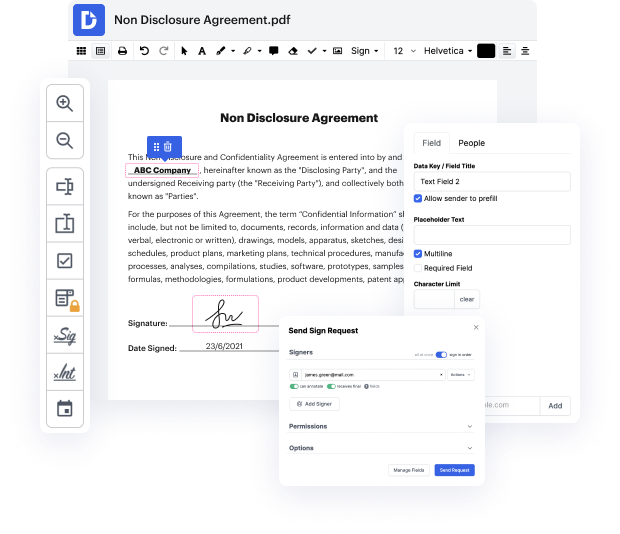
  7. Turn your Csv file into a fillable template by clicking on the Manage Fields tool.
  8. Place fields for various sorts of data.
  9. Assign Roles to your fields and make them mandatory or optional to ensure parties fill them out properly.
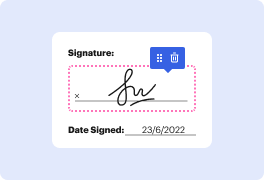
  10. Add Signature Fields and click on Sign to approve your documentation yourself.
  11. Choose how you share your form - via email or using a shareable link.

Once you complete modifying and sharing, you can save your updated Csv file on your device or to the cloud as it is or with an Audit Trail that contains all alterations applied. Also, you can save your paperwork in its initial version or turn it into a multi-use template - accomplish any document management task from anyplace with DocHub. Subscribe today!

PDF editing simplified with DocHub

icon
Seamless PDF editing
Editing a PDF is as simple as working in a Word document. You can add text, drawings, highlights, and redact or annotate your document without affecting its quality. No rasterized text or removed fields. Use an online PDF editor to get your perfect document in minutes.
icon
Smooth teamwork
Collaborate on documents with your team using a desktop or mobile device. Let others view, edit, comment on, and sign your documents online. You can also make your form public and share its URL anywhere.
icon
Automatic saving
Every change you make in a document is automatically saved to the cloud and synchronized across all devices in real-time. No need to send new versions of a document or worry about losing information.
icon
Google integrations
DocHub integrates with Google Workspace so you can import, edit, and sign your documents directly from your Gmail, Google Drive, and Dropbox. When finished, export documents to Google Drive or import your Google Address Book and share the document with your contacts.
icon
Powerful PDF tools on your mobile device
Keep your work flowing even when you're away from your computer. DocHub works on mobile just as easily as it does on desktop. Edit, annotate, and sign documents from the convenience of your smartphone or tablet. No need to install the app.
icon
Secure document sharing and storage
Instantly share, email, and fax documents in a secure and compliant way. Set a password, place your documents in encrypted folders, and enable recipient authentication to control who accesses your documents. When completed, keep your documents secure in the cloud.
dochub logo
google logo

Drive efficiency with the DocHub add-on for Google Workspace

Access documents and edit, sign, and share them straight from your favorite Google Apps.
Install now

How to Restore dot in csv

4.6 out of 5
30 votes

when i import data from a csv file into power bi i often encounter two problems the first problem is that sometimes my decimals disappear and i have way too big values in my result now the second problem that i sometimes have is that i add columns to my data source file csv file and then i refresh and they dont show up in power bi now lets see how we can fix both of [Applause] them welcome to how to power bi my name is boss and if this is the very first time for you visiting this channel then make sure to hit that subscribe button if you want to stay up to date on all of my videos now lets have a look at the csv files that were going to import into power bi so here you have the data from two csv files that we are going to import into power bi and theyre almost the same the only difference is the decimal separators and the thousand separators so you see in the first data set we have the dots as a decimal separator and comma theres a thousand separator in the second data set we hav

video background

Got questions?

Here are some common questions from our customers that may provide you with the answer you're looking for. If you can't find an answer to your question, please don't hesitate to reach out to us.
Contact us
To preserve all the digits in text-formatted numbers, you have to import the downloaded CSV file as raw data into a new Excel spreadsheet, set the column datatypes as needed, and then save the new file as an Excel workbook. Excel (XLSX) files will preserve these formats, CSV files wont.
0:27 1:28 How to Change the Decimal Separator in Excel - YouTube YouTube Start of suggested clip End of suggested clip Then under editing options look for the section use system separators. Here you can specify whatMoreThen under editing options look for the section use system separators. Here you can specify what separators you want to use were going to change the decimal separator.
Open your CSV using a text editor. Press Enter/Return to create a new line at the very top, and add sep=; if the separator used in the CSV is a semicolon (;), or sep=, if the separator is a comma (,). Save your changes (command + S or control + S), then re-open in any Spreadsheet app.
Using Commas in Numbers (US, UK, and China) In the US, UK, and China, a comma is placed every 3 digit positions for numbers larger than 999. The decimal point is shown with a period (full stop). For example: 1,234.
To preserve all the digits in text-formatted numbers, you have to import the downloaded CSV file as raw data into a new Excel spreadsheet, set the column datatypes as needed, and then save the new file as an Excel workbook.
Right-click on the Excel XLS/CSV file and select Properties; 2. Go to Previous Versions, find and select the latest version or the last version before Excel replaced or saved, click Restore. Then you can get your Excel file XLS or CSV restored without losing any saved data.
Click File Options. On the Advanced tab, under Editing options, clear the Use system separators check box. Type new separators in the Decimal separator and Thousands separator boxes. Tip: When you want to use the system separators again, select the Use system separators check box.
Steps include: Right-click on the CSV file. Choose Properties. Click on Previous Versions. Select the last version prior to save or replace. Click Restore.
Change separator when saving Excel file as CSV Click File Options Advanced. Under Editing options, clear the Use system separators check box. Change the default Decimal separator. As this will change the way decimal numbers are displayed in your worksheets, choose a different Thousands separator to avoid confusion.
A comma-separated values (CSV) file is a delimited text file that uses a comma to separate values. Each line of the file is a data record. Each record consists of one or more fields, separated by commas. The use of the comma as a field separator is the source of the name for this file format.

See why our customers choose DocHub

Great solution for PDF docs with very little pre-knowledge required.
"Simplicity, familiarity with the menu and user-friendly. It's easy to navigate, make changes and edit whatever you may need. Because it's used alongside Google, the document is always saved, so you don't have to worry about it."
Pam Driscoll F
Teacher
A Valuable Document Signer for Small Businesses.
"I love that DocHub is incredibly affordable and customizable. It truly does everything I need it to do, without a large price tag like some of its more well known competitors. I am able to send secure documents directly to me clients emails and via in real time when they are viewing and making alterations to a document."
Jiovany A
Small-Business
I can create refillable copies for the templates that I select and then I can publish those.
"I like to work and organize my work in the appropriate way to meet and even exceed the demands that are made daily in the office, so I enjoy working with PDF files, I think they are more professional and versatile, they allow..."
Victoria G
Small-Business

Security and compliance

At DocHub, your data security is our priority. We follow HIPAA, SOC2, GDPR, and other standards, so you can work on your documents with confidence.

Learn more
ccpa2
pci-dss
gdpr-compliance
hipaa
soc-compliance
be ready to get more

Edit and sign PDFfor free

Get started now