
Locate line bulletin easily



How to Locate line bulletin and save your time
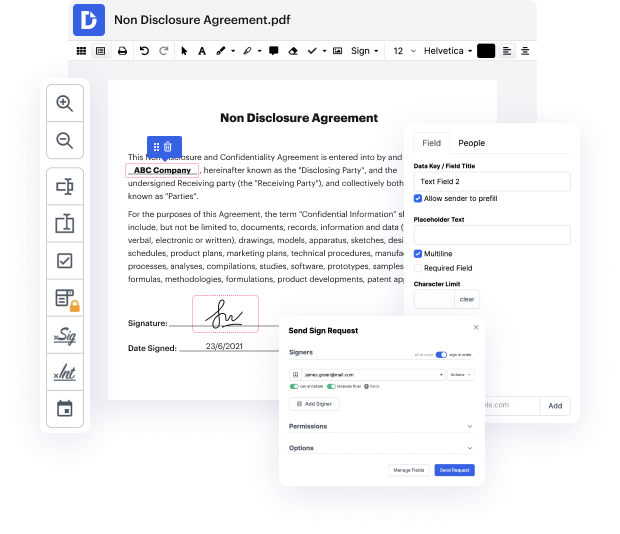
You know you are using the proper file editor when such a simple job as Locate line bulletin does not take more time than it should. Editing documents is now an integral part of a lot of working operations in various professional fields, which is the reason accessibility and straightforwardness are essential for editing resources. If you find yourself studying tutorials or searching for tips about how to Locate line bulletin, you might want to find a more user-friendly solution to save your time on theoretical learning. And here is where DocHub shines. No training is required. Just open the editor, which will guide you through its principal functions and features.
Kickstart your editing flows in several simple steps.
- Go to the DocHub site and hit the Sign up button.
- Provide your account information for the signup or opt for the fast signup using your existing email profile.
- Once you see the Dashboard, you are all set. Click on the New Document button to add the file in which you need to Locate line bulletin.
- Upload it from your device as a drag and drop or use a link to the cloud where it is placed.
- Open the file in the editing mode and use the user-friendly toolbar to apply the adjustments required.
- Save the file in your account or download it on your device instantly.
A workflow gets smoother with DocHub. Take advantage of this instrument to complete the paperwork you need in short time and take your productivity one stage further!
PDF editing simplified with DocHub






Drive efficiency with the DocHub add-on for Google Workspace
How to locate line bulletin
- A utility locator is a tool used to find existing utilities with conductive pipes or tracer wires to give an estimated depth. Although this gives you a depth estimation, it does not remove the responsibilities for verifying and exposing all utilities prior to excavation or trenchless installation. Before using your locator, be sure to read and understand your operators manual. The basic components you need on a jobsite will consist of: a receiver, transmitter, ground stake, direct connect cables and an operators manual. Once the location of a utility is determined, insert the ground stake at a 90-degree angle from the direction of the utilitys path, making sure not to cross any other utilities while making the 90-degree angle. Using the direct connect cables, plug the connector into the transmitter, connect the red clip on the target line wire or above ground piping, and the black clip on the ground stake. Now that the direct connect clips are properly installed, power on the tra

See why our customers choose DocHub


Security and compliance
At DocHub, your data security is our priority. We follow HIPAA, SOC2, GDPR, and other standards, so you can work on your documents with confidence.
Learn more




