
Discover the quickest way to Invent Conditional Field Log For Free



Invent Conditional Field Log For Free with the swift ease
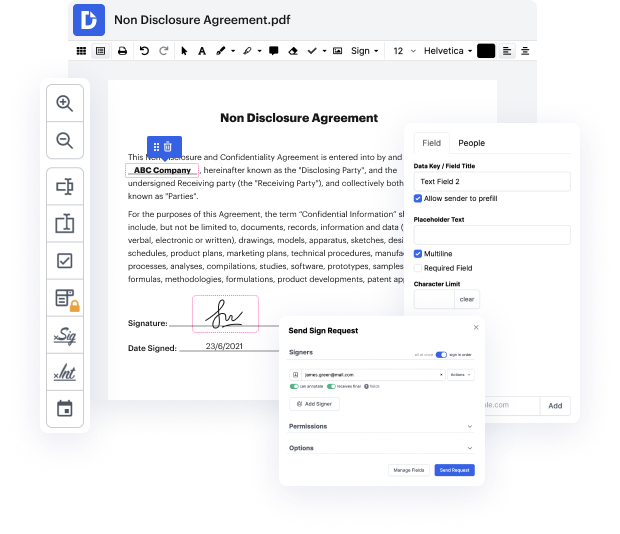
Contrary to popular belief, editing files online can be trouble-free. Sure, some file formats might appear too hard with which to deal. But if you have the right solution, like DocHub, it's straightforward to tweak any file with minimum resources. DocHub is your go-to solution for tasks as simple as the ability to Invent Conditional Field Log For Free a single document or something as intimidating as dealing with a massive stack of complex paperwork.
Below, you can find six simple steps to get you up and running and Invent Conditional Field Log For Free with DocHub:
- Head to to the upload page and choose how you want to upload the file.
- You can start editing your document when you’re taken to the editor.
- Locate the required option to Invent Conditional Field Log For Free and use the undo option to revert unwanted modifications.
- Take advantage of the features at the top of your editor to make your added file look neater, more structured, and more professional.
- Share your file with other parties or download it to your computer.
- Upload a different document and keep checking out DocHub’s capabilities.
When it comes to a solution for online file editing, there are many solutions on the market. However, not all of them are powerful enough to accommodate the needs of people requiring minimum editing capabilities or small businesses that look for more advanced tools that allow them to collaborate within their document-based workflow. DocHub is a multi-purpose solution that makes managing documents online more simplified and easier. Try DocHub now!
PDF editing simplified with DocHub






Drive efficiency with the DocHub add-on for Google Workspace
How to Invent Conditional Field Log For Free
In this tutorial, Pierre from Notion Forms demonstrates how to use custom logic in Notion forms to display or hide questions based on user inputs. He starts by creating a table in his Notion workspace to receive form responses, with columns for user names, preferences between apples and strawberries, and reasons for their preferences. After setting up the table, Pierre creates a new form on the Notion form page using the conditional logic he defined. The form includes fields for user names, preferences, and reasons for preferences. This allows for personalized and dynamic form displays based on user responses.

See why our customers choose DocHub


Security and compliance
At DocHub, your data security is our priority. We follow HIPAA, SOC2, GDPR, and other standards, so you can work on your documents with confidence.
Learn more