Export Value Choice Contract in Linux in no time

Aug 6th, 2022
forms filled out
0
forms filled out
forms signed
0
forms signed
forms sent
0
forms sent
Service screenshot
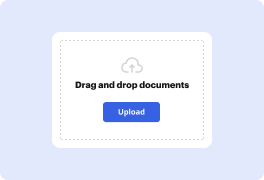
01. Upload a document from your computer or cloud storage.
Service screenshot
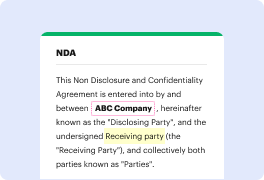
02. Add text, images, drawings, shapes, and more.
Service screenshot
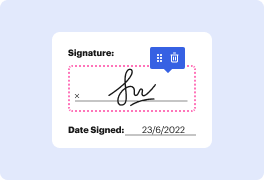
03. Sign your document online in a few clicks.
Service screenshot
04. Send, export, fax, download, or print out your document.

Export Value Choice Contract in Linux
Form edit decoration

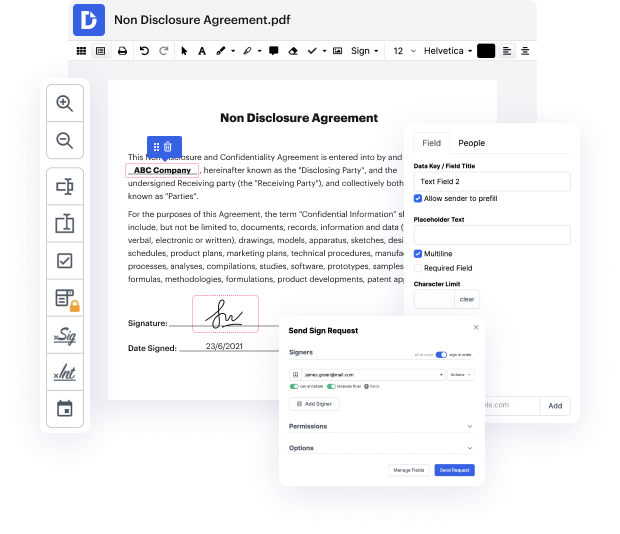
DocHub is an exceptional platform designed to streamline document editing, signing, and distribution. With its user-friendly interface and robust features, it empowers users to manage their documents effectively. Whether you're operating from a Linux system or utilizing iOS 17, 18, or 19, our editor allows seamless integration with Google Workspace, making document import, export, and modification a breeze. Let’s explore how to Export Value Choice Contract in Linux effortlessly.

Follow the steps to Export Value Choice Contract in Linux

  1. Begin by accessing the DocHub website through your preferred web browser and log in to your account.
  2. Once logged in, navigate to your documents section where you can locate the Value Choice Contract you wish to export.
  3. Open the document in the editor. Here, you can review and make any necessary edits or annotations to ensure everything is in order before exporting.
  4. After finalizing the document, look for the option to initiate the export process. This will typically involve selecting a format suitable for your needs, such as PDF.
  5. Confirm your selections and proceed to execute the export. You will then be presented with options to download the document directly to your Linux system, print it, or share it via email or other platforms.

Experience the convenience of document management today—start using DocHub for free and streamline your workflow!

PDF editing simplified with DocHub

icon
Seamless PDF editing
Editing a PDF is as simple as working in a Word document. You can add text, drawings, highlights, and redact or annotate your document without affecting its quality. No rasterized text or removed fields. Use an online PDF editor to get your perfect document in minutes.
icon
Smooth teamwork
Collaborate on documents with your team using a desktop or mobile device. Let others view, edit, comment on, and sign your documents online. You can also make your form public and share its URL anywhere.
icon
Automatic saving
Every change you make in a document is automatically saved to the cloud and synchronized across all devices in real-time. No need to send new versions of a document or worry about losing information.
icon
Google integrations
DocHub integrates with Google Workspace so you can import, edit, and sign your documents directly from your Gmail, Google Drive, and Dropbox. When finished, export documents to Google Drive or import your Google Address Book and share the document with your contacts.
icon
Powerful PDF tools on your mobile device
Keep your work flowing even when you're away from your computer. DocHub works on mobile just as easily as it does on desktop. Edit, annotate, and sign documents from the convenience of your smartphone or tablet. No need to install the app.
icon
Secure document sharing and storage
Instantly share, email, and fax documents in a secure and compliant way. Set a password, place your documents in encrypted folders, and enable recipient authentication to control who accesses your documents. When completed, keep your documents secure in the cloud.
dochub logo
google logo

Drive efficiency with the DocHub add-on for Google Workspace

Access documents and edit, sign, and share them straight from your favorite Google Apps.
Install now

How to Export Value Choice Contract in Linux

4.9 out of 5
40 votes

Welcome to Linux Essentials where we cover your first 100 commands. In today's tutorial, we will focus on the export command. Linux is essential for internet usage and is used by enthusiasts. Export allows passing environment variables to other processes. Commands are like words in a language, and export is the 47th command to memorize. It helps to set and share environment variables. Commands follow a structure of command, options, and arguments. The export command has three options, and the argument is the variable to set for other processes.

video background

Got questions?

Here are some common questions from our customers that may provide you with the answer you're looking for. If you can't find an answer to your question, please don't hesitate to reach out to us.
Contact us
Use echo to Display a Linux Environment Variable One of the quickest ways to display a single Linux environment variable is to use the echo command. The basic syntax is echo $ . The echo $ command also works for shell variables that are NOT environment variables.
The syntax for the export command is: export [-f] [-n] [name[=value] ] Running the command without any options outputs all the exported variables and functions: The command runs successfully unless you pass an invalid option or an invalid variable [name] .
The SETENV command can be used to define an environment variable and assign a value to it. The value of an environment variable can be retrieved from within the SAS session using the SYSGET function during autoexec processing. The command x setenv a /tmp; sets a=/tmp . The command x echo $a; results in the value /tmp.
Windows In Search, search for and then select: System (Control Panel) Click the Advanced system settings link. Click Environment Variables. In the Edit System Variable (or New System Variable) window, specify the value of the PATH environment variable. Reopen Command prompt window, and run your java code.
echo is a command for printing text and variables to stdout (or redirect). export lists the current exported variables in the shell.
The basic syntax for the export command is straightforward: # export [options] [name[=value] ] This basic syntax allows you to set environment variables that will be inherited by child processes initiated by the current shell.
Manipulating your PATH variable To make the change permanent, enter the command PATH=$PATH:/opt/bin into your home directorys . bashrc file. When you do this, youre creating a new PATH variable by appending a directory to the current PATH variable, $PATH . A colon ( : ) separates PATH entries.
A: To set an environment variable in Linux, you can use the export command followed by the variable name and value. For example, to set a variable named MYVAR to the value hello, you would use the command export MYVAR=hello.

See why our customers choose DocHub

Great solution for PDF docs with very little pre-knowledge required.
"Simplicity, familiarity with the menu and user-friendly. It's easy to navigate, make changes and edit whatever you may need. Because it's used alongside Google, the document is always saved, so you don't have to worry about it."
Pam Driscoll F
Teacher
A Valuable Document Signer for Small Businesses.
"I love that DocHub is incredibly affordable and customizable. It truly does everything I need it to do, without a large price tag like some of its more well known competitors. I am able to send secure documents directly to me clients emails and via in real time when they are viewing and making alterations to a document."
Jiovany A
Small-Business
I can create refillable copies for the templates that I select and then I can publish those.
"I like to work and organize my work in the appropriate way to meet and even exceed the demands that are made daily in the office, so I enjoy working with PDF files, I think they are more professional and versatile, they allow..."
Victoria G
Small-Business

Security and compliance

At DocHub, your data security is our priority. We follow HIPAA, SOC2, GDPR, and other standards, so you can work on your documents with confidence.

Learn more
ccpa2
pci-dss
gdpr-compliance
hipaa
soc-compliance
be ready to get more

Edit and sign PDFfor free

Get started now