
Export Surname Field Contract in Linux in no time



Export Surname Field Contract in Linux
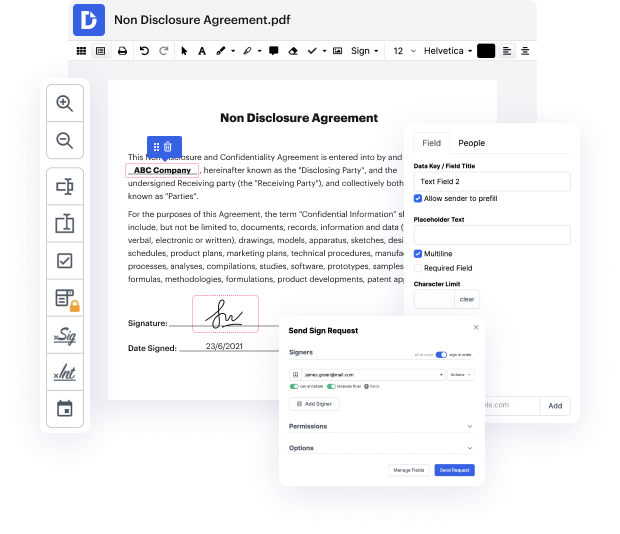
DocHub is your go-to platform for streamlining document management and enhancing productivity. With powerful features that enable you to edit, sign, and distribute documents seamlessly, our editor is designed to facilitate smooth workflows. Whether you are using iOS 17, iOS 18, or iOS 19, you can rely on our online tools to handle your document needs for free, making it easier than ever to manage contracts and forms.
Follow the steps to Export Surname Field Contract in Linux
- Open your web browser and navigate to the DocHub website. Log in with your credentials or create an account if you haven't already.
- Once logged in, locate the document you wish to edit. You can upload a new file or select an existing one from your library.
- Access the document's editing tools and find the surname field. Click to enter the necessary information, ensuring all details are accurate.
- After filling out the surname field, review the document for any additional changes or required fields. Make sure everything is complete.
- Once satisfied with your edits, proceed to export the document. Choose the desired format for exporting, and ensure to save it locally or in your cloud service.
- Finally, you can download the document to your device, print it directly, or share it via email or other platforms as needed.
Start using DocHub today to manage your documents effortlessly!
PDF editing simplified with DocHub






Drive efficiency with the DocHub add-on for Google Workspace
How to Export Surname Field Contract in Linux
If you need to export users from Active Directory, there are a few options available. Ill present how to do this with Active Directory Users and Computers, and with PowerShell. First I bring up the run console and execute the DSA.MSC file. The Active Directory Users Computers tool opens. I start with filtering the results to users only. If I needed to export more than 2000 users, Id also need to change the shown items limit. Next, I go to my domain, click users and go to Add and remove columns. The columns I choose, determine which users attributes will be exported. Finally, I click export list, enter a name and save it as CSV file. When I click Save, the users list is ready. Another method of exporting users requires PowerShell. I begin with opening Exchange Management Shell. You can also use any PowerShell console and connect it to the Exchange environment. Now, I copy the cmdlet from this videos description, choose where to export the list and run the code. The cmdlet exp

See why our customers choose DocHub


Security and compliance
At DocHub, your data security is our priority. We follow HIPAA, SOC2, GDPR, and other standards, so you can work on your documents with confidence.
Learn more




