Create Mark Document in Linux in no time

Aug 6th, 2022
forms filled out
0
forms filled out
forms signed
0
forms signed
forms sent
0
forms sent
Service screenshot
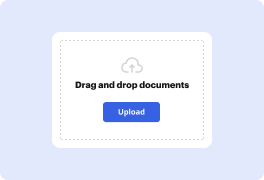
01. Upload a document from your computer or cloud storage.
Service screenshot
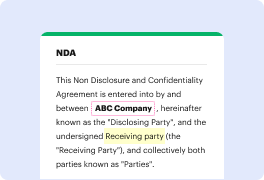
02. Add text, images, drawings, shapes, and more.
Service screenshot
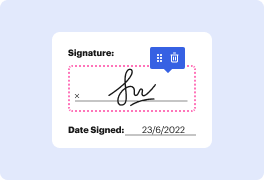
03. Sign your document online in a few clicks.
Service screenshot
04. Send, export, fax, download, or print out your document.

How to Create Mark Document in Linux with DocHub
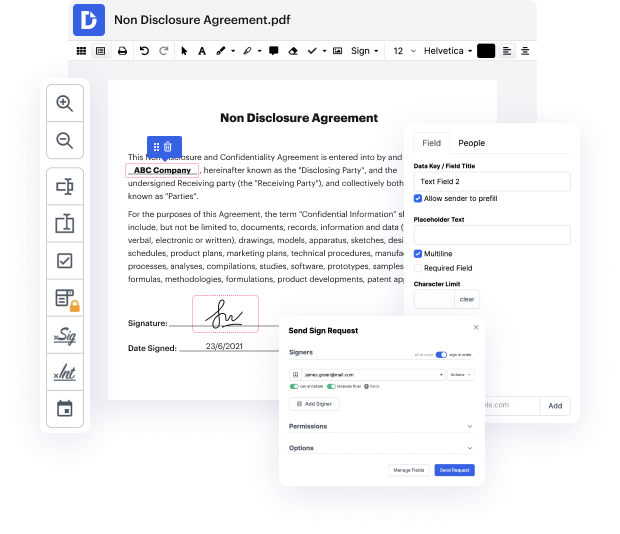
Form edit decoration

DocHub is an innovative platform that simplifies document editing, signing, distribution, and forms completion, enhancing your productivity. With seamless integration with Google Workspace, our editor allows users to import, export, modify, and sign documents directly from Google apps. This guide will empower you to create a mark document in Linux, making document management a breeze, whether you're using iOS 17, iOS 18, or iOS 19.

Follow the steps to create your mark document:

  1. Open the DocHub website in your Linux web browser and log in to your account.
  2. Navigate to the section where you can create a new document. Choose the option to start with a blank document or upload an existing file.
  3. Once your document is open in the editor, use the appropriate tools to add marks, annotations, or highlights as needed.
  4. After editing, review your document to ensure all marks are placed correctly and that the content meets your requirements.
  5. Finally, choose to download the document, print it, or share it directly with others via email or links.

Start creating your mark documents today with our platform, and experience the convenience of seamless document management!

PDF editing simplified with DocHub

icon
Seamless PDF editing
Editing a PDF is as simple as working in a Word document. You can add text, drawings, highlights, and redact or annotate your document without affecting its quality. No rasterized text or removed fields. Use an online PDF editor to get your perfect document in minutes.
icon
Smooth teamwork
Collaborate on documents with your team using a desktop or mobile device. Let others view, edit, comment on, and sign your documents online. You can also make your form public and share its URL anywhere.
icon
Automatic saving
Every change you make in a document is automatically saved to the cloud and synchronized across all devices in real-time. No need to send new versions of a document or worry about losing information.
icon
Google integrations
DocHub integrates with Google Workspace so you can import, edit, and sign your documents directly from your Gmail, Google Drive, and Dropbox. When finished, export documents to Google Drive or import your Google Address Book and share the document with your contacts.
icon
Powerful PDF tools on your mobile device
Keep your work flowing even when you're away from your computer. DocHub works on mobile just as easily as it does on desktop. Edit, annotate, and sign documents from the convenience of your smartphone or tablet. No need to install the app.
icon
Secure document sharing and storage
Instantly share, email, and fax documents in a secure and compliant way. Set a password, place your documents in encrypted folders, and enable recipient authentication to control who accesses your documents. When completed, keep your documents secure in the cloud.
dochub logo
google logo

Drive efficiency with the DocHub add-on for Google Workspace

Access documents and edit, sign, and share them straight from your favorite Google Apps.
Install now

How to Create Mark Document in Linux

4.6 out of 5
56 votes

Today's video tutorial from Lenode delves into the topic of aliases in Linux. Aliases allow users to condense long commands into short, personalized ones. Through the use of the alias command, users can create their own commands and even chain multiple commands together. The video explains the concept of aliases and provides examples of how to create and use them effectively. It also shares some favorite aliases that viewers can implement. Creating aliases is a powerful tool that can streamline and personalize the Linux user experience.

video background

Got questions?

Here are some common questions from our customers that may provide you with the answer you're looking for. If you can't find an answer to your question, please don't hesitate to reach out to us.
Contact us
The m{letter} command allows us to create a mark at the current cursor position (mⓘ). Lowercase letters create marks that are local to a buffer, whereas uppercase letters create global marks. Having set a mark, we can snap our cursor back to it with the `{letter} command (`ⓘ).
Using the cat command you can quickly create a file and put text into it. To do that, use the redirect operator to redirect the text in the file. The file is created, and you can begin populating it with text. To add multiple lines of text just press Enter at the end of each line.
Perhaps the most popular method to append text to a file involves the and operators. In summary, when appending text to a file in Linux, the operator overwrites the files contents, while appends to the end of the file.
You must have UID(0) to create a character special file. The best way to obtain UID(0) is to be defined to BPX. SUPERUSER FACILITY class. Then issue the su command to switch to UID(0) before issuing the mknod command.
Writing to a File You can use the echo content file command to create a file with some content to the standard output. The symbol is used to redirect the output of the echo command to a file instead of the terminal screen.
The redirection() operator is commonly used to redirect the output of a command or data and used for linux append to file. You can use the echo command with the operator to add lines of text to the end of a file. To append both standard output and standard error to a file, use the 21 syntax.
How to Create a File in Linux Using the Command Line Method #1: Use the touch Command to Create a Text File. Method #2: Use the Redirect Operator to Create a New Empty File. Method #3: Use the cat Command to Create a New File. Method #4: Use the echo Command to Create a New File.

See why our customers choose DocHub

Great solution for PDF docs with very little pre-knowledge required.
"Simplicity, familiarity with the menu and user-friendly. It's easy to navigate, make changes and edit whatever you may need. Because it's used alongside Google, the document is always saved, so you don't have to worry about it."
Pam Driscoll F
Teacher
A Valuable Document Signer for Small Businesses.
"I love that DocHub is incredibly affordable and customizable. It truly does everything I need it to do, without a large price tag like some of its more well known competitors. I am able to send secure documents directly to me clients emails and via in real time when they are viewing and making alterations to a document."
Jiovany A
Small-Business
I can create refillable copies for the templates that I select and then I can publish those.
"I like to work and organize my work in the appropriate way to meet and even exceed the demands that are made daily in the office, so I enjoy working with PDF files, I think they are more professional and versatile, they allow..."
Victoria G
Small-Business

Security and compliance

At DocHub, your data security is our priority. We follow HIPAA, SOC2, GDPR, and other standards, so you can work on your documents with confidence.

Learn more
ccpa2
pci-dss
gdpr-compliance
hipaa
soc-compliance
be ready to get more

Edit and sign PDFfor free

Get started now