
Compose columns contract easily





How to easily Compose columns contract and enhance your workflow
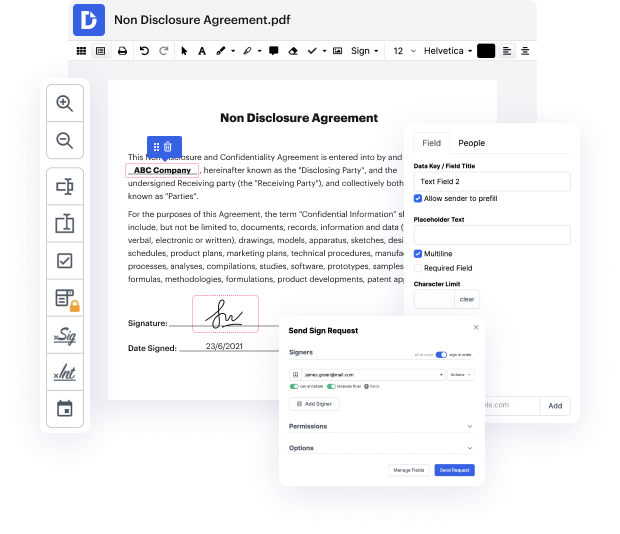
Document editing comes as an element of numerous occupations and jobs, which is the reason instruments for it must be accessible and unambiguous in their use. An advanced online editor can spare you a lot of headaches and save a substantial amount of time if you want to Compose columns contract.
DocHub is a great example of an instrument you can grasp in no time with all the useful features at hand. You can start modifying immediately after creating an account. The user-friendly interface of the editor will enable you to find and utilize any feature in no time. Notice the difference using the DocHub editor the moment you open it to Compose columns contract.
Simply follow these easy steps to get started on modifying your paperwork:
- Visit the DocHub site and click Sign up to create an account.
- Give your current email address and set up a password to complete the registration.
- Once finished with the registration, you will be forwarded to your dashboard. Select the New Document button to add the file you need to modify.
- Drag and drop the file from your gadget or link it from your cloud storage space.
- Open the file in the editor and utilize its toolbar to Compose columns contract.
- All of the changes in the document will be saved automatically. Upon completing the editing, simply go to your Dashboard or download the file on your gadget.
Being an important part of workflows, file editing should remain easy. Utilizing DocHub, you can quickly find your way around the editor and make the required alterations to your document without a minute wasted.
PDF editing simplified with DocHub






Drive efficiency with the DocHub add-on for Google Workspace
How to compose columns contract
uh hello there and welcome back to my new video in this video im going to show you how to use a columns and rows with a jetpack compose and in the previous video we have written our first composable function and now it is time to get introduced with some layout composables which will allow us to place its children in a vertical or a horizontal orientation now in the traditional view system we have a different kind of layouts like a linear layout constraint layout frame layout and so on while with the jetpack compose its a little different so the main layout composables that we have are a colon and row and those two composables are very similar to the linear layout which we have in our view system so a column composable function will add all its children composables in a vertical orientation while a row will add all its children composables in a horizontal orientation okay so enough theory lets see some practical examples so here i have created the one a simple project using a compo

Got questions?
How many types of layout are there in Android Studio?
What is the difference between surface and card in compose?
What is the basic of Jetpack Compose?
How do you create a layout in Jetpack Compose?
What is the difference between surface and card in compose?
What are the three basic standard layout elements in compose?
What is the difference between compose LazyColumn and Column?
What are the components of layout editor?
What is the difference between LazyRow and LazyColumn?
What is the difference between box and Column in Jetpack Compose?
See why our customers choose DocHub


Security and compliance
At DocHub, your data security is our priority. We follow HIPAA, SOC2, GDPR, and other standards, so you can work on your documents with confidence.
Learn more




