
Blend Paper For Free with DocHub and make the most of your documents




Blend Paper For Free easily
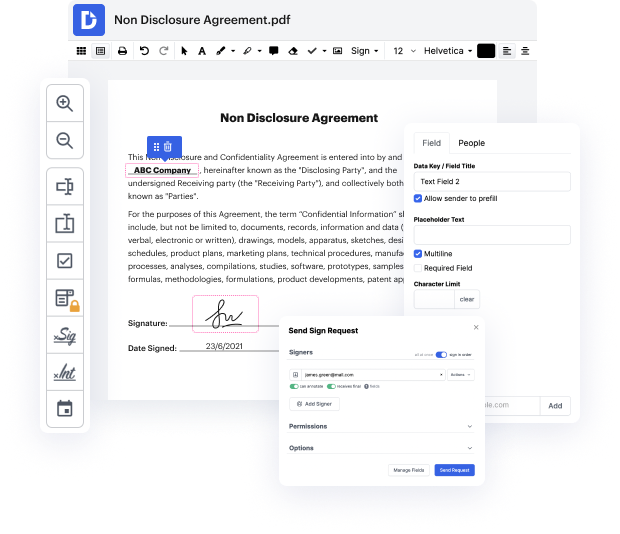
Contrary to popular belief, editing documents online can be hassle-free. Sure, some file formats might appear too challenging with which to work. But if you get the right solution, like DocHub, it's straightforward to modify any file with minimum effort. DocHub is your go-to tool for tasks as simple as the ability to Blend Paper For Free a single file or something as intimidating as processing a huge stack of complex paperwork.
Below, you can find six simple steps to get you up and running and Blend Paper For Free with DocHub:
- Head to to the upload page and select how you want to upload the file.
- You can start working on your file when you’re redirected to the editor.
- Find the required feature to Blend Paper For Free and use the undo option to revert unwanted changes.
- Take advantage of the features at the top of your editor to make your added file look neater, more organized, and more professional.
- Share your file with other parties or download it to your computer.
- Upload a different file and keep exploring DocHub’s capabilities.
When it comes to a tool for online file editing, there are many solutions available. However, not all of them are robust enough to accommodate the needs of people requiring minimum editing functionality or small businesses that look for more extensive set of features that allow them to collaborate within their document-based workflow. DocHub is a multi-purpose service that makes managing documents online more simplified and smoother. Sign up for DocHub now!
PDF editing simplified with DocHub






Drive efficiency with the DocHub add-on for Google Workspace
How to Blend Paper For Free
Welcome back, Im That Chemist, and today we have five important papers in organic synthesis for the month of December 2022. The first paper for today is a very important paper involving the haloboration of carbonyls. Some highlights of this paper include the conversion of aldehydes and ketones into -haloboronates. This involves the removal of the oxygen and the installation of both the halogen atom as well as a Bpin group. This is a two-step one-pot process that features an excellent scope. Additionally, the authors demonstrated that enantioselective conditions were possible. Now while this paper lacked an investigation into the mechanism, I would propose the following: first, B₂pin₂ is able to be installed under catalytic conditions with copper, this affords this -Bpin boronate; then, once a TMS halide is added, the TMS group is able to coordinate to the oxygen of the boronate, and this would make this into a better leaving group, and then the halide could displace this as a leavi

See why our customers choose DocHub


Security and compliance
At DocHub, your data security is our priority. We follow HIPAA, SOC2, GDPR, and other standards, so you can work on your documents with confidence.
Learn more