
Annotate break transcript easily


How to easily Annotate break transcript and enhance your workflow
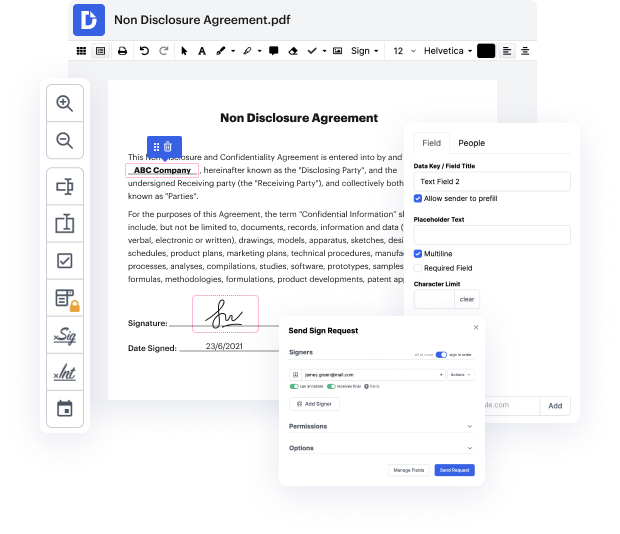
Document editing comes as a part of numerous professions and careers, which is the reason tools for it must be reachable and unambiguous in their use. A sophisticated online editor can spare you plenty of headaches and save a considerable amount of time if you have to Annotate break transcript.
DocHub is a great example of a tool you can grasp in no time with all the important features accessible. You can start editing instantly after creating your account. The user-friendly interface of the editor will help you to discover and make use of any function right away. Notice the difference using the DocHub editor the moment you open it to Annotate break transcript.
Simply follow these steps to start editing your documents:
- Go to the DocHub site and click Sign up to create an account.
- Provide your email address and set up a password to complete the signup.
- Once finished with the signup, you will be directed to your dashboard. Click the New Document button to add the file you need to edit.
- Drag and drop the document from your device or link it from your cloud storage space.
- Open the document in the editor and use its toolbar to Annotate break transcript.
- All the modifications in the document will be saved automatically. After completing the editing, simply go to your Dashboard or download the file on your device.
Being an important part of workflows, file editing must remain straightforward. Using DocHub, you can quickly find your way around the editor and make the necessary adjustments to your document without a minute lost.
PDF editing simplified with DocHub






Drive efficiency with the DocHub add-on for Google Workspace
How to annotate break transcript
Hello, my name is Marina DiStefano and Im a clinical molecular genetics fellow at Harvard, and a postdoc in the ClinGen Resource. This is part one of a three-part training series on transcript annotation and curation. Part 1 will discuss transcript annotation. This is an outline of the entire series. As I said, in this first part I will cover why transcript curation matters, citing examples from the hearing loss clinical domain. I will also provide an overview of transcript annotation bodies and their differences. Please continue on to part 2 for more discussion on transcript curation resources, and part 3 to hear about a specific transcript curation strategy that we deployed in the hearing loss domain. As many bio-curators already know, gene curation is required for variant curation. If a gene is not associated with disease, the effect of a variant on the gene cannot be determined. This is best represented by the graph on the left here, modified from Daniel MacArthur, with variant-l

See why our customers choose DocHub


Security and compliance
At DocHub, your data security is our priority. We follow HIPAA, SOC2, GDPR, and other standards, so you can work on your documents with confidence.
Learn more


