Create your US Legal Forms for Lien from scratch

Start Building Now
Title decoration

Here's how it works

01. Start with a blank US Legal Forms for Lien
Open the blank document in the editor, set the document view, and add extra pages if applicable.
02. Add and configure fillable fields
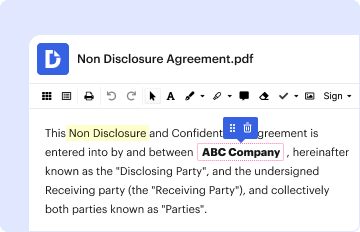
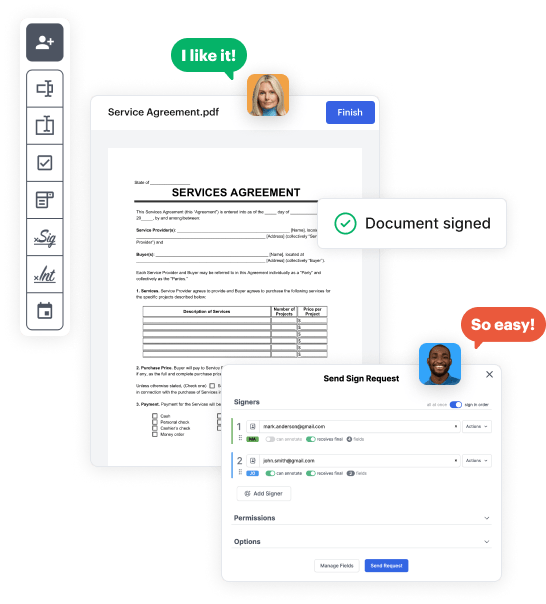
Use the top toolbar to insert fields like text and signature boxes, radio buttons, checkboxes, and more. Assign users to fields.
03. Distribute your form
Share your US Legal Forms for Lien in seconds via email or a link. You can also download it, export it, or print it out.

A detailed walkthrough of how to design your US Legal Forms for Lien online
Form edit decoration

Step 1: Start with DocHub's free trial.

Go to the DocHub website and sign up for the free trial. This provides access to every feature you’ll need to build your US Legal Forms for Lien without any upfront cost.

Step 2: Access your dashboard.

Log in to your DocHub account and go to the dashboard.

Step 3: Craft a new document.

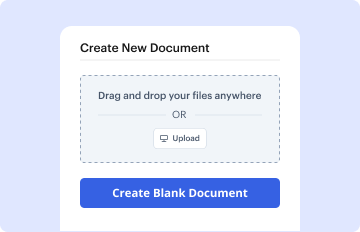
Click New Document in your dashboard, and select Create Blank Document to design your US Legal Forms for Lien from scratch.

Step 4: Utilize editing tools.

Insert different elements such as text boxes, radio buttons, icons, signatures, etc. Arrange these elements to match the layout of your document and designate them to recipients if needed.

Step 5: Organize the form layout.

Rearrange your document effortlessly by adding, moving, removing, or merging pages with just a few clicks.

Step 6: Create the US Legal Forms for Lien template.

Convert your freshly crafted form into a template if you need to send many copies of the same document multiple times.

Step 7: Save, export, or distribute the form.

Send the form via email, distribute a public link, or even post it online if you aim to collect responses from a broader audience.

be ready to get more

Build your US Legal Forms for Lien in minutes

Start creating now

Got questions?

We have answers to the most popular questions from our customers. If you can't find an answer to your question, please contact us.
Contact us
New York prohibits the waiving of lien rights prior to performance. Furthermore, waivers cannot be made in advance of payment, but only with, or after, payment. New York has no requirement that a lien waiver must be docHubd.
Generally, a written contract isnt required in California to be able to file a mechanics lien. The only exception is a design professional who must have a written contract with the property owner.
A lien expires 10 years from the date of recording or filing, unless we extend it. If we extend the lien, we will send a new Notice of State Tax Lien and record or file it with the county recorder or California Secretary of State. We will not release expired liens.
Specify the property or asset that was subject to the lien. Include details such as the address, make and model (if applicable), and any other relevant identifying information. Clearly state the reason for the lien release. This could be due to payment in full, a change in ownership, or any other applicable reason.
Small claims court allows you to sue a person, business, or government agency that you think owes you money. Generally, you can only sue for up to $12,500 in small claims court (or up to $6,250 if youre a business). You can ask a lawyer for advice before you go to court, but you cant have one with you in court.
be ready to get more

Build your US Legal Forms for Lien in minutes

Start creating now

Related Q&A to US Legal Forms for Lien

In California, if youre the person owed money (the creditor), you can place a judgment lien on the debtors real estate or personal property. How do you do this? You take or mail something called an Abstract of Judgment to the county recorders office.
Last updated July 24, 2024. If contractors and suppliers dont get paid on a construction project in New York, they can file a mechanics lien to secure payment. A mechanics lien is a legal tool that provides the unpaid party with a security interest in the property.
If you do not pay the judgment, the judgment creditor can garnish or seize your property. The judgment creditor can get an order that tells the Sheriff to take your personal property, like the money in your bank account or your car, to pay the judgment.

Additional resources on building your forms