Manage Foreign Judgments easily online

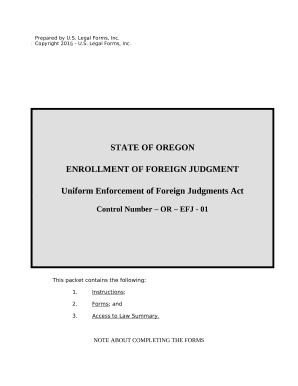
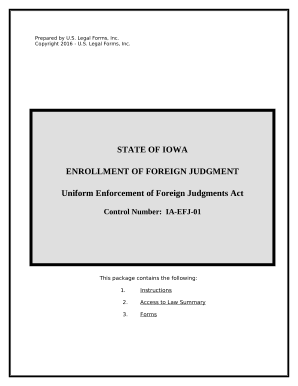
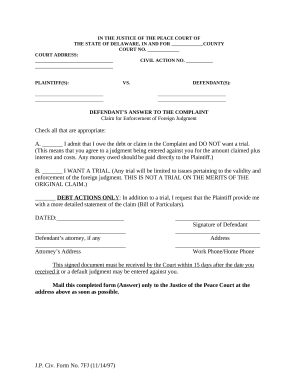
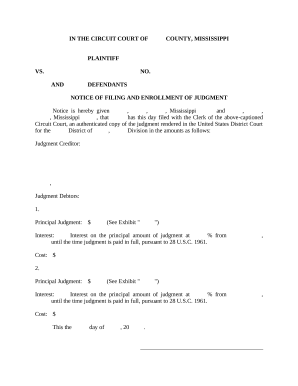
Document managing can overwhelm you when you can’t find all of the forms you need. Luckily, with DocHub's extensive form collection, you can discover everything you need and easily take care of it without switching among programs. Get our Foreign Judgments and begin utilizing them.

Using our Foreign Judgments using these simple steps:

  1. Check Foreign Judgments and choose the form you need.
  2. Preview the template and then click Get Form.
  3. Wait for it to open in the online editor.
  4. Change your form: include new information and images, and fillable fields or blackout some parts if required.
  5. Fill out your form, conserve modifications, and prepare it for delivering.
  6. When ready, download your form or share it with other contributors.

Try out DocHub and browse our Foreign Judgments category with ease. Get a free profile today!

Video Guide on Foreign Judgments management

video background

Commonly Asked Questions about Foreign Judgments

To enforce a foreign judgment in Mexico, several regulations must be complied with. The most important of which is the Federal Constitution, which grants constitutional status to international treaties that Mexico has ratified and are in force, ing to its Article 133.
An exemplified judgment is a copy of the judgment to which a certificate has been attached and signed in three places, once by the judge and twice by the clerk, attesting to the authenticity and validity of the judgment.
Enforcement of a Foreign Judgment in the U.S. Under U.S. law, an individual seeking to enforce a foreign judgment, decree or order in this country must file suit before a competent court. The court will determine whether to recognize and enforce the foreign judgment.
The Act has been enacted by all states with the exception of California and Vermont, plus the District of Columbia, U.S. Virgin Islands, and Puerto Rico.
A foreign judgment is any judgment of a court of any other state in the United States in a civil action which was not obtained by default in appearance or by confession of judgment.
Recent cases in China, coupled with the 2023 amendments to the Civil Procedure Law, suggest that US judgments are generally enforceable in China under the principle of reciprocity. Chinas amended Civil Procedure Law provides clearer criteria for enforcing foreign judgments, including those from the US.
Every state is required to enforce judgments from any other state. Its because of the full faith in credit clause in the Constitution. Theres no such thing as a full faith in credit clause worldwide. Japan, England, France, Germany, China, Italy, are not required to enforce U.S. judgments.
The United States has formal diplomatic relations with most nations. This includes all United Nations members and observer states other than Bhutan, Iran, North Korea and Syria, and the UN observer Territory of Palestine. Additionally, the U.S. has diplomatic relations with Kosovo and the European Union.