Create your Easement Legal Form from scratch

Start Building Now
Title decoration

Here's how it works

01. Start with a blank Easement Legal Form
Open the blank document in the editor, set the document view, and add extra pages if applicable.
02. Add and configure fillable fields
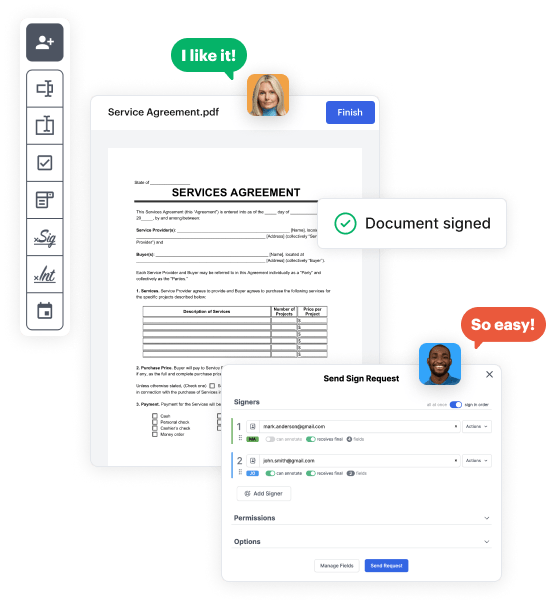
Use the top toolbar to insert fields like text and signature boxes, radio buttons, checkboxes, and more. Assign users to fields.
03. Distribute your form
Share your Easement Legal Form in seconds via email or a link. You can also download it, export it, or print it out.

A detailed walkthrough of how to design your Easement Legal Form online
Form edit decoration

Step 1: Start with DocHub's free trial.

Visit the DocHub website and sign up for the free trial. This provides access to every feature you’ll need to create your Easement Legal Form without any upfront cost.

Step 2: Access your dashboard.

Log in to your DocHub account and go to the dashboard.

Step 3: Initiate a new document.

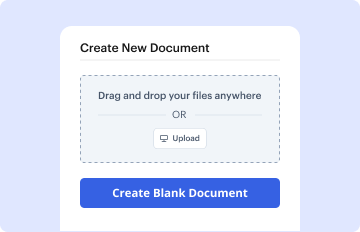
Click New Document in your dashboard, and choose Create Blank Document to create your Easement Legal Form from the ground up.

Step 4: Utilize editing tools.

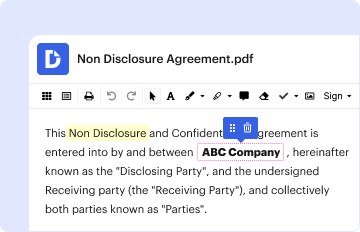
Add various fields such as text boxes, radio buttons, icons, signatures, etc. Arrange these elements to suit the layout of your document and assign them to recipients if needed.

Step 5: Organize the form layout.

Organize your document quickly by adding, repositioning, removing, or combining pages with just a few clicks.

Step 6: Set up the Easement Legal Form template.

Convert your freshly designed form into a template if you need to send many copies of the same document multiple times.

Step 7: Save, export, or share the form.

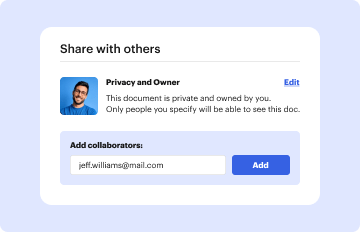
Send the form via email, share a public link, or even publish it online if you want to collect responses from a broader audience.


be ready to get more

Build your Easement Legal Form in minutes

Start creating now

Got questions?

We have answers to the most popular questions from our customers. If you can't find an answer to your question, please contact us.
Contact us
4 Types of Easements Express Easements. Implied Easement by Existing Use. Easement by Necessity. Prescriptive Easement.
Common examples of easement by implication are: Utility companies need to layout an access road to service power lines crossing over private property.
Include all relevant information Identify the existing property and the proposed easement. Specify what type of easement is being created (e.g. right of way, access, etc.) Include the legal description of the easement. Specify the duration of the easement (e.g. 20 years, in perpetuity, etc.)
Implied Easement Elements​ There must be a common ownership of a parcel and a transfer or conveyance of one parcel, or a portion of a parcel, to another. Prior to the division of title, there must have been an existing obvious, and apparently permanent, use of the quasi-easement by the common owner.
Execution: The Easement must be executed on behalf of both the Grantor and the Grantee, and all signatures must be acknowledged by a Notary Public. Recording: The Easement must be recorded in the Office of the County Recorder of the county in which the Land is located.
be ready to get more

Build your Easement Legal Form in minutes

Start creating now

Related Q&A to Easement Legal Form

An easement is a right to use anothers land or prevent another from a particular use of the owners land. Thus, an owner cannot hold an easement over their own land. [ Calif. Civil Code 805] Only the division of commonly owned parcels by the transfer of a parcel triggers the creation of an implied easement.
An example of an implied easement is when one owner uses a dirt road over a neighbors property to access a lake for years. There is no express permission or grant of that right, but it is implied that there is an easement to access the lake by the conduct of the parties.

Additional resources on building your forms