




01. Edit your form online
Type text, add images, blackout confidential details, add comments, highlights and more.

Type text, add images, blackout confidential details, add comments, highlights and more.

Draw your signature, type it, upload its image, or use your mobile device as a signature pad.

Send it via email, link, or fax. You can also download it, export it or print it out.
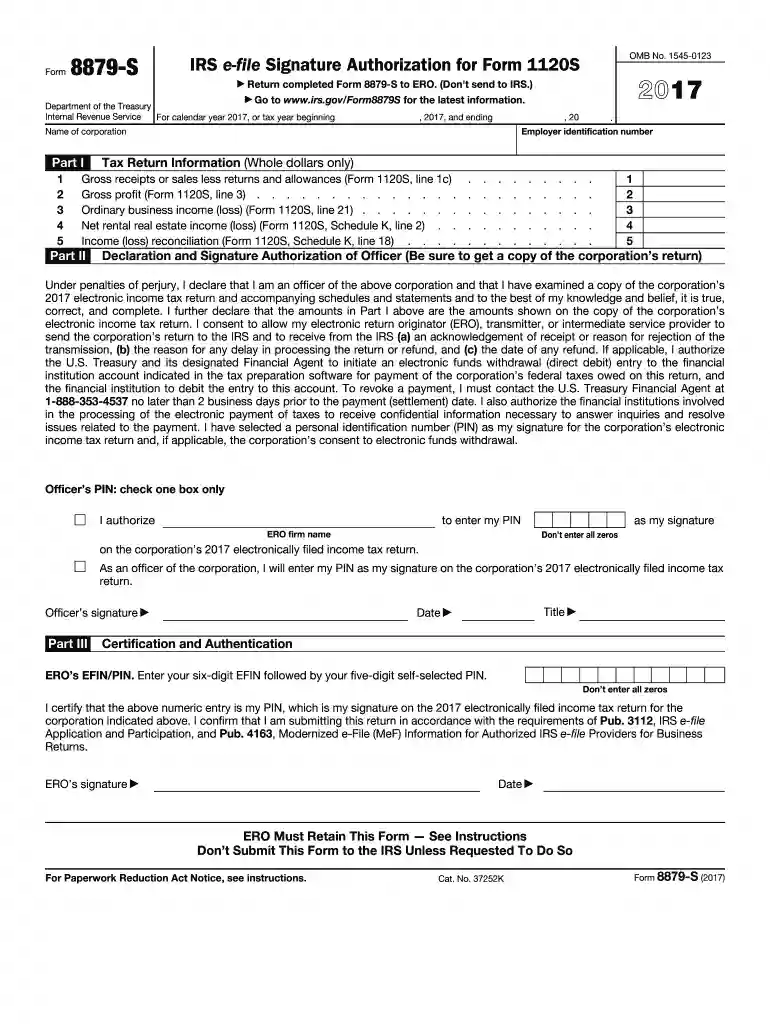
Form 8879, specifically for the year 2017, is known as the IRS e-file Signature Authorization form. This form permits taxpayers to authorize an electronic return originator (ERO) to file their federal tax returns electronically. By doing so, the taxpayer validates the use of a personal identification number (PIN) as their electronic signature. This authorization is critical as it replaces the traditional paper signature, making the e-filing process more efficient and streamlined. The form primarily seeks to ensure that both the taxpayer and the ERO acknowledge the accuracy and completeness of the submitted information.
Obtain the Form: Initially, access the 2017 version of Form 8879. This can be typically downloaded from the IRS website or acquired through a tax preparation software that incorporates prior year forms.
Enter Personal Information: Fill in your name and social security number accurately to ensure proper identification.
Review Tax Return Information: The form requires specific figures from your tax return, namely the Adjusted Gross Income (AGI) and the total tax. Double-check these numbers against your tax return documents.
Assign a PIN: Choose a personal identification number that will serve as your electronic signature. This number can be between five to ten digits, and it acts as your electronic signature for the e-filing process.
Taxpayer Declaration: Read the declaration carefully and sign the form. This signature certifies that the return is true, correct, and complete.
ERO Signature: The Electronic Return Originator must also sign the form, confirming their role in the preparation and submission of the tax return.
Submission to ERO: Once completed, deliver the form back to the ERO holding the form for recordkeeping. Note that it is not filed with the IRS.
Efficiency: This process expedites the filing of your tax returns as it allows electronic submission, reducing the time spent waiting for paper processing.
Reduced Errors: Digital submissions often encounter fewer errors due to built-in checks. Form 8879 authorizes the use of systems that help catch discrepancies before submission.
Environmental Benefits: By opting for e-filing, you contribute to environmental conservation efforts by reducing paper use.
Security: Form 8879 incorporates security measures, such as encryption and PIN usage, ensuring the confidentiality and integrity of your personal information.
Individuals who opt to file their tax returns electronically typically use Form 8879. Specifically, it is utilized by taxpayers who work with an Electronic Return Originator (ERO) to prepare and file their returns. This can include a wide variety of individuals such as self-employed workers, business owners, or anyone engaging a tax professional for assistance. It is particularly advantageous for those looking for a more efficient and error-reduced tax-filing experience.
The IRS has outlined specific guidelines for the use of Form 8879. Importantly, the form must be completed and signed before the electronic transmission of the tax return. The IRS mandates that both the taxpayer and the ERO retain copies of the signed Form 8879 for a predetermined period, typically three years, as part of recordkeeping responsibilities. Compliance with these IRS guidelines is crucial, as failure to do so can lead to complications or penalties.
Form 8879 is primarily associated with electronically filed tax returns; hence, its submission is not directly done to the IRS but retained by the ERO. The form itself is completed and returned to the ERO for their records. Tax returns facilitated by Form 8879 are usually submitted online through electronic filing systems, reducing the cumbersome nature of physical mailing processes.
The legal framework around Form 8879 emphasizes the lawfulness of using electronic systems for federal tax return submissions. The form, accompanied by the chosen PIN, serves as a legally binding signature under the ESIGN Act. By completing and signing the form, the taxpayer confirms the completeness and accuracy of the tax information shared, thereby acknowledging responsibility for the data provided.
We've got more versions of the form 8879 2017 form. Select the right form 8879 2017 version from the list and start editing it straight away!
| Versions | Form popularity | Fillable & printable |
|---|---|---|
| 2021 | 4.8 Satisfied (164 Votes) | |
| 2020 | 4.4 Satisfied (182 Votes) | |
| 2019 | 4.1 Satisfied (72 Votes) | |
| 2018 | 4.3 Satisfied (133 Votes) | |
| 2017 | 4.2 Satisfied (110 Votes) | |
| 2016 | 4.4 Satisfied (139 Votes) | |
| 2015 | 4 Satisfied (51 Votes) | |
| 2014 | 4 Satisfied (26 Votes) | |
| 2013 | 4.1 Satisfied (46 Votes) | |
| 2012 | 4 Satisfied (49 Votes) | |
| 2011 | 4 Satisfied (49 Votes) |
At DocHub, your data security is our priority. We follow HIPAA, SOC2, GDPR, and other standards, so you can work on your documents with confidence.
Complete Form 8879 when the Practitioner. PIN method is used or when the taxpayer authorizes the ERO to enter or generate the taxpayers personal identificationRead more
Jun 15, 2022 If you are going to make an electronic funds withdrawal (direct debit) with this Form 8868, see Form 8453-EO and Form 8879-EO for payment.Read more


