




01. Edit your form 8879 vs 1040 online
Type text, add images, blackout confidential details, add comments, highlights and more.

Type text, add images, blackout confidential details, add comments, highlights and more.

Draw your signature, type it, upload its image, or use your mobile device as a signature pad.

Send 8879 vs 1040 via email, link, or fax. You can also download it, export it or print it out.
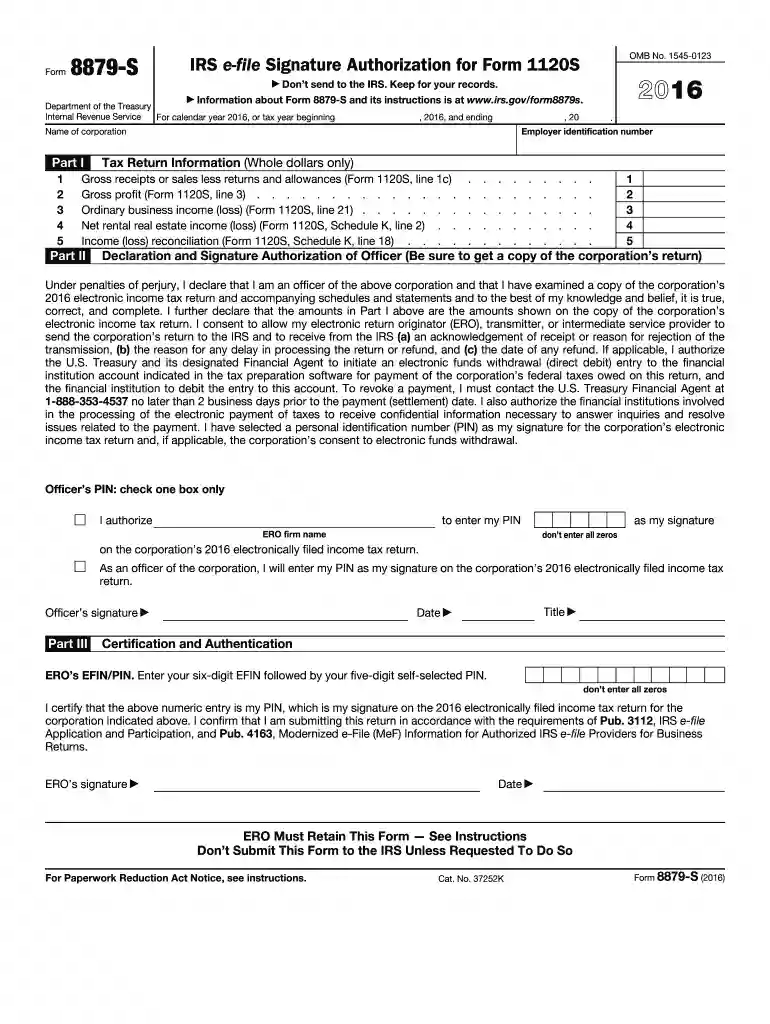
Form 8879, also known as the IRS e-file Signature Authorization, is a crucial document that allows taxpayers to authorize an electronic return originator (ERO) to electronically file income tax returns. The 2016 version specifically applies to tax filing for that year and must be retained by the ERO for record-keeping. This form is not submitted to the IRS but serves as an internal record confirming the taxpayer's consent.
To correctly utilize Form 8879 within your tax process, a taxpayer must first complete their tax return and then compute the return information that will appear on the form. An ERO will explain how to properly review each section of the form, which includes verifying the accuracy of entries such as the adjusted gross income and total tax liability. After thorough verification, the taxpayer and the ERO sign the form, confirming authorization for electronic tax return filing.
Accessing Form 8879 for the 2016 tax year can be easily managed through several channels. Taxpayers can download the form directly from the IRS website, ensuring the latest version is being used. Alternatively, reaching out to a certified tax professional or your ERO can supply you with a hard or digital copy of the form. Collecting this form in advance allows ample time for gathering required information and signatures.
Form 8879 is primarily utilized by taxpayers engaging in the process of filing U.S. federal tax returns electronically for the tax year 2016. This includes individuals, businesses, or entities employing an ERO to manage electronic filing processes. The form is essential for anyone intending to leverage the speed and convenience of electronic tax filing but is particularly significant for those with complex tax situations requiring professional assistance.
Form 8879 is governed by laws regarding electronic filings, underpinned by the ESIGN Act. It is a legally binding document once signed, ensuring both parties understand the responsibilities and implications of electronic tax return submission. Non-compliance, such as failure to retain the form, could lead to issues in case of an audit or enquiry by tax authorities.
The IRS outlines specific guidelines for retaining Form 8879, mandating the form be kept securely by the ERO for a period of three years from the return's due date. Taxpayers are advised to work closely with their EROs to ensure all entries are accurate and verified, as the IRS relies on these forms for verifying the authenticity of electronic filings. Adhering to these practices reduces potential errors and mitigates compliance risks.
While Form 8879 is a federal document, state tax authorities may have additional requirements for electronic filing processes. Taxpayers must verify whether their state has specific forms analogous to Form 8879 for state tax compliance. Alignment with both federal and state regulations ensures a comprehensive approach to e-filing without lapses in cross-jurisdictional requirements.
By meticulously following the steps and guidelines associated with Form 8879 for the 2016 tax year, taxpayers can efficiently authorize and execute their electronic returns, reaping the benefits of a streamlined filing process while ensuring robust compliance.
We've got more versions of the form 8879 vs 1040 form. Select the right form 8879 vs 1040 version from the list and start editing it straight away!
| Versions | Form popularity | Fillable & printable |
|---|---|---|
| 2021 | 4.8 Satisfied (164 Votes) | |
| 2020 | 4.4 Satisfied (182 Votes) | |
| 2019 | 4.1 Satisfied (72 Votes) | |
| 2018 | 4.3 Satisfied (133 Votes) | |
| 2017 | 4.2 Satisfied (110 Votes) | |
| 2016 | 4.4 Satisfied (139 Votes) | |
| 2015 | 4 Satisfied (51 Votes) | |
| 2014 | 4 Satisfied (26 Votes) | |
| 2013 | 4.1 Satisfied (46 Votes) | |
| 2012 | 4 Satisfied (49 Votes) | |
| 2011 | 4 Satisfied (49 Votes) |
At DocHub, your data security is our priority. We follow HIPAA, SOC2, GDPR, and other standards, so you can work on your documents with confidence.
Apr 1, 2019 (Whole Dollars Only). Check the box for the return for which you are using this Form 8879-EO and enter the applicable amount, if any,Read more
Beginning in 2017, you can use Form 8879 to e-file your 2016 Form 1040NR, U.S.. Nonresident Alien Income Tax Return. Purpose of Form. Form 8879 is theRead more
Check the box for the return for which you are using this Form 8879-TE and enter the applicable amount, if any, from the return. Form 8038-CP and.Read more


