




01. Edit your 8916 a online
Type text, add images, blackout confidential details, add comments, highlights and more.

Type text, add images, blackout confidential details, add comments, highlights and more.

Draw your signature, type it, upload its image, or use your mobile device as a signature pad.

Send form 8916 via email, link, or fax. You can also download it, export it or print it out.
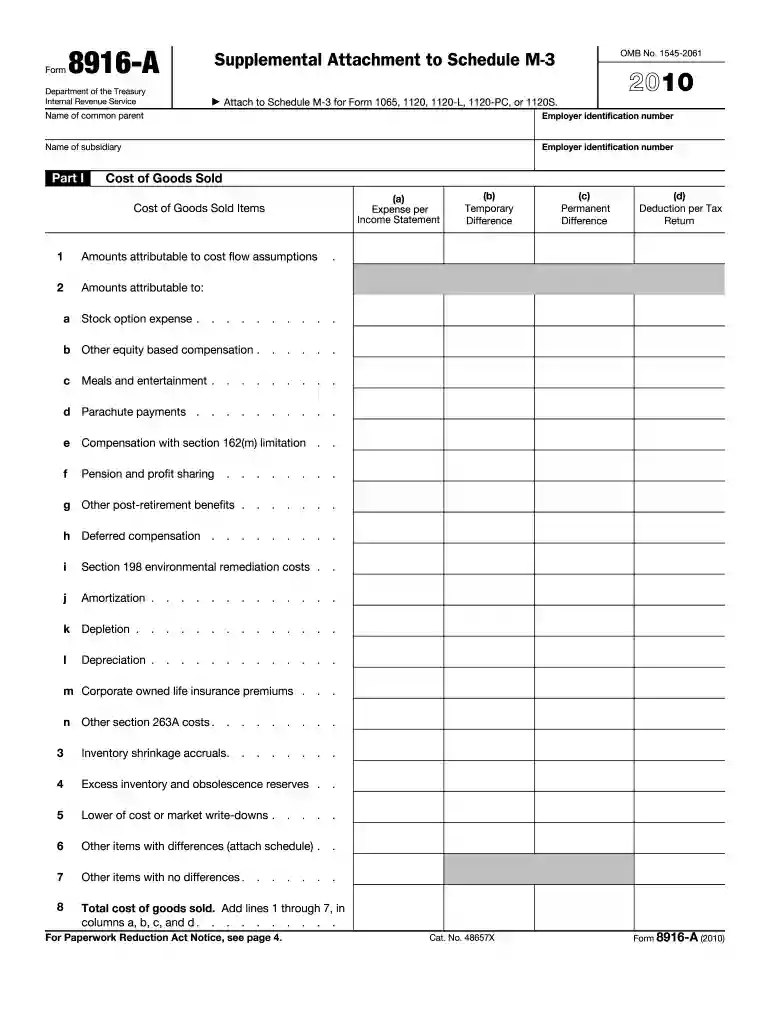
Form 8916-A for 2010 is designed as a supplemental attachment to Schedule M-3, which is part of the U.S. Internal Revenue Service (IRS) tax reporting requirements. This form is specifically used to provide detailed schedules of cost of goods sold, interest income, and interest expense. Entities required to file Schedule M-3 utilize Form 8916-A to ensure compliance with the Internal Revenue Code's stipulations by reporting the differences between book and tax amounts. This level of detail is essential for meeting the IRS's transparency and reporting standards.
When preparing Form 8916-A, it is crucial to accurately detail all relevant financial information that supports submissions on Schedule M-3. The form requires entities to:
Preparation of this form often requires collaboration between accountants and financial officers to gather and verify the necessary data, ensuring all corporate financial dealings are transparently reported to the IRS.
Completing Form 8916-A involves several detailed steps:
Understanding key terms related to Form 8916-A can enhance the accuracy of its completion:
Familiarity with these terms is essential for completing the form accurately.
The IRS provides explicit guidelines for completing Form 8916-A, emphasizing transparency and consistency. These guidelines ensure that all financial figures reported on the tax forms match the corporation's accounting records. Taxpayers are advised to refer to the IRS instructions when completing the form to avoid discrepancies that could lead to audits or penalties.
For the tax year 2010, Form 8916-A should be filed alongside Schedule M-3 and other related tax documentation by the corporate tax filing deadline. Typically, this deadline falls on March 15 for calendar-year corporations. Extensions can be requested, but the basic form must be submitted by the conventional deadline to avoid any potential late filing penalties.
Completing Form 8916-A necessitates various supporting documents:
Having these documents organized and available will streamline the completion of Form 8916-A and verify the accuracy of the reported amounts.
Non-compliance with the requirements associated with Form 8916-A can result in significant penalties. These may include:
Being diligent and timely in filing this form helps in avoiding these penalties.
Form 8916-A is predominantly used by corporations that are required to file Schedule M-3 with their tax return. This includes large corporations, typically those with total assets greater than $10 million, ensuring transparency in financial reporting. These organizations fill out the form to provide a detailed reconciliation of financial reports and tax submissions, helping maintain compliance with the IRS.
There are several ways to submit Form 8916-A:
Choosing the submission method that complements existing workflows is crucial for efficient tax filing.
We've got more versions of the 8916 a form. Select the right 8916 a version from the list and start editing it straight away!
| Versions | Form popularity | Fillable & printable |
|---|---|---|
| 2019 | 4.8 Satisfied (103 Votes) | |
| 2018 | 4.3 Satisfied (151 Votes) | |
| 2017 | 4.3 Satisfied (285 Votes) | |
| 2016 | 4.4 Satisfied (639 Votes) | |
| 2015 | 4.2 Satisfied (58 Votes) | |
| 2014 | 4.4 Satisfied (68 Votes) | |
| 2013 | 4.2 Satisfied (52 Votes) | |
| 2012 | 4 Satisfied (27 Votes) | |
| 2011 | 4.1 Satisfied (26 Votes) | |
| 2010 | 4 Satisfied (22 Votes) |
At DocHub, your data security is our priority. We follow HIPAA, SOC2, GDPR, and other standards, so you can work on your documents with confidence.
Use of form: Completion of this form is required before a claim for foster parent insurance (s. 48.627) can be made to the department. The.
Use Form 8916-A to provide a detailed schedule of the amounts reported on the applicable Schedule M-3 for cost of goods sold, interest income and interestRead more


