




01. Edit your form online
Type text, add images, blackout confidential details, add comments, highlights and more.

Type text, add images, blackout confidential details, add comments, highlights and more.

Draw your signature, type it, upload its image, or use your mobile device as a signature pad.

Send it via email, link, or fax. You can also download it, export it or print it out.
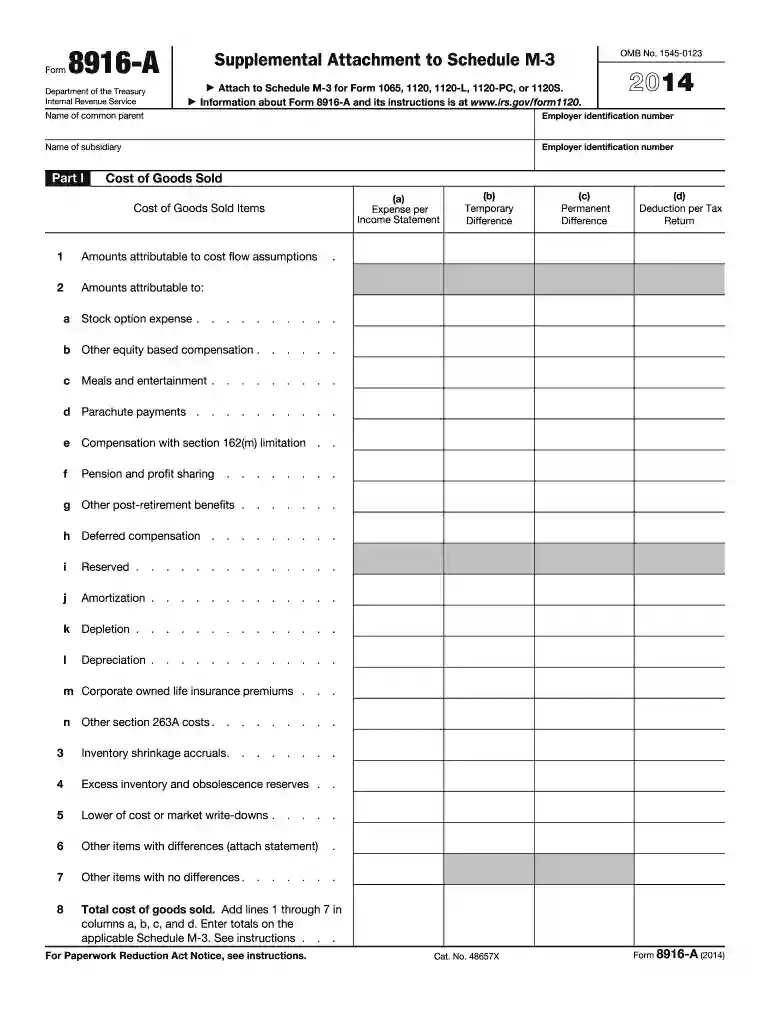
Schedule M-3 (Form 1120-L) is a tax form used by insurance companies filing Form 1120-L, U.S. Life Insurance Company Income Tax Return, to reconcile net income outlined on financial statements with taxable income reported to the IRS. It highlights discrepancies between financial accounting and tax reporting to ensure transparency and compliance with tax laws. By using Schedule M-3, companies provide a detailed breakdown of revenue and expenses, offering a clear view of taxable income divergences.
The instructions for Schedule M-3 (Form 1120-L) guide users through completing the form accurately. These instructions detail each line item on the schedule, explaining what information is required and how it should be reported. They include definitions of terms, calculation methods, and examples for clarity. Users are advised to follow each step methodically to capture all necessary information and ensure compliance with IRS requirements.
The instructions are critical for accurately filling out Schedule M-3, ensuring compliance with federal tax regulations. Following the guidance helps prevent errors that could lead to audits or penalties. Proper use of these instructions aids companies in presenting transparent financial records to the IRS, demonstrating diligence and accuracy in tax reporting.
Primarily, life insurance companies subject to federal taxation under Form 1120-L utilize these instructions. Accountants and tax professionals specializing in corporate insurance taxation also rely on this guide to assist their clients. Typically, larger corporations with complex financial statements benefit most from the detailed reconciliation process provided by Schedule M-3.


The IRS guidelines embedded within the instructions outline how to report specific figures and the legal parameters surrounding tax adjustments. These include the accounting standards companies must adhere to and acceptable methods for reporting discrepancies between book and taxable income.
Adhering to filing deadlines is crucial to avoid penalties. Schedule M-3 is due with Form 1120-L by the 15th day of the fourth month following the end of the tax year. For calendar year filers, this typically means an April 15 deadline.
To complete Schedule M-3 accurately, you must prepare the following:
Failure to properly complete and file Schedule M-3 can lead to significant penalties, such as fines for underreporting income or failing to reconcile discrepancies. The IRS may assess accuracy-related penalties or other sanctions, depending on the nature and severity of the filing error.
Although Schedule M-3 (Form 1120-L) is specifically for life insurance companies filing as corporations, understanding other business types aids tax professionals in comprehending their clients' diverse needs. Each business entity type may have different obligations regarding tax reconciliation.
The choice between digital and paper submission can impact the ease of completing Schedule M-3. Digital versions allow for more efficient data entry and submission, often providing error checks. However, some companies may prefer filing paper documents for traditional record-keeping practices.
We've got more versions of the Instructions for Schedule M-3 (Form 1120-L) (2017 ... - IRS.gov form. Select the right Instructions for Schedule M-3 (Form 1120-L) (2017 ... - IRS.gov version from the list and start editing it straight away!
| Versions | Form popularity | Fillable & printable |
|---|---|---|
| 2019 | 4.8 Satisfied (103 Votes) | |
| 2018 | 4.3 Satisfied (151 Votes) | |
| 2017 | 4.3 Satisfied (285 Votes) | |
| 2016 | 4.4 Satisfied (639 Votes) | |
| 2015 | 4.2 Satisfied (58 Votes) | |
| 2014 | 4.4 Satisfied (68 Votes) | |
| 2013 | 4.2 Satisfied (52 Votes) | |
| 2012 | 4 Satisfied (27 Votes) | |
| 2011 | 4.1 Satisfied (26 Votes) | |
| 2010 | 4 Satisfied (22 Votes) |
At DocHub, your data security is our priority. We follow HIPAA, SOC2, GDPR, and other standards, so you can work on your documents with confidence.
Schedule M-3, Part I, asks certain questions about the corporations financial statements and reconciles financial statement net income (loss) for theRead more
Apr 15, 1976 Increased section 179 deduction dollar limits. The maximum amount you can elect to deduct for most sec- tion 179 property you placed inRead more
Under penalties of perjury, I declare that I have examined this return, including accompanying schedules and statements, and to the best of my knowledge.


