
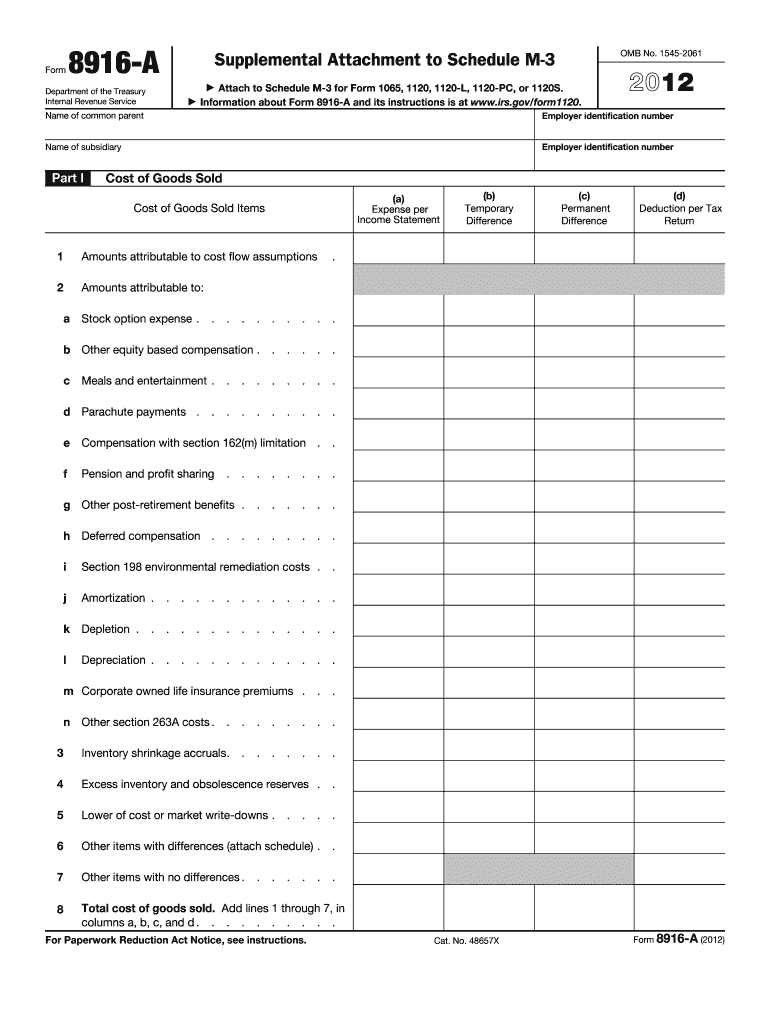







Understanding Form 8916-A
Form 8916-A serves as a supplemental document to Schedule M-3 for certain tax forms, primarily used by corporations to provide detailed breakdowns of cost of goods sold, interest income, and reporting discrepancies between financial and tax accounting methods. This form plays a crucial role in ensuring transparency and compliance with IRS requirements by elucidating the differences between reported financial income and taxable income as per the IRS guidelines.
How to Use Form 8916-A
When preparing Form 8916-A, you'll need to report discrepancies in financial versus tax accounting for cost of goods sold, interest income, and similar items. Completing this form typically involves:
- Collecting detailed financial data relevant to the listed items.
- Segregating information into multiple categories as prescribed by the form instructions.
- Reviewing for consistency, ensuring all reported figures match corresponding entries in other tax forms.
- Cross-referencing with Schedule M-3 to maintain accurate reporting across all required schedules.
Obtaining Form 8916-A
Form 8916-A is available directly from the IRS website in PDF format for easy download. It is also accessible through most tax preparation software platforms such as TurboTax or QuickBooks, which guide users through the completion process. Ensure you are obtaining the correct version that matches your filing year, in this case, 2012.
Step-by-Step Guide to Completing Form 8916-A
To properly complete Form 8916-A, follow these steps:
- Identify Necessary Documents: Gather your company's financial statements and previous tax returns to ensure accuracy.
- Complete Section 1: Fill in information specific to cost of goods sold, ensuring figures align with related declarations in Schedule M-3.
- Proceed to Section 2: Record details related to interest income and other income sources as outlined by the form, cross-referencing with your financial statements.
- Validate Your Entries: Double-check all figures for consistency with other parts of your tax return to avoid discrepancies.
- Review Instructions: Ensure compliance by closely adhering to the IRS instructions specific to Form 8916-A.
Importance of Using Form 8916-A
The use of Form 8916-A is vital for certain businesses required to file Schedule M-3, as it provides an essential level of detail that supports the reconciliation of financial and taxable income. Ensuring accuracy in reporting aids in reducing the risk of audits and potential penalties from discrepancies.
Who Typically Utilizes Form 8916-A?
Form 8916-A is predominantly used by corporate taxpayers who file Schedule M-3, those with complex financial structures, or entities undergoing significant financial transactions that require thorough accounting disclosures and reconciliations. Typically this includes large corporations and companies with international operations or multiple divisions.
Legal Compliance and Form 8916-A
Filing Form 8916-A is mandatory for entities obligated to submit Schedule M-3, following specific IRS guidelines. Non-compliance or inaccurate submission may result in penalties. Corporations are advised to maintain meticulous records to support the entries declared within the form.
Essential Elements of Form 8916-A
The critical components of Form 8916-A include:
- Cost of Goods Sold (COGS): Detailed schedules explaining inventory and expense allocations.
- Interest Income and Expenses: Clarity in the income and expenses related to interest, featuring a breakdown of any deviances in tax versus financial reporting.
- Reporting Discrepancies: Specific entries highlighting differences between your financial and IRS tax reporting methodologies.
Illustrative Scenarios and Form 8916-A
Consider a multinational corporation reporting sales across multiple jurisdictions. Accurate reporting through Form 8916-A becomes indispensable in reflecting the company's cost of goods sold discrepancies arising from currency exchanges or international tariff applications. Each entry plays a role in forming a comprehensive view of the company's taxable landscape as seen through the IRS's lens.
By understanding and meticulously completing Form 8916-A, corporations can ensure adherence to tax regulations, thus securing timely processing and evaluation of their filings while minimizing risks associated with non-compliance.




