






Definition & Meaning
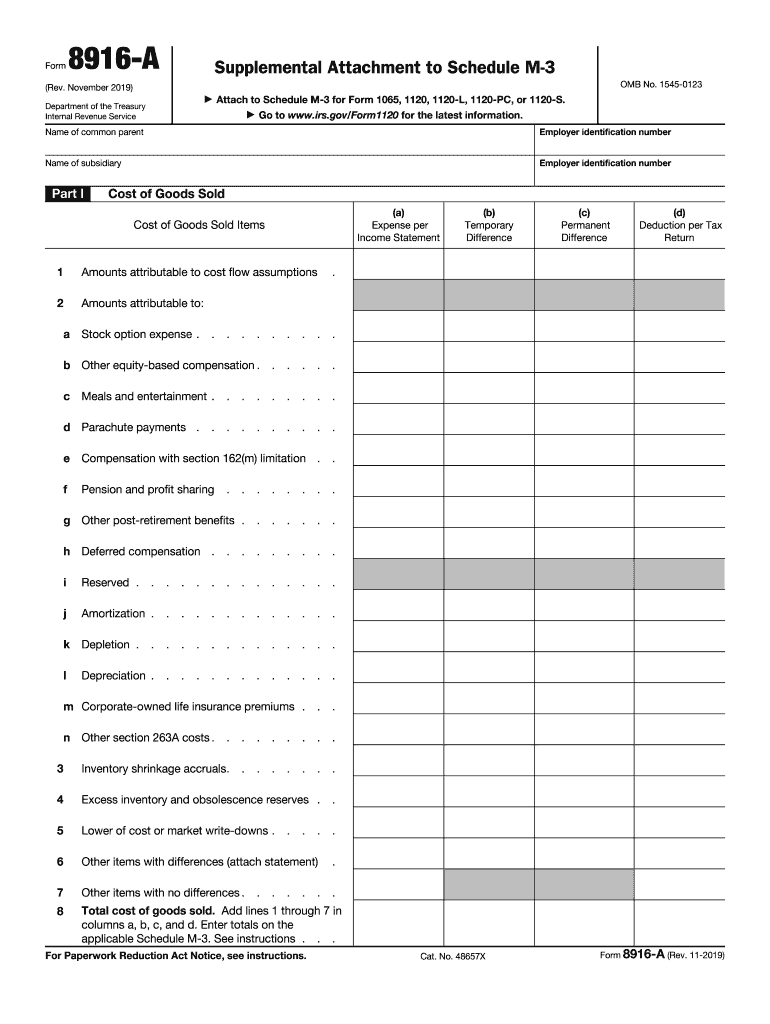
The federal Form 8916 is officially known as "Form 8916-A," which serves as a supplemental attachment to Schedule M-3 for certain tax forms in the United States. This form is specifically designed to provide a detailed account of specific financial items such as cost of goods sold, interest income, and interest expense. Its primary function is to ensure compliance with Internal Revenue Service (IRS) regulations, helping businesses accurately report their tax obligations. This documentation is critical for entities that need to present a nuanced financial breakdown in their tax filings, particularly for those using the Schedule M-3.
How to Use Form 8916
To properly utilize Form 8916, businesses are required to include it when filing tax returns necessitating Schedule M-3. Here’s a structured process for its use:
-
Preparation: Collect detailed records of your financial transactions that fall under the categories needed for Form 8916, such as cost of goods sold and interest-related items.
-
Filling Out the Form: Enter the collated data into the corresponding sections of the form, ensuring accuracy and adherence to IRS guidelines.
-
Submission: Attach the completed Form 8916 alongside your Schedule M-3 to the main tax return submission. Ensure all figures align with the primary form to avoid discrepancies.
Using this form correctly ensures that your tax reporting is comprehensive and meets legal requirements, reducing potential audit risks.
Steps to Complete the Federal 8916
Completing Form 8916 involves several detailed steps:
-
Gathering Necessary Documents: Compile all financial records relating to the cost of goods sold, interest income, and related expenses.
-
Understanding Each Section: Familiarize yourself with each section of the form to ensure correct data entry. This includes delineations for direct costs, indirect costs, and various financial incomes and expenses.
-
Accurate Data Entry: Begin entering data into the required sections. Each entry should be meticulously checked for accuracy to avoid errors.
-
Review and Verification: Post-entry, review all data thoroughly. Cross-verify with primary financial statements and Schedule M-3 to ensure consistency.
-
Final Check: Ensure all information complies with IRS instructions and guidelines.
Completing these steps thoroughly will help in submitting a precise and valid Form 8916.
Key Elements of the Federal 8916
The Form 8916 includes several crucial elements necessary for comprehensive tax filing:
-
Cost of Goods Sold: This includes all expenses directly associated with the production of goods sold by the business.
-
Interest Income and Expenses: Detailed breakdowns of income generated through interest and the expenses incurred through interest payments.
-
Other Specific Financial Data: Any other relevant financial transactions that are necessary for full disclosure and compliance with IRS requirements.
These elements are crucial for a business’s financial transparency in its tax submission process.
Why Should You Use Form 8916
Utilizing Form 8916 is crucial for entities requiring detailed financial schedules to support their tax documents. It ensures:
-
Compliance: Aligns with IRS requirements, helping avoid penalties or audits.
-
Accuracy: Enables a detailed breakdown of critical financial categories, improving the accuracy of tax filings.
-
Transparency: Provides clear insight into specific financial activities within the organization.
This form is an essential tool for maintaining strict adherence to federal tax laws.
Filing Deadlines / Important Dates
Filing deadlines for Form 8916 align with those for submitting the main tax return. It’s imperative to check:
-
Due Date: Generally the same as the corporate tax return, often March 15 for calendar-year taxpayers.
-
Extension Options: Businesses may file for an extension to allow more time for completion, typically extending the deadline by six months.
Staying aware of these dates ensures timely and compliant filing of your tax documents.
Who Typically Uses the Federal 8916
Form 8916 is predominantly used by:
-
Corporations: Large corporations filing Schedule M-3 to provide granular financial data.
-
Businesses with Complex Financial Structures: Entities with extensive inventories and diverse financial activities.
-
Tax Professionals: Accountants or tax preparers handling comprehensive tax filings needing detailed financial entries.
These users benefit the most from the detailed financial reporting capabilities of Form 8916.


Penalties for Non-Compliance
Failure to properly file Form 8916 can result in significant penalties:
-
Monetary Fines: Fines varying according to the extent of the discrepancies or delays in filing.
-
Increased Audit Risk: Inaccurate or missing forms can trigger an IRS audit, leading to further investigations.
-
Legal Repercussions: Severe cases of non-compliance might lead to legal action against the business.
Any oversight with this form carries weighty consequences, emphasizing the importance of correct and timely filing.