




01. Edit your form online
Type text, add images, blackout confidential details, add comments, highlights and more.

Type text, add images, blackout confidential details, add comments, highlights and more.

Draw your signature, type it, upload its image, or use your mobile device as a signature pad.

Send it via email, link, or fax. You can also download it, export it or print it out.
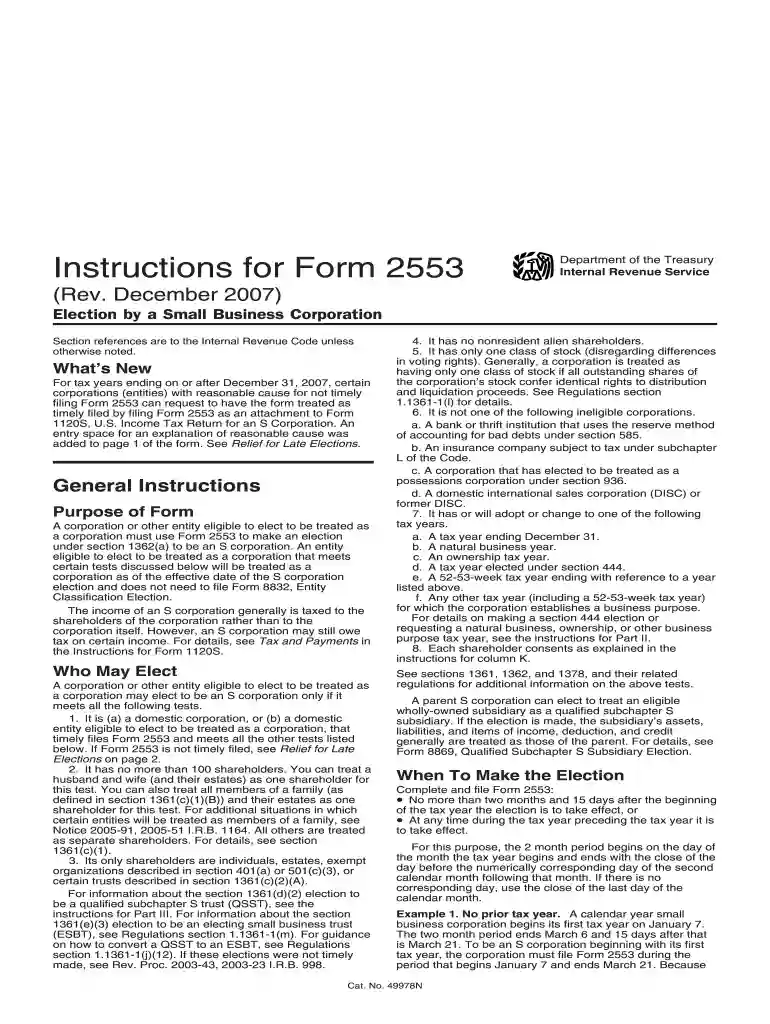
IRS Form 2553, officially known as "Election by a Small Business Corporation," is a crucial document used by eligible corporations to elect S corporation status for tax purposes under Subchapter S of the Internal Revenue Code. This election allows certain corporations to enjoy the benefits of pass-through taxation, where income is taxed at the shareholder level rather than at the corporate level. The form enables businesses to avoid double taxation, which is typically encountered by C corporations.
Consider a small corporation that wants to avoid being taxed twice — once at the corporate level and again on dividends received by shareholders. By filing IRS Form 2553, the corporation can elect S corporation status and have profits, and some losses, passed directly to its owners' personal income without being subject to corporate tax rates.
Completing IRS Form 2553 requires attention to detail to ensure eligibility and proper election of the S corporation status. Follow these essential steps:
Provide Basic Information:
Select Tax Year:
Shareholder Consent:
Corporation Officer's Verification:
Check for Complete Information:
Before filing IRS Form 2553, corporations must confirm their eligibility to elect S corporation status. Key criteria include:


Entities such as banks or insurance companies are ineligible for S corporation status. Moreover, the corporation must adhere to specific regulations regarding passive income limitations.
Timeliness is critical when electing S corporation status with Form 2553. Corporations must adhere to specific deadlines:
Example: A corporation with a calendar year tax year ending December 31 should file Form 2553 by March 15 to be effective for that tax year.
Electing S corporation status via Form 2553 offers significant tax advantages and operational benefits:
A small tech startup with initial years of losses can file Form 2553, allowing losses to be passed through to offset the founders' personal income, thereby providing financial relief during critical growth phases.
Corporations have several options for submitting IRS Form 2553:
IRS guidelines for Form 2553 ensure that corporations follow consistent filing procedures and maintain eligibility throughout the S corporation's existence. These guidelines are detailed in the IRS instructions accompanying Form 2553 and cover:
The guidelines also emphasize adherence to ongoing operational guidelines and the importance of shareholder agreement to maintain S status.
The legal framework surrounding the use of IRS Form 2553 ensures corporations elect S corporation status accurately and lawfully under tax regulations. Legal considerations include:
Proper use of Form 2553 aligns corporate tax strategy with the IRS's legal expectations, safeguarding against penalties or the unintended loss of S status due to non-compliance.
We've got more versions of the Irs form 2553 fillable 2007 form. Select the right Irs form 2553 fillable 2007 version from the list and start editing it straight away!
Sure, and it’s really straightforward! DocHub is a web-based PDF editor with advanced document processing features that allow you rapidly adjust your forms, fill out blank fields and insert new ones for others to fill out, and create eSignatures in several ways. Add your Irs form 2553 fillable 2007, provide information as required, and select how you want to eSign your template - by typing your name, drawing your signature, uploading its image, or utilizing a QR code.
In case your go-to email service is Gmail, you can easily integrate your DocHub editor into your work. Edit your Irs form 2553 fillable 2007 with DocHub instruments and connect it to your drafts in Gmail. See how easy it is to exchange papers and collaborate with a swift PDF editing solution at hand.
At DocHub, your data security is our priority. We follow HIPAA, SOC2, GDPR, and other standards, so you can work on your documents with confidence.
2a Tax-exempt interest . . . 2a b Taxable interest . . . . . 2b. 3a Qualified dividends . . . 3a b Ordinary dividends . . . . . 3b. 4a IRA distributions .Read more
Name and address of each shareholder or former shareholder required to consent to the election. (See the instructions for column K.) K. Shareholders ConsentRead more


