




01. Edit your revenue procedure 2013 30 online
Type text, add images, blackout confidential details, add comments, highlights and more.

Type text, add images, blackout confidential details, add comments, highlights and more.

Draw your signature, type it, upload its image, or use your mobile device as a signature pad.

Send it via email, link, or fax. You can also download it, export it or print it out.
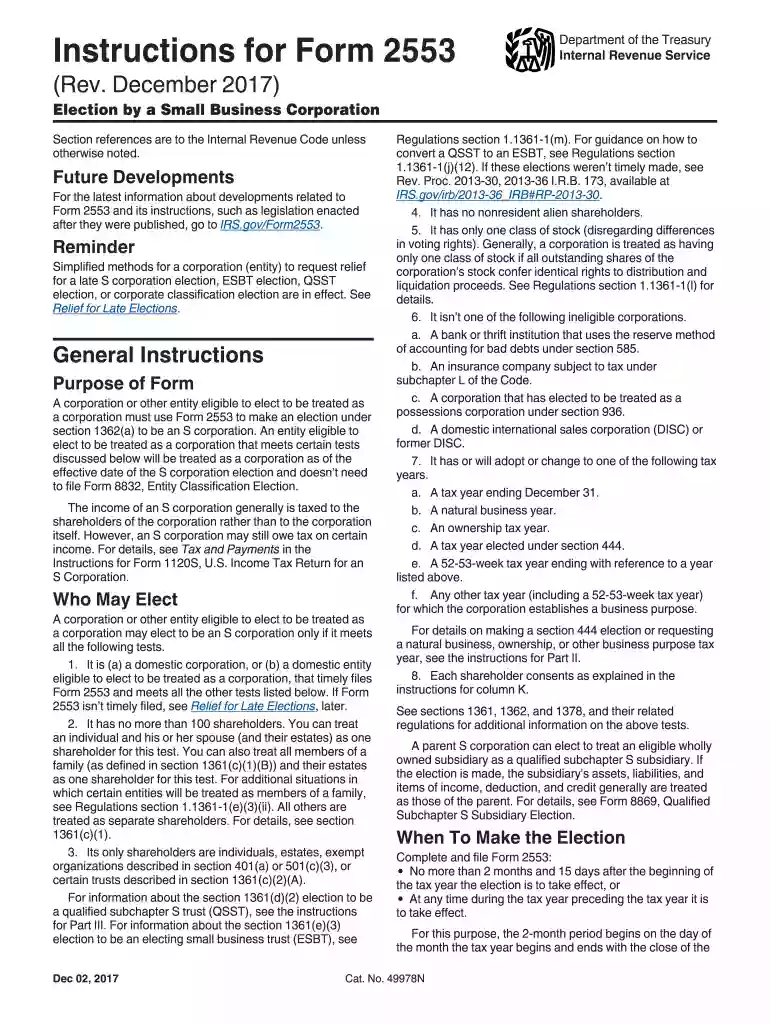
Form 2553, known as the "Election by a Small Business Corporation," is a form used by eligible domestic corporations to elect S corporation status under the Internal Revenue Code. This election allows the corporation's income, losses, deductions, and credits to pass through to shareholders for federal tax purposes, akin to a partnership. Such an arrangement can be particularly beneficial for businesses looking to avoid the double taxation typically associated with standard corporations.
Form 2553 includes several critical sections that must be completed accurately for a successful election. These sections require the corporate name, address, employer identification number (EIN), and the election date. Companies must also provide signatures from all shareholders, affirming their consent to the S corporation election. The form outlines specific filing instructions that are essential for validation by the IRS.
Form 2553 must be filed with the IRS by no later than two months and 15 days after the start of the tax year when the election is to take effect. If this deadline is missed, the corporation can file for late election relief, provided it meets certain criteria outlined by the IRS.
Typically, small domestic corporations looking to take advantage of pass-through taxation elect S corporation status using Form 2553. This form is particularly appealing to entities wishing to reduce their overall tax burden by avoiding double taxation at both corporate and personal levels.
While Form 2553 is primarily aimed at domestic corporations, some limited liability companies (LLCs) that qualify as corporations can also elect S corporation status. This is particularly useful for LLCs operating within certain tax and regulatory frameworks that benefit from the S corporation's pass-through taxation model.
Form 2553 must adhere to strict IRS guidelines to avoid compliance issues. Accurate completion and timely submission are critical to ensuring that the S corporation election is recognized legally. Corporations must maintain thorough records of their election process and ensure all future tax filings reflect S corporation status to remain compliant.
Failing to properly file Form 2553 or meet the eligibility criteria can lead to significant penalties. The IRS might treat the entity as a standard corporation, subjecting it to the associated tax implications. In cases of suspected fraud or negligence, further penalties may apply, emphasizing the importance of accuracy in the election process.
Many small businesses, particularly startups and family businesses, use Form 2553 to optimize their tax strategies. For example, a tech startup with several founding members might elect S corporation status to facilitate profit-sharing and minimize overall tax burdens. In contrast, a family-owned business might use the election to simplify tax reporting and shift some income tax responsibility to individual family members, who may be in lower tax brackets.
While federal taxation under S corporation status is consistent across the United States, state taxation rules may vary significantly. Some states do not recognize S corporation status and may tax the corporation as a standard entity. Businesses must research their state's specific requirements and consider consulting tax professionals to navigate state-specific regulations effectively.
We've got more versions of the revenue procedure 2013 30 form. Select the right revenue procedure 2013 30 version from the list and start editing it straight away!
eSignatures are a great replacement for traditional signing, as they save time, effort, and costs people spend on printing, scanning, and paper delivery. You can eSign your form 2553 utilizing a reliable and powerful online document management tool like DocHub. It complies with primary eSignature policies (ESIGN and UETA), so all documents approved there are legally binding and have the same validity as physically signed ones.
If you use Chrome, there are two easy methods to modify your form 2553 online. First, visit the DocHub site, add your file, and modify it utilizing our toolbar. You can also set up our Chrome extension and modify any document by dragging and dropping it in your browser tab.
At DocHub, your data security is our priority. We follow HIPAA, SOC2, GDPR, and other standards, so you can work on your documents with confidence.
Form 2553, election by a small business corporation (under section 1362 of the Internal Revenue Code). ; United States. Internal Revenue Service.Read more
Jun 27, 2013 To facilitate efficient investments and financing of infrastruc- ture projects and new job creation through the establish-. VerDate Mar 15 2010Read more
To make the election, you must complete Form 8716, Election To Have a Tax Year Other Than a. Required Tax Year, and either attach it to Form 2553 or file itRead more


