




01. Edit your form 9465 online
Type text, add images, blackout confidential details, add comments, highlights and more.

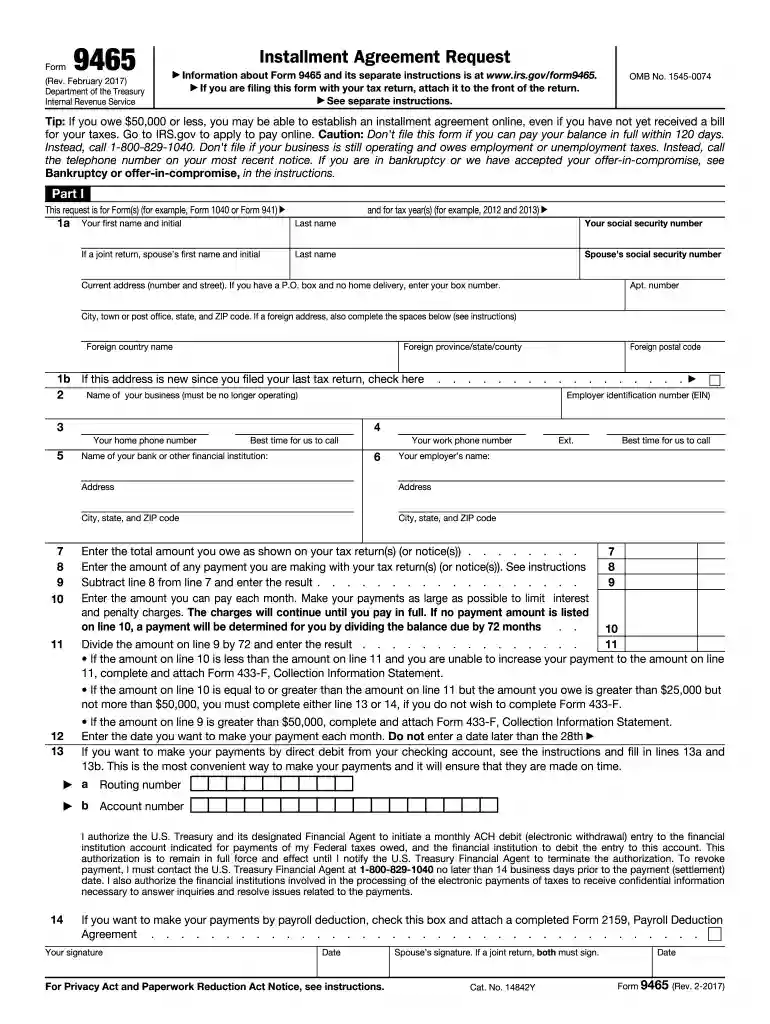
Type text, add images, blackout confidential details, add comments, highlights and more.

Draw your signature, type it, upload its image, or use your mobile device as a signature pad.

Send form 9465 irs via email, link, or fax. You can also download it, export it or print it out.
Form 9465, also known as the Installment Agreement Request, is utilized by taxpayers to establish a payment plan for their federal tax liabilities with the Internal Revenue Service (IRS). This form is particularly useful for individuals who owe taxes but are unable to pay the full amount immediately. With the installment agreement, taxpayers can negotiate a manageable monthly payment that allows them to settle their debts over time, providing financial relief and flexibility.
The primary function of the 2017 Form 9465 is to initiate a monthly payment arrangement with the IRS. Taxpayers must accurately fill out the form with essential personal and financial information, including income, expenses, and the amount they propose to pay each month. It's crucial to ensure all data is current and correct to avoid delays or potential rejections. The form can be submitted online or via mail, depending on taxpayer preference and IRS requirements.
This form is predominantly used by individual taxpayers and small business owners who have found themselves with a balance due after their taxes are assessed. These groups often include self-employed individuals, retirees with unexpected tax obligations, or students who have entered the workforce and faced under-withholding issues. By setting up an installment agreement, these taxpayers can avoid more severe penalties and interest that accrue from unpaid taxes.


To qualify for an installment agreement using the 2017 Form 9465, taxpayers must meet specific conditions:

When completing Form 9465, the IRS may require specific documents to assess and validate the taxpayer's financial situation accurately:
Taxpayers have multiple options for submitting their 2017 Form 9465:
Failure to establish an installment agreement or comply with agreed terms can lead to severe consequences:
Accurately utilizing and submitting the 2017 Form 9465 can aid taxpayers in avoiding these outcomes by providing a structured and manageable path to fulfilling their tax obligations.
We've got more versions of the form 9465 form. Select the right form 9465 version from the list and start editing it straight away!
At DocHub, your data security is our priority. We follow HIPAA, SOC2, GDPR, and other standards, so you can work on your documents with confidence.





Description. Problem Definition. Non small cell lung cancer (NSCLC) is one of the most common types of lung cancer, accounting for 85% of all lung cancerRead more
Tip: If you owe $50,000 or less, you may be able to establish an installment agreement online, even if you have not yet received a bill for your taxes.Read more
Caution: Dont file this form if you can pay your balance in full within 120 days. Instead, call 1-800-829-1040. Dont file if your business is still operatingRead more


