




01. Edit your 9465 form online
Type text, add images, blackout confidential details, add comments, highlights and more.

Type text, add images, blackout confidential details, add comments, highlights and more.

Draw your signature, type it, upload its image, or use your mobile device as a signature pad.

Send 9465 pdf via email, link, or fax. You can also download it, export it or print it out.
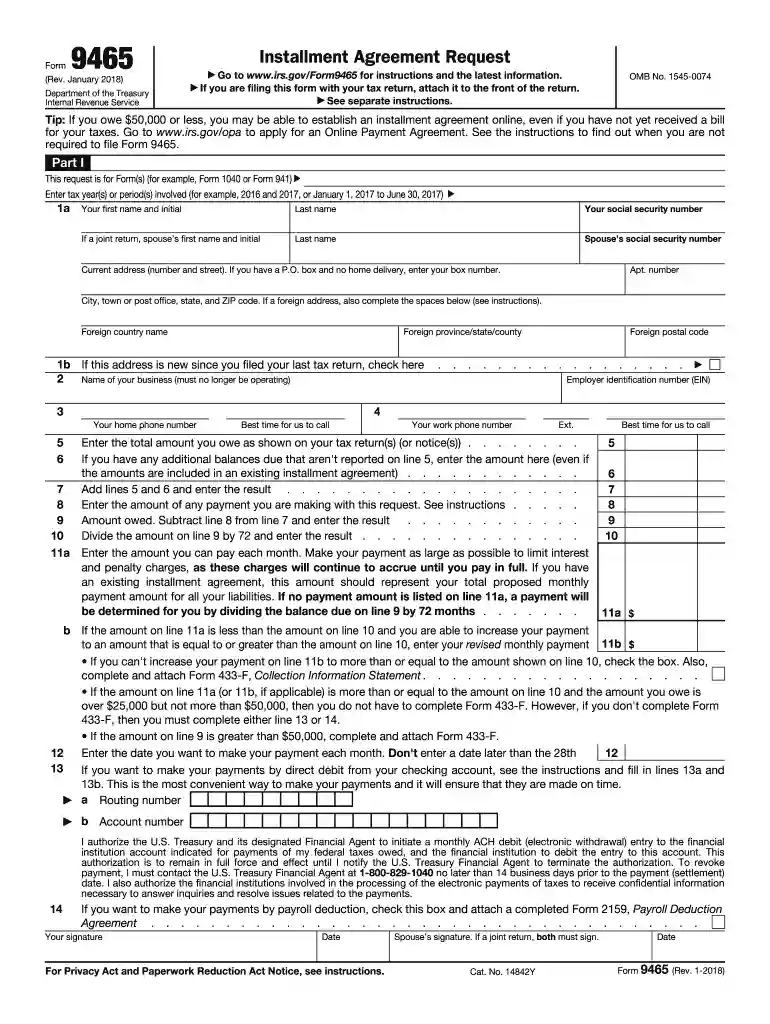
Form 9465, the Installment Agreement Request, is an official document from the Internal Revenue Service (IRS) used by taxpayers in the United States who owe taxes and wish to establish a payment plan. The purpose of this form is to facilitate a structured repayment schedule for individuals who need more time to settle their tax liabilities. By completing this form, taxpayers can propose a monthly installment plan, thereby avoiding immediate penalties and potential legal actions associated with unpaid taxes. The agreement allows for financial flexibility, accommodating those who cannot pay their full tax debt within the standard deadline.
Individuals can obtain Form 9 from multiple sources. It is available for download on the IRS official website, where taxpayers can find both the form and instructions for completing it. For those who prefer physical copies, forms can be requested by contacting the IRS directly via phone. Additionally, tax software programs such as TurboTax often include digital copies of the form within their platforms, enabling users to complete and submit it electronically. Obtaining the right version of the form is essential, as each year may contain specific updates or changes relevant to that tax period.
Completing Form 9 involves several key steps:
Personal Information: Enter your full legal name, current mailing address, and Social Security Number.
Tax Information: Specify the type of taxes owed, such as income or employment taxes, and the tax year in question.
Proposed Installment Plan: Indicate the monthly payment amount you can afford and choose between direct debit, payroll deduction, or other payment methods.
Financial Information: If applicable, provide additional financial details that support your payment plan proposal.
Sign and Date: Ensure the form is signed and dated before submission.
Comprehensive instructions provided by the IRS should be reviewed to ensure accuracy and compliance with all requirements.
Taxpayers must meet specific eligibility criteria to qualify for an installment agreement using Form 9465. The primary requirement is that they owe $50,000 or less in combined income tax, penalties, and interest. If the debt exceeds this amount, taxpayers may need to provide additional financial details or consider an alternative payment option. It is also crucial to have filed all required tax returns up to date. Taxpayers currently under an existing installment agreement must pay it in full before applying for a new one unless they seek to revise the terms of the active agreement.


The IRS provides clear guidelines for processing installment agreements via Form 9465. Generally, once the IRS approves your request, they will send a written notification outlining the terms of the agreement, including payment amounts and due dates. Taxpayers are encouraged to make their payments on time to avoid defaulting on the agreement, which could lead to additional penalties or enforcement actions. The guidelines also specify that interest and penalties continue to accrue on the unpaid balance, even under an approved installment plan, although at a reduced rate compared to taxpayers without a payment plan.
Understanding key terms associated with Form 9465 is vital:
These terms are integral to navigating the complexities of tax payment plans effectively.
Form 9465 can be submitted via several methods:
Online submission is generally recommended for convenience and expedited processing.
Failure to adhere to the terms of an installment agreement can have significant consequences. Non-compliance may lead to penalties such as reinstated collection activities, additional fees, and interest accruing at higher rates. The IRS may terminate the agreement following repeated missed payments or failure to file future tax returns on time, making taxpayers subject to standard IRS enforcement actions. It's crucial for taxpayers under an installment agreement to maintain diligent, timely payments and comply with all filing requirements to avoid these penalties.
We've got more versions of the 9465 form form. Select the right 9465 form version from the list and start editing it straight away!
At DocHub, your data security is our priority. We follow HIPAA, SOC2, GDPR, and other standards, so you can work on your documents with confidence.





Tip: If you owe $50,000 or less, you may be able to avoid filing Form 9465 and establish an installment agreement online, even if you havent yet received a taxRead more
Feb 20, 2018 File Form 1040 by April 17, 2018. The due date is April 17, because 9465, which is available at IRS.gov. Extensions of Deadlines To.Read more


