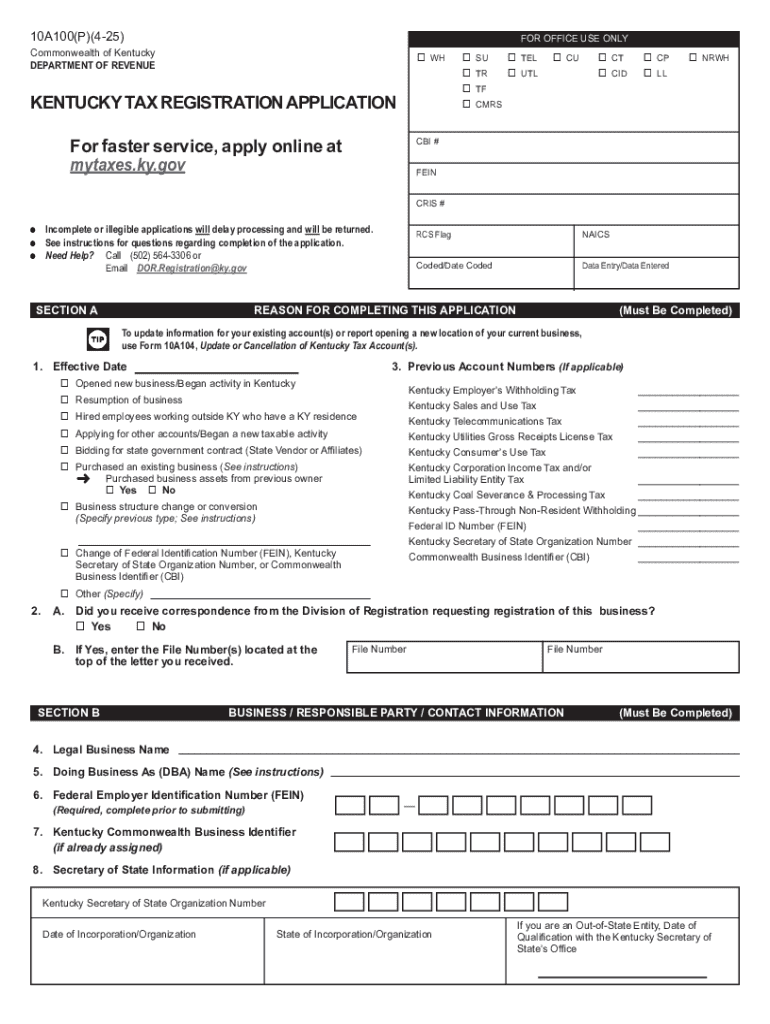







Definition and Purpose of the Kentucky Tax Registration Application
The Kentucky Tax Registration Application is a foundational document required for businesses operating within the state. It is designed for entities such as corporations, partnerships, or sole proprietorships to register for various state tax accounts, including Employer’s Withholding Tax and Sales and Use Tax. The application ensures that businesses comply with state tax laws, facilitating proper tax collection and management. Filling out this form accurately is crucial to prevent any administrative or financial complications, which can delay business operations.
Steps to Complete the Kentucky Tax Registration Application
Completing the Kentucky Tax Registration Application involves several detailed steps, each crucial to ensure accurate registration:
- Business Information: Start by entering your business name, address, and contact information. This identifies the entity registering for tax purposes.
- Tax Account Type: Specify the types of tax accounts needed, such as Sales and Use Tax or Transient Room Tax.
- Business Structure: Indicate your business structure - LLC, Corporation, Partnership, or Sole Proprietorship. This information is vital to determine applicable tax obligations and regulations.
- Reason for Registration: Clearly state the purpose of your registration, whether starting a new business, hiring employees, or expanding operations.
- Signature and Date: Conclude the application with a signature and date to verify the authenticity of the information provided.
Careful attention to each step is necessary to ensure compliance with state tax requirements. Errors or omissions can lead to processing delays or rejections.
Required Documents for the Kentucky Tax Registration Application
When preparing to submit the Kentucky Tax Registration Application, gather the following documents to support your registration:
- Business License or Articles of Incorporation: Provide proof of formal business registration in Kentucky.
- Federal Employer Identification Number (FEIN): This number is mandatory for businesses with employees and helps in registering for state Employer's Withholding Tax.
- Personal Identification: Owners and responsible parties should have identification, such as a driver’s license, to verify their authority and responsibility for the business.
- SS-4 Form: If applicable, this form documents your request for an FEIN and is needed for tax account setup.
- Operating Agreement (for LLCs): This document outlines the management structure of an LLC and is often required for tax registration purposes.
Having these documents ready ensures a smooth registration process, minimizing potential requests for additional information.
Important Terms Related to the Kentucky Tax Registration Application
Understanding the terminology associated with the Kentucky Tax Registration Application enhances accuracy and ease during completion:
- Withholding Tax: Tax withheld from employees’ wages by the employer, remitted directly to the state.
- Sales and Use Tax: A tax on goods and services sold within Kentucky, which businesses must collect from customers.
- Transient Room Tax: A tax on temporary lodging, applicable to hotels and similar businesses.
- Taxpayer Identification Number (TIN): A unique identifier for a business, used in all tax-related documentation.
- Effective Date: The date when tax obligations commence, typically following approval of the registration.
Familiarity with these terms ensures accurate form completion and streamlined communication with tax authorities.
State-Specific Rules for the Kentucky Tax Registration Application
Certain rules apply specifically to the Kentucky Tax Registration Application, which applicants must follow:
- Business Changes: Any alterations in business structure or ownership must be reported to the Kentucky Department of Revenue promptly.
- Local Taxes: Some areas may levy additional taxes, requiring businesses to register at the local level separately.
- Electronic Filing: While paper submissions are accepted, online filing through the Kentucky Online Gateway offers quicker processing times.
- Mandatory Registration: All businesses with physical or economic presence within the state are compelled to register for applicable tax accounts.
Being cognizant of these Kentucky-specific regulations aids businesses in maintaining full compliance with state tax laws.
Legal Use of the Kentucky Tax Registration Application
The Kentucky Tax Registration Application is a legally binding document that formalizes a business's obligation to remit state taxes. Once processed and approved, it mandates compliance with Kentucky’s tax laws and allows businesses to legally conduct operations that involve taxable transactions. Misrepresentation or falsification of information on this form can result in penalties, fines, or denial of registration. Hence, accuracy and transparency are imperative while completing the application.
Penalties for Non-Compliance with the Kentucky Tax Registration
Failure to comply with Kentucky’s tax registration requirements can lead to severe consequences, including:
- Fines and Interest: Delinquent accounts may incur financial penalties and accumulating interest on unpaid taxes.
- Revocation of Business License: Persistent non-compliance may result in suspension or revocation of the business’s operational license.
- Legal Action: The state reserves the right to pursue legal measures against businesses failing to adhere to registration obligations, potentially leading to court proceedings.
Being diligent in registration and tax affairs helps avoid these costly and time-consuming penalties.
Who Issues the Kentucky Tax Registration Application
The Kentucky Tax Registration Application is issued by the Kentucky Department of Revenue. This government body oversees tax collection and regulation for the state, ensuring that businesses and individuals adhere to applicable tax statutes. The department provides guidance and assistance throughout the process, ensuring clarity and support for applicants. When in need of assistance or clarification, applicants may contact the department directly to receive expert advice pertaining to their situation.