
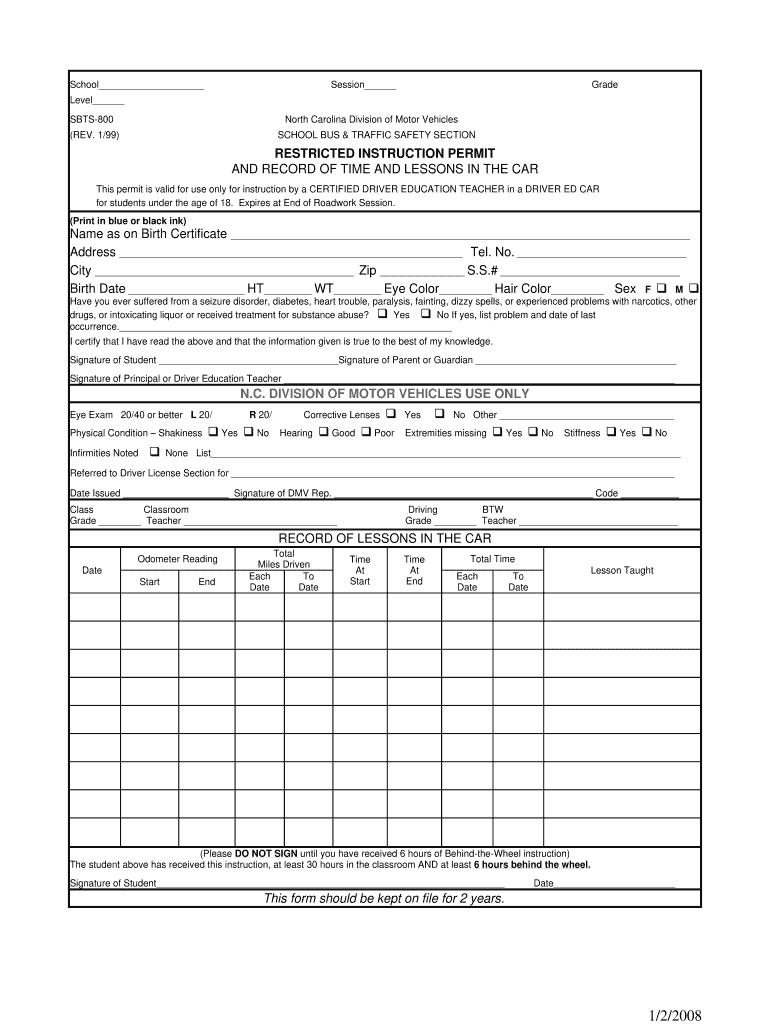







Definition & Meaning of the Restricted Instruction Permit
The restricted instruction permit is a specific type of learner's permit issued to individual drivers, particularly those under 18 years of age, who are undergoing driver education. This permit allows novice drivers to practice driving under certain restrictions, ensuring they gain necessary experience before obtaining a full driver's license. Generally, this document is issued by individual state departments of motor vehicles (DMVs) and is integral in the progression of young drivers toward full licensure.
Key Features of the Restricted Instruction Permit
- Driver Education Requirement: To qualify for this permit, applicants typically must complete a state-approved driver education program.
- Supervised Driving: Permit holders must always be accompanied by a licensed adult driver in the front seat, ensuring safety and guidance.
- Limited Driving Hours: There are often restrictions on the hours during which permit holders may drive, such as prohibitions on night driving unless accompanied by a guardian.
How to Obtain the Restricted Instruction Permit
Acquiring a restricted instruction permit involves several steps designed to confirm the applicant's preparedness and understanding of driving regulations.
Steps to Acquire the Permit
- Complete the Required Driver Education Course: Successful completion of a mandated driver education course is the first step.
- Gather Necessary Documentation: This includes proof of age (such as a birth certificate), identification, and a signed consent form from a parent or guardian.
- Pass the Vision Test: Most states require a vision test to ensure that applicants can satisfy vision standards for driving.
- Submit the Application: Applicants must submit their application, along with the required documents, at their local DMV office.
- Pay the Associated Fees: Fees for processing the application and issuing the permit will vary by state.
Additional Considerations
- Age Requirements: Each state may have specific age requirements for applicants. Generally, applicants must be at least 15 or 16 years old.
- Residency Status: Proof of state residency might be required, potentially including utility bills or lease agreements in the applicant's name.
Important Terms Related to the Restricted Instruction Permit
Understanding the terminology associated with the restricted instruction permit is essential for application and adherence to regulations.
Commonly Used Terms
- Learner's Permit: A broader category that includes all types of temporary permits for novice drivers.
- Provisional License: A subsequent stage after the restricted instruction permit, often allowing for more driving privileges with fewer restrictions.
- Certification of Instruction: A formal acknowledgment by a certified driving instructor indicating that the applicant has completed the required training.
Legal Use of the Restricted Instruction Permit
The legal parameters governing the restricted instruction permit are essential to ensure that permit holders comply with state driving laws.
Restrictions and Regulations
- Driving Under Supervision: Permits should only be used while accompanied by a licensed adult, often specified to be over a minimum age, usually 21 years.
- Types of Vehicles: Limitations may exist concerning the class of vehicle that may be driven—typically, a standard passenger vehicle is permitted, while others might be restricted.
- Obligations Related to Traffic Laws: The permit holder must adhere to all traffic laws, and violations may jeopardize their ability to advance to a full license.
State-Specific Rules for the Restricted Instruction Permit
Each state has unique requirements and restrictions associated with the restricted instruction permit, which may differ from one jurisdiction to another.
Variations by State
- Application Process: The steps to obtain the permit, including documentation and age requirements, can vary significantly from state to state.
- Duration of Permit Validity: Some states may issue a permit that is valid for six months, while others might extend this period to one year, depending on the specific requirements for transitioning to a full license.
- Restrictions on Driving Times: States may have specific hours during which young drivers are prohibited from driving, typically during late-night hours to enhance safety.
Examples of Using the Restricted Instruction Permit
The application of the restricted instruction permit in real-world scenarios demonstrates its importance in promoting safe driving practices among young drivers.
Practical Scenarios
- Practice with a Parent: A teenager uses their restricted instruction permit to practice driving with a parent during the weekends, ensuring they gain confidence without the distractions of solo driving.
- Completing Driving Lessons: An exemplary case is a student driver who logs hours with a certified instructor, using documented driving lessons to fulfill state requirements for transitioning to a full license.
- Assisting New Drivers: Parents may leverage the permit to help guide their child through challenging driving situations, such as highway driving or busy intersections, enhancing the educational aspect of the experience.
Conclusion
The restricted instruction permit plays a critical role in the education and training of novice drivers, providing a structured and supervised framework that enables them to develop their driving skills in a safe environment. Adhering to state-specific rules and effectively utilizing this permit lays the groundwork for responsible driving habits and prepares young drivers for the responsibilities of full licensure.




