




01. Edit your form online
Type text, add images, blackout confidential details, add comments, highlights and more.

Type text, add images, blackout confidential details, add comments, highlights and more.

Draw your signature, type it, upload its image, or use your mobile device as a signature pad.

Send it via email, link, or fax. You can also download it, export it or print it out.
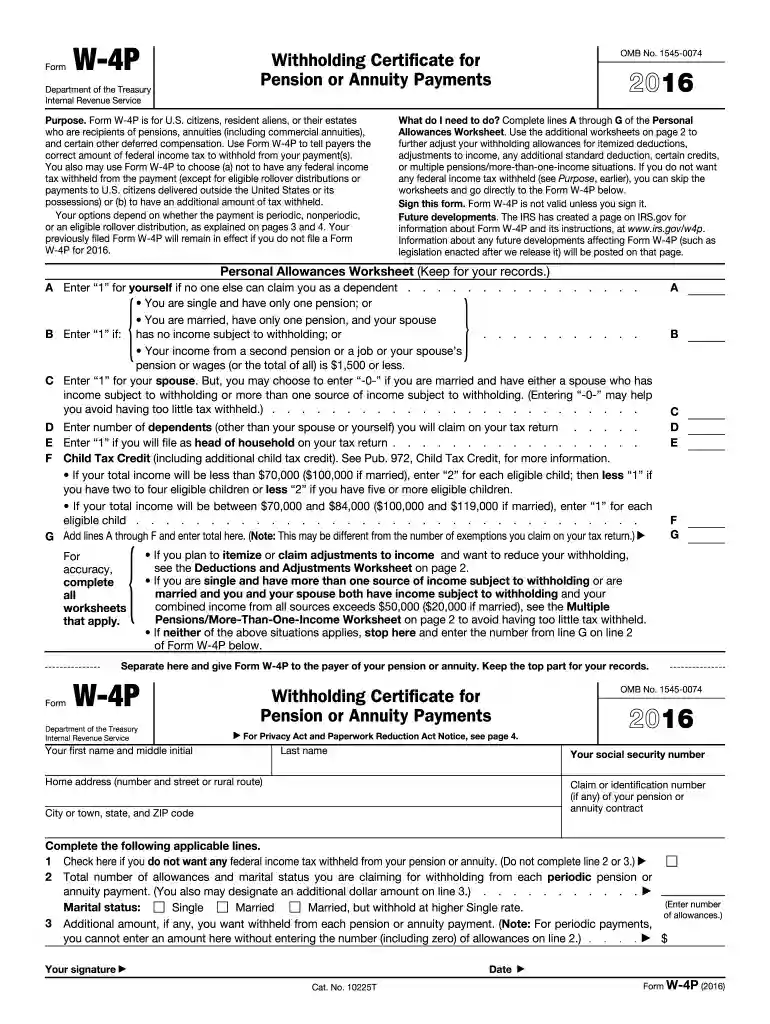
The W-4P 2016 form, known as the "Withholding Certificate for Pension or Annuity Payments," allows individuals in the United States to specify federal income tax withholding from their pension or annuity payments. This form is essential for ensuring that the right amount of taxes are withheld from these payments, reflecting changes in personal tax situations and preventing substantial tax obligations at the end of the fiscal year. By accurately completing the W-4P, individuals can manage their annual tax burden more effectively.
Using the W-4P 2016 form involves several key steps to ensure accurate and effective withholding. First, review your current financial situation and determine any changes in personal allowances, marital status, or additional income that may affect withholding. Then, access the form through the IRS website or your pension provider. Fill out the necessary sections, including filing status and the number of allowances claimed. Be sure to check for accuracy in each section before submitting it to your pension administrator, as this will determine the withholding applied to your payments.
The IRS provides detailed guidelines for completing the W-4P 2016 form. These include instructions on using the worksheets to calculate withholding allowances accurately and considering factors like additional income, credits, or deductions. It's crucial to review these guidelines to avoid common errors that may lead to incorrect withholding.
While the W-4P form does not have a strict filing deadline like a tax return, it should be updated whenever there are significant life changes that affect your tax situation. Examples include a change in marital status or a shift in other income sources. For new retirees, it’s advisable to file as soon as you begin receiving pension or annuity payments.
When completing the W-4P 2016 form, you need access to your tax documents, such as tax returns, to accurately determine your allowances. Having your Social Security card will ensure precise entry of personal identification numbers. If you plan to adjust withholding based on additional income, gather documentation of those income sources as well.
Filing the W-4P 2016 form can be facilitated using financial software such as TurboTax or QuickBooks. These tools provide step-by-step guidance and ensure compliance with IRS protocols. Compatibility with such software aids in accurate filing and can simplify complex calculations related to withholding.
The W-4P form is available in both digital and paper formats. The digital version can be filled out and submitted online through the IRS platform or pension provider websites, offering convenience and speed. The paper version remains an option for those who prefer a traditional approach, allowing for physical submission via mail. Both versions hold the same legal validity.
We've got more versions of the w 4p 2016 form form. Select the right w 4p 2016 form version from the list and start editing it straight away!
| Versions | Form popularity | Fillable & printable |
|---|---|---|
| 2024 | 4.4 Satisfied (52 Votes) | |
| 2023 | 4.8 Satisfied (46 Votes) | |
| 2022 | 4.7 Satisfied (40 Votes) | |
| 2021 | 4.8 Satisfied (136 Votes) | |
| 2020 | 4.3 Satisfied (128 Votes) | |
| 2019 | 4 Satisfied (49 Votes) | |
| 2018 | 4.3 Satisfied (103 Votes) | |
| 2017 | 4.4 Satisfied (1175 Votes) | |
| 2016 | 4.2 Satisfied (57 Votes) | |
| 2015 | 3.9 Satisfied (35 Votes) | |
| 2014 | 4 Satisfied (55 Votes) | |
| 2013 | 4 Satisfied (36 Votes) | |
| 2012 | 4.3 Satisfied (59 Votes) |
At DocHub, your data security is our priority. We follow HIPAA, SOC2, GDPR, and other standards, so you can work on your documents with confidence.
Use Form W-4P to tell payers the correct amount of federal income tax to withhold from your payment(s). You also may use Form W-4P to choose (a) not to have anyRead more
Jan 23, 2018 For payments other than eligible rollover distributions, you can tell the payer how much to withhold by filing a. Form W-4P, WithholdingRead more


