
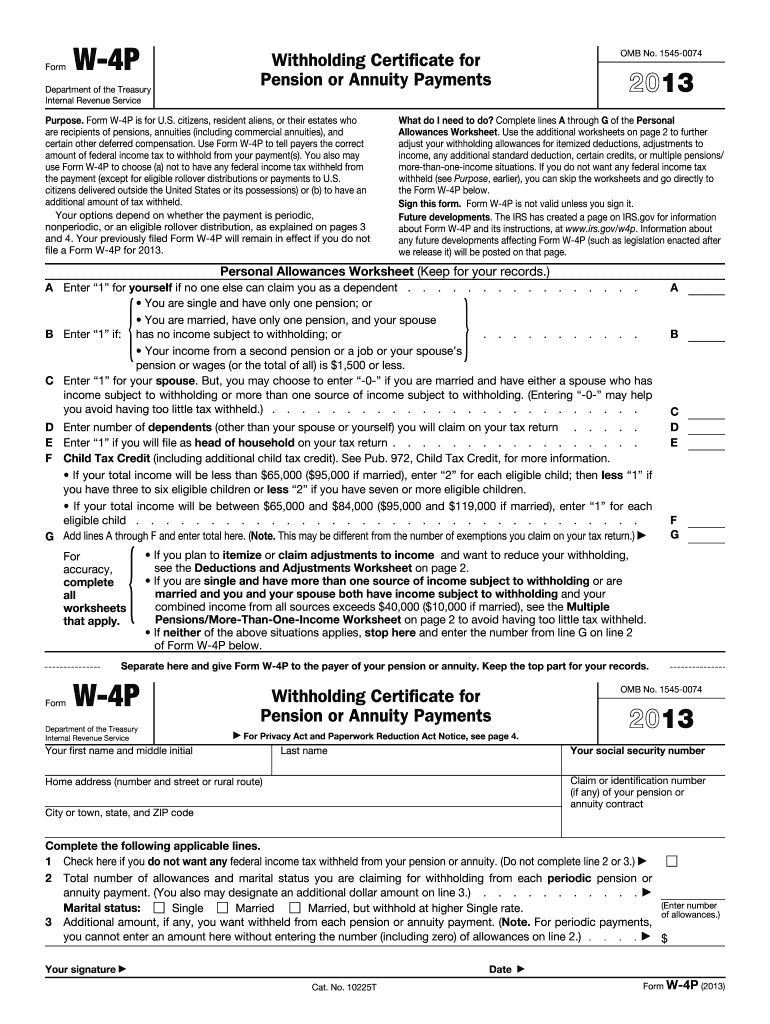







Definition and Purpose of the 2013 W-4P Form
The 2013 W-4P form functions as a withholding certificate specifically utilized by U.S. citizens and resident aliens to designate the amount of federal income tax to be withheld from pension or annuity payments. This document allows recipients to customize their withholding preferences, from specifying whether taxes should be withheld to determining the exact amount. The form is essential in tailoring tax payments according to individual financial circumstances, helping recipients avoid owing taxes at the end of the year or having too much withheld during the year.
Importance and Utility
- Adjusts the tax withholding from pensions or annuities.
- Helps manage personal cash flow by aligning tax payments with tax liabilities.
- Offers worksheets to assist in calculating tax withholding accurately.
Procedure to Obtain the 2013 W-4P Form
Acquiring the 2013 W-4P form can be done through various channels. Typically, it's available directly from the Internal Revenue Service (IRS) website, where taxpayers can download and print the form for completion. Alternatively, individuals can receive the form from their financial institution or employer managing the pension or annuity payments.
Common Sources
- IRS official website provides downloadable PDFs of the form.
- Pension providers and financial institutions may distribute the form at the start of new annuity payments.
- Tax preparation services often supply the form during the tax planning process.
Key Steps to Complete the 2013 W-4P Form
Filling out the 2013 W-4P form involves careful handling to ensure accurate tax withholding. Below are the typical steps involved in completing the form:
- Personal Information: Enter your name, address, Social Security Number, and filing status.
- Allowance Calculation: Use the provided worksheets to determine the number of personal allowances. This step is crucial for calculating withholding amounts.
- Additional Withholding: Indicate any additional amount you wish to have withheld from each payment.
- Signature and Date: The form must be signed and dated to be valid.
Practical Examples
- A retiree withdrawing from an IRA might adjust withholding to reflect investment income.
- An individual with additional non-pension income may choose higher withholding to offset other taxable income.
Who Typically Utilizes the 2013 W-4P Form
The primary users of the 2013 W-4P form are retirees and individuals who receive pension or annuity payments, including those with retirement plans such as IRAs, 401(k)s, or annuity contracts. These taxpayers need the form to appropriately manage their federal withholding obligations in line with their anticipated tax liabilities.
Applicable Scenarios
- Retirees with fixed pension income use the form to stabilize withholding in line with pensions.
- Annuity recipients managing dynamic income streams may adjust withholding amounts periodically.
Legal and IRS Guidelines for Using the W-4P Form
The W-4P form must be used in compliance with IRS rules and requirements. The instructions provide detailed guidance on accurately estimating withholding and ensuring all necessary sections are properly filled out.
Legal Considerations
- Compliance with the IRS under the ESIGN Act ensures legal acceptance of electronic signatures.
- A change in financial circumstances requires submission of a new form to reflect withholding adjustments.
Important Terms Related to the W-4P Form
Understanding the terminology associated with the 2013 W-4P form is crucial for accurate completion and submission. Key terms include "allowance," which determines withholding amounts, and "additional withholding," allowing for extra tax payments to the IRS.
Glossary of Key Terms
- Allowance: A number that represents personal or dependency factors affecting withholding.
- Payer: The entity responsible for distributing pension or annuity payments and withholding taxes.
State-Specific Rules Impacting the 2013 W-4P Form
While the 2013 W-4P form is used for federal tax withholding, various states may have their own withholding forms or requirements. Understanding these differences is crucial for complete compliance.
Example Variations
- Certain states require additional state withholding forms, separate from the federal W-4P.
- Variances in tax rates and bracket systems further necessitate tailored withholding strategies.
Potential Penalties for Non-Compliance with the W-4P
Failing to correctly complete the 2013 W-4P form or neglecting to file it altogether can result in penalties from the IRS. This could include underpayment of estimated taxes or failure to accurately report income, leading to interest charges or fines.
Compliance Tips
- Reviewing financial changes regularly can prevent unexpected liabilities.
- Consulting a tax professional can help navigate complex withholding scenarios or adjustments throughout the year.
This comprehensive guide provides detailed insights into the 2013 W-4P form, essential for those receiving regular pension or annuity payments. By understanding each aspect, from obtaining and completing the form to the legal implications, recipients can make well-informed decisions regarding their tax withholding and overall financial planning.




