




01. Edit your w4p 2022 online
Type text, add images, blackout confidential details, add comments, highlights and more.

Type text, add images, blackout confidential details, add comments, highlights and more.

Draw your signature, type it, upload its image, or use your mobile device as a signature pad.

Send federal w 4 2022 via email, link, or fax. You can also download it, export it or print it out.
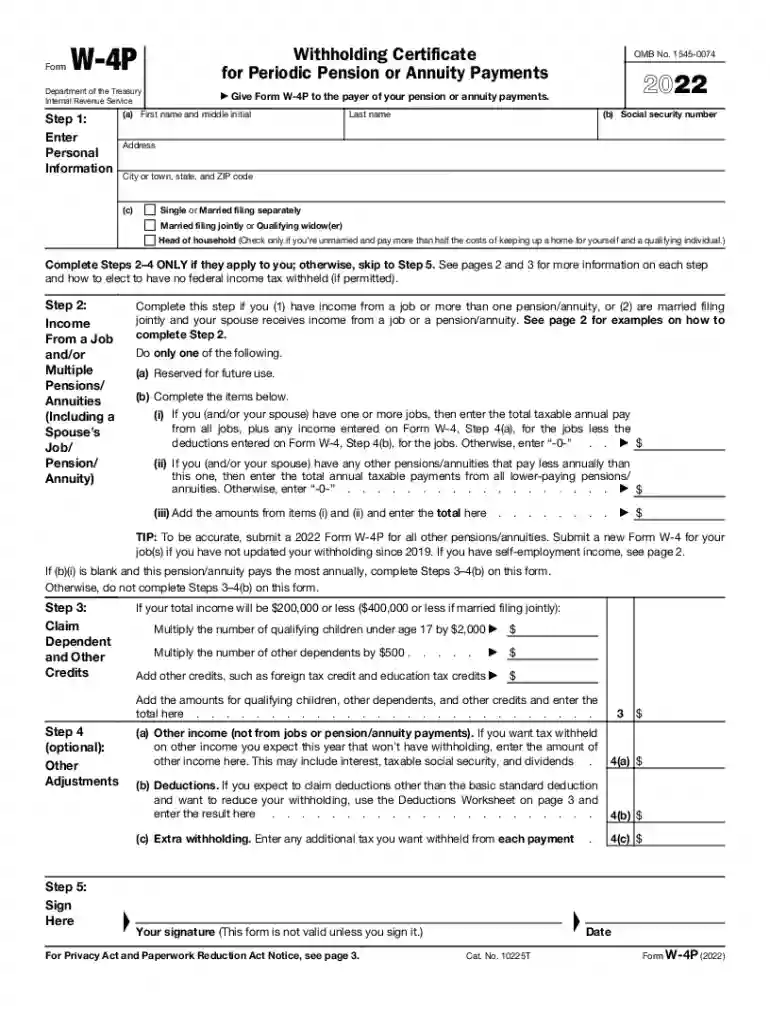
The 2022 Form W-4P, known as the Withholding Certificate for Periodic Pension or Annuity Payments, is an official document issued by the IRS. It allows individuals who receive pensions or annuities to specify the amount of federal income tax to be withheld from their payments. The form plays a crucial role in tax planning, helping recipients manage their cash flow and ensure sufficient tax withholding throughout the year, thereby avoiding potential underpayment penalties.
Completing the 2022 Form W-4P involves several detailed steps to ensure accuracy in tax withholding.
Understanding the primary components of the form is essential for correct completion.
Personal Allowances: Previously used for withholding calculations, allowances have been removed as of recent updates in tax law.
Additional Withholding: You can specify an extra amount to be withheld from each payment if desired.
Claim of Exemption: If you’re in a situation where you owed no federal tax last year and don't expect to owe any this year, you can claim an exemption from withholding.
Scenario: Those with varying income levels year to year must reassess their withholding needs annually.
Access to the Form W-4P is straightforward and can be done through several convenient methods:
IRS Website: The most direct source, featuring the most up-to-date version of the form.
Mail: Request a hard copy from the IRS or a local tax office.
Financial Institution: Many payers of pensions and annuities have copies available and can help with completion.
Example: Accessing the form online allows for quicker completion and submission, especially useful for last-minute adjustments before payment deadlines.
The IRS provides specific guidelines to ensure compliance with tax withholding laws.
Guidance: Review IRS Publication 505 for detailed instructions on tax withholding and estimated tax.
Non-Compliance: Failure to submit an accurate form may result in incorrect withholding, potential penalties, and interest charges on unpaid taxes.
Case Study: A taxpayer who underestimated their withholding may face a significant tax bill and penalties at the end of the year.
The IRS is the issuing body for Form W-4P, but the responsibility for management lies with both the taxpayer and the payer.
Payer Role: Pension and annuity payers collect the completed forms and adjust withholding based on the provided information.
Taxpayer Responsibility: Ensure timely submission and accuracy of the form based on current income projections.
Example: A retiree periodically reviewing their circumstances can ensure their withholding remains appropriate throughout retirement.
Many situations require the use of the Form W-4P for proper tax planning.
Partial Year Retirement: Individuals retiring mid-year may need to adjust withholding to account for changes in income and filing status.
Changing Dependents: Adjustments in claiming dependents can affect withholding amounts.
Withholding Adjustments: Needed when receiving a new source of income or significant life changes occur, such as a marriage.
Scenario: Retirees may need to adjust withholding if they begin working part-time after retirement to avoid a tax shortfall.
Timing is vital when dealing with tax forms, including the Form W-4P.
Annual Review: It’s advisable to review withholding annually or upon any significant financial change.
Submission Timing: Forms should be submitted well ahead of the next scheduled payment to ensure changes are applied timely.
Penalty Avoidance: Making timely adjustments can help avoid penalties associated with under-withholding.
Example: When receiving notice of tax code changes at the year’s end, it may be necessary to adjust your withholding to comply with new regulations.
Correctly handling Form W-4P and its nuances ensure a seamless tax experience, allowing recipients to plan proactively and mitigate any adverse tax implications.
We've got more versions of the w4p 2022 form. Select the right w4p 2022 version from the list and start editing it straight away!
| Versions | Form popularity | Fillable & printable |
|---|---|---|
| 2024 | 4.4 Satisfied (52 Votes) | |
| 2023 | 4.8 Satisfied (46 Votes) | |
| 2022 | 4.7 Satisfied (40 Votes) | |
| 2021 | 4.8 Satisfied (136 Votes) | |
| 2020 | 4.3 Satisfied (128 Votes) | |
| 2019 | 4 Satisfied (49 Votes) | |
| 2018 | 4.3 Satisfied (103 Votes) | |
| 2017 | 4.4 Satisfied (1175 Votes) | |
| 2016 | 4.2 Satisfied (57 Votes) | |
| 2015 | 3.9 Satisfied (35 Votes) | |
| 2014 | 4 Satisfied (55 Votes) | |
| 2013 | 4 Satisfied (36 Votes) | |
| 2012 | 4.3 Satisfied (59 Votes) |
At DocHub, your data security is our priority. We follow HIPAA, SOC2, GDPR, and other standards, so you can work on your documents with confidence.
If you are an employee, you must complete this form so your employer can withhold the correct amount of Illinois Income Tax from your pay.
Complete Form W-4P to have payers withhold the correct amount of federal income tax from your periodic pension, annuity (including commercial annuities), profitRead more


