Definition & Meaning
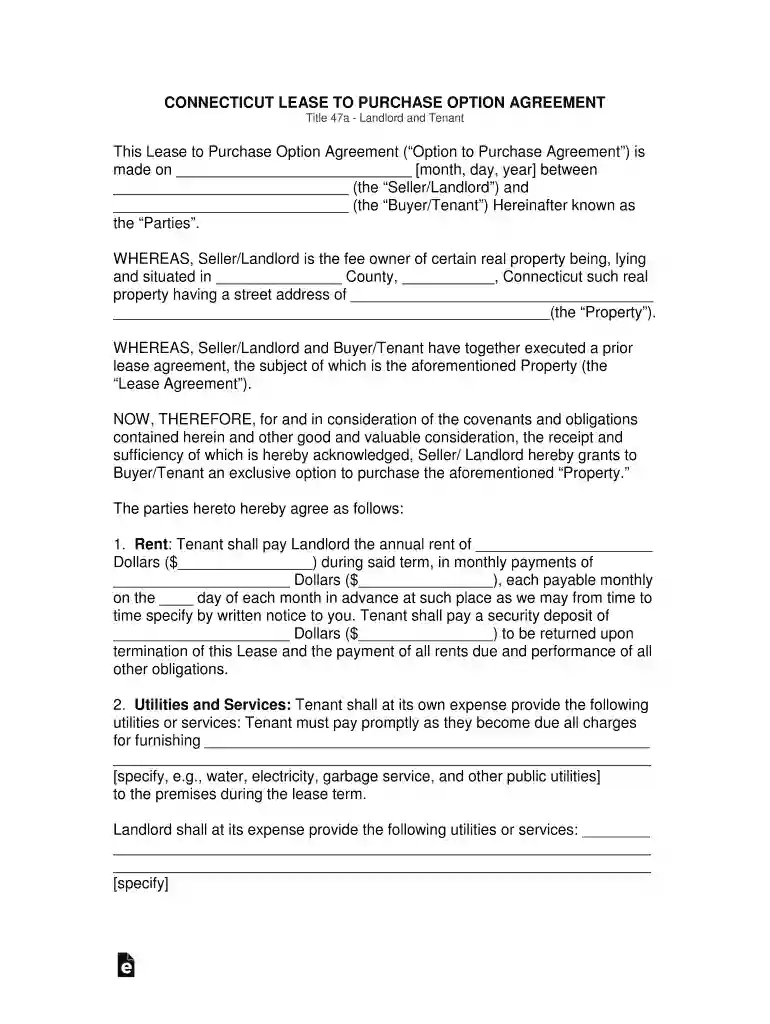
A Connecticut Lease to Own (Option to Purchase) Agreement is a specialized legal contract that allows a Buyer/Tenant to lease a residential property with the option to purchase it at a later date. This arrangement is typically beneficial for individuals who aim to secure a future property purchase while occupying the home. The agreement encompasses terms related to rental payments, responsibilities for maintaining the property, and conditions necessary to exercise the purchase option.
Elements of the Contract
- Parties Involved: The agreement involves at least two parties—the Seller/Landlord and the Buyer/Tenant.
- Lease Terms: Specifies the rental period, the amount payable as rent, and the allocation of responsibilities (e.g., utilities, repairs).
- Purchase Option: Provides details on how and when the Tenant can opt to buy the property.
- Governing Law: It is explicitly stated that the arrangement follows Connecticut State Law.
Key Elements of the Connecticut Lease to Own (Option to Purchase) Agreement
The agreement is composed of several crucial elements that both parties need to clearly understand.
Rental and Option Terms
- Monthly Rent: Amount payable monthly by the Tenant, often including a portion that contributes to the property's purchase price.
- Purchase Price: Pre-determined cost at which the Tenant can buy the home, valid during the option period.
Conditions for Exercising the Purchase Option
- Option Period: The timeframe within which the Tenant can execute the option to purchase.
- Conditions: Requirements such as timely rental payments and maintenance responsibilities that need to be met to exercise the option.
Default and Termination
- Default Terms: Outlines actions that constitute a default, potentially resulting in the loss of the purchase option.
Steps to Complete the Connecticut Lease to Own (Option to Purchase) Agreement
Completing this form requires precision and adherence to specific steps.
- Review Terms: Both parties should thoroughly examine all clauses to ensure clarity and agreement.
- Identify Details: Fill in personal details of the Buyer/Tenant and Seller/Landlord accurately.
- Define Financials: Specify the rent amount, purchase price, and any related fees.
- Establish Timeframes: Clearly mark the option period and other relevant dates.
- Signatures and Execution: Legal execution requires signatures from all involved parties.
Documentation
- Proof of Identity: Both parties must provide legal identification.
- Financial Disclosures: Any financial arrangements or previous agreements related to the transaction.
Important Terms Related to Connecticut Lease to Own (Option to Purchase) Agreement
Familiarity with certain terms enhances understanding and negotiation.
Common Terms
- Lease Agreement: The initial contract that outlines the rental terms.
- Option Fee: A non-refundable amount paid by the Tenant for the purchase option.
- Closing Process: Legal proceeding that finalizes the sale, should the Tenant decide to buy.
Legal Specifics
- Entire Agreement Clause: States that the signed document represents the full agreement and supersedes prior negotiations.
Legal Use of the Connecticut Lease to Own (Option to Purchase) Agreement
This agreement's legality stems from its compliance with Connecticut State Law, ensuring all contractual obligations are enforceable.
Legal Requirements
- Written Agreement: Mandated by law to validate the terms of the lease and purchase option.
- Compliance with Connecticut Law: Ensures both parties' rights and obligations are protected within the legal framework of the state.
Target Users
- First-time Homebuyers: Individuals looking to transition from renting to owning.
- Sellers Aiming to Secure Future Sales: Property owners who wish to lock in potential buyers.
Practical Scenarios
- Real Estate Investors: Utilize agreements for properties in transitional markets, providing flexibility for potential appreciation in value.
State-Specific Rules for the Connecticut Lease to Own (Option to Purchase) Agreement
Unique state guidelines impact how these agreements are structured and enforced.
Connecticut-Specific Guidelines
- Disclosure Requirements: Connecticut law dictates explicit disclosure of property conditions and any known issues.
- Consumer Protections: Safeguards for tenants include legal recourse in cases of non-disclosure or misrepresentation by the landlord.
Examples of Using the Connecticut Lease to Own (Option to Purchase) Agreement
Creating real-world situations provides clarity on practical use.
Example Case
- Negotiation Between Seller and Buyer: A tenant aiming to buy a property but lacking immediate funds uses the lease-to-own agreement to build credit and save for the purchase price.
- Seller Perspective: A landlord wanting to transition from being a landlord to cashing in on equity uses this agreement to secure a future sale while maintaining income through rent.
Penalties for Non-Compliance
Understanding consequences for breaches helps ensure compliance.
Potential Penalties
- Loss of Option Fee: Failure to adhere to agreed terms might result in the Tenant losing the option to purchase and any associated fees.
- Legal Remedies: Both parties have legal avenues for enforcement, including financial penalties or specific performance decrees.
Software Compatibility and Modern Practices
Technological integration assists users in adapting these agreements efficiently.
Tools and Platforms
- Document Management Systems: DocHub offers features for digitally handling legal agreements, enabling edits, annotations, and e-signatures.
- Integration with Cloud Services: Seamless compatibility with platforms like Google Drive increases accessibility and ease of use.