




01. Edit your form online
Type text, add images, blackout confidential details, add comments, highlights and more.

Type text, add images, blackout confidential details, add comments, highlights and more.

Draw your signature, type it, upload its image, or use your mobile device as a signature pad.

Send it via email, link, or fax. You can also download it, export it or print it out.
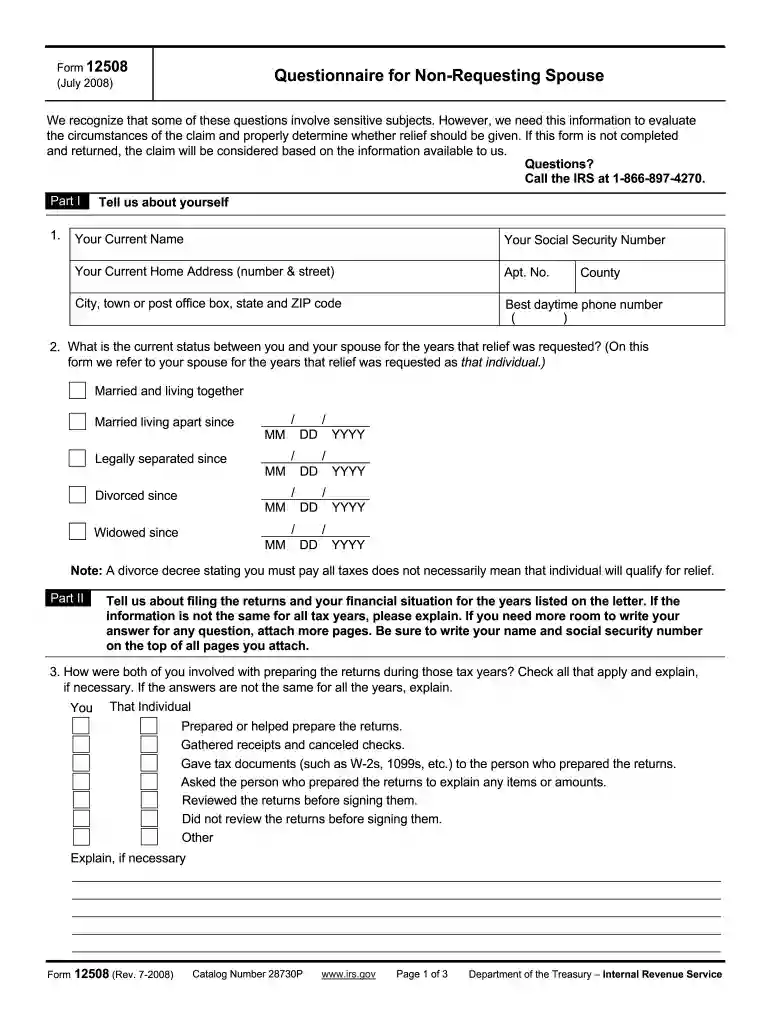
Form 12508, July 2008, is used by the Internal Revenue Service (IRS) to collect vital information from non-requesting spouses involved in Innocent Spouse Relief claims. This form serves as a questionnaire, ensuring the IRS gathers comprehensive insights into the personal and financial circumstances of the non-requesting spouse within the context of tax relief provisions. By submitting Form 12508, individuals provide crucial data that aids the IRS in assessing eligibility for relief from joint tax responsibilities, ensuring fair treatment under specific circumstances outlined in tax laws.
To use Form 12508 effectively, non-requesting spouses must provide detailed information that accurately reflects their situation during the tax years in question. This involves filling out sections concerning personal details, financial status, involvement in tax return preparation, and any asset transfers that might have occurred. Users should ensure that all data is accurate and truthful to aid in the reliable evaluation of their claim for relief. Since this form is instrumental in determining tax liabilities, it is crucial that it is filled out precisely, with attention to detail in every section.
Form 12508 is primarily utilized by individuals who are non-requesting spouses seeking Innocent Spouse Relief from the IRS. These are spouses who, though they filed joint tax returns, believe they should not be held responsible for the tax debt incurred due to the actions of their partner. This need often arises when one spouse is unaware of discrepancies such as underreported income or improper deductions on a jointly filed return. The form ensures these individuals can present their case adequately to seek relief from potential liability.
Legally, Form 12508 is used to assert a claim for relief from tax liabilities that arise from the misreporting on a jointly filed tax return. It provides the IRS with necessary background information to judge whether a non-requesting spouse qualifies for Innocent Spouse Relief. U.S. tax laws, requiring equitable treatment of spouses in unique financial partnerships, mandate this provision. Form 12508 facilitates legal processes by ensuring claims are substantiated with detailed personal and financial information.
When completing Form 12508, spouses should be ready to provide various supporting documents, such as:
Under IRS guidelines, Form 12508 must be filled out with complete accuracy, as it forms an integral part of the Innocent Spouse Relief assessment. IRS mandates that all information provided be true and complete, under penalty of perjury, requiring individuals to certify the accuracy of their submissions. The IRS reviews the form along with supporting documentation to determine eligibility for tax relief, taking into account all financial and personal elements presented.
While there is no fixed deadline specific to Form 12508, the timing for filing it largely depends on the discovery of eligibility for Innocent Spouse Relief. Typically, it should be filed within two years of any IRS attempt to collect the tax debt in question. Meeting these timing requirements is crucial, as failure to submit the form promptly can affect the outcome of the relief application process.
Noncompliance with the requirements of Form 12508 can lead to significant legal challenges. If the form is incorrectly completed or contains false information, individuals may face penalties associated with tax fraud or evasion. Additionally, failure to submit supporting documents or provide accurate data can result in denial of Innocent Spouse Relief, leaving the non-requesting spouse liable for joint tax debts.
Eligibility for using Form 12508 centers around specific IRS conditions. The non-requesting spouse must establish that they had no knowledge of the misstatements on the tax return, demonstrate an unequal financial burden, and be able to show that holding them solely liable would be unreasonable and unjust. Providing clear evidence of limited involvement in tax determinations and lack of benefit from erroneous claims is crucial in gaining relief.


We've got more versions of the form 12508 july 2008 form. Select the right form 12508 july 2008 version from the list and start editing it straight away!
At DocHub, your data security is our priority. We follow HIPAA, SOC2, GDPR, and other standards, so you can work on your documents with confidence.
by AK Sarata 2011 Cited by 3 On May 21, 2008, the Genetic Information Nondiscrimination Act of 2008 (GINA), referred to by its sponsors as the first civil rights act ofRead more
Scientific Investigations Report 2008-5097. (Published online, July 2008). Watts, R., 2006. Enhanced Reactant-Contaminant Contact Through the Use ofRead more
May 13, 2008 INSTRUCTIONS: Public Officers must complete this form in full. Public employees who hold positions in the Executive Branch of. State GovernmentRead more


