
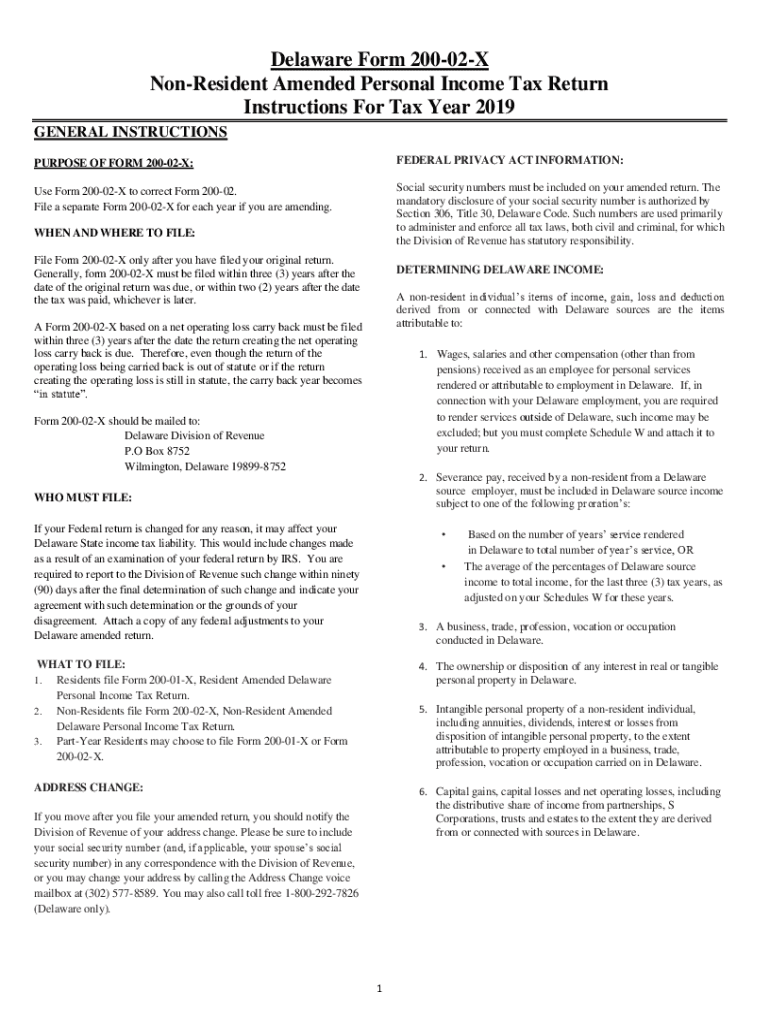







Definition & Purpose of Delaware Form 200-01-X
The Delaware Form 200-01-X Resident Amended Personal Income is designed for residents of Delaware who need to amend a previously filed personal income tax return. This form allows taxpayers to correct any errors or omissions made on the original return, ensuring accurate reporting of income, deductions, and credits. By filing this form, individuals can adjust their tax liability and potentially receive a refund if overpayment occurred.
Key Reasons to Use This Form
- Errors on the original tax return, such as incorrect income reporting or missed deductions, can lead to filing Form 200-01-X.
- New tax documents received after filing the original return that affect income or deductions.
- Changes to previously reported credits or adjustments due to revised tax legislation.
Obtaining the Delaware Form 200-01-X
Taxpayers can acquire the Delaware Form 200-01-X through multiple avenues:
- Online Accessibility: Delaware's Department of Revenue provides downloadable PDF versions from their website. This format is ideal for digital completion and submission.
- Physical Copies: Post offices, libraries, and some government buildings in Delaware may stock paper copies.
- By Request: Residents can request the form by contacting the Delaware Department of Revenue directly, where it can be mailed.
Importance of Correct Retrieval
Ensuring the use of the latest version of the form is crucial to include any recent updates or changes in state tax laws.
Steps to Complete the Form
Completing the Delaware Form 200-01-X involves several crucial steps to ensure accuracy:
- Gather Necessary Documentation: Have all relevant documents such as W-2s, 1099s, and any previous tax return copies.
- Review Original Return: Carefully examine the original return to identify specific sections requiring amendments.
- Complete the Form:
- Enter personal information including name, address, and Social Security Number.
- Clearly indicate the tax year being amended.
- Provide details on the originally reported figure and the amended figures for income, tax, and credits.
- Justification for Amendments: Clearly specify reasons for amendments in the declaration section.
- Calculate Adjusted Tax Liability: Determine changes in tax liability or refund due, using the updated figures.
Double-Checking Entries
Cross-reference all entries against previous tax forms to prevent further errors.
Important Terms Related to the Form
Understanding key terminology enhances the accuracy and clarity of filing:
- Amended Return: A revised version of the tax return correcting mistakes in the original submission.
- Tax Year: The specific year for which the tax return and amendments are applicable.
- Tax Liability: The amount owing in taxes after evaluation of income and deductions.
Common Mistakes
Misinterpretation of terms, such as mixing up tax credits with deductions, can lead to erroneous filings.
Required Documents
To effectively complete Delaware Form 200-01-X, necessary documents include:
- Original Tax Return: Required to cross-check any amendments.
- W-2 Forms: Statements of earnings provided by employers.
- 1099 Forms: For interest, dividends, or self-employment income.
- Supporting Documentation: Any additional receipts or documentation for claimed deductions and credits.
Impact of Incomplete Documentation
Missing documentation can delay processing and might lead to penalties or interest charges.
Filing Deadlines & Important Dates
Delaware residents must adhere to specific deadlines when submitting the Form 200-01-X:
- General Timeline: Amendments must be filed within three years of the original return filing date or within two years after tax was paid, whichever is later.
- Consider Extensions: If a federal extension was granted, the deadline for the Delaware amended return may also be extended.
Consequences of Missing Deadlines
Filing beyond prescribed periods might result in forfeited refunds or additional tax liabilities.
Penalties for Non-Compliance
Failure to file the Delaware Form 200-01-X correctly or within deadlines can result in:
- Fines and Interest: Accrued on any additional taxes determined due.
- Further Audits: Repeated errors or omissions may trigger detailed audits by tax authorities.
Strategies to Avoid Penalties
Utilizing tax professionals’ services or software can help ensure accuracies, such as TurboTax or QuickBooks, which are compatible for such filings.
Software Compatibility & Digital Vs. Paper Submission
Filing can be streamlined through software integration:
- Digital Submission: Preferred for its speed and receipt confirmation. Tools like TurboTax facilitate electronic completion and submission.
- Paper Filing: Available for individuals preferring traditional methods, required to be mailed to designated state IRS addresses.
Benefits of Each Submission Method
- Efficiency: Digital submissions are often processed faster than paper filings.
- Recording: Digital submissions provide instant confirmation and records, aiding in filing follow-up documentation.




