
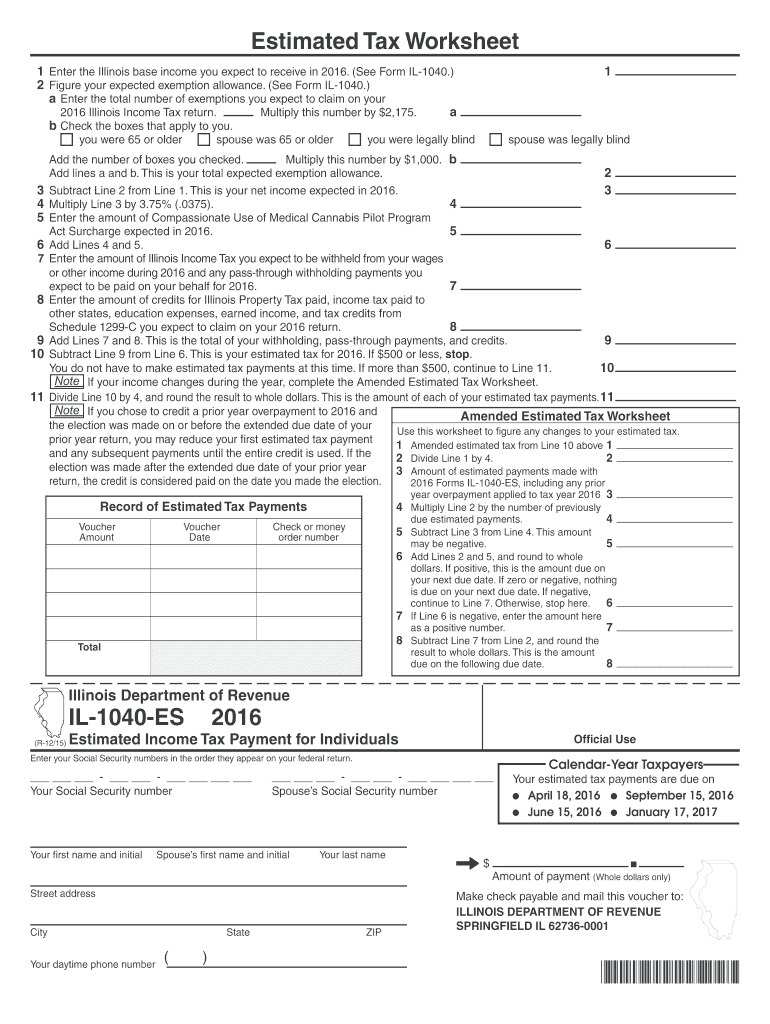







Definition and Purpose of the IL-1040-ES Estimated Income Form
The Illinois Department of Revenue IL-1040-ES Estimated Income form is a crucial document for Illinois taxpayers who anticipate owing income taxes beyond what is withheld through regular employer payroll deductions. This form, used for making estimated tax payments, ensures compliance with state tax regulations. Taxpayers must submit the IL-1040-ES if their expected tax liability after credits and deductions exceeds $500. By doing so, individuals can avoid potential penalties associated with underpayment or late payment of taxes.
How to Use the IL-1040-ES Estimated Income Form
Utilizing the IL-1040-ES involves completing various sections to determine your estimated tax payments accurately. Here's a step-by-step breakdown:
-
Estimate Income and Deductions: Begin by forecasting your total annual income. Include wages, self-employment income, dividends, and any other income sources.
-
Calculate Deductions and Credits: Deduct eligible expenses to reduce your taxable income. Consider deductions such as mortgage interest, state taxes paid, and educational expenses as per Illinois law.
-
Determine Liability: Use the Estimated Tax Worksheet provided by the Illinois Department of Revenue to subtract applicable credits and deductions.
-
Divide Payment: Equally divide the remaining taxable amount across four quarterly payments, focusing on the designated due dates to avoid penalties.
-
Submit Payments: Payments can be submitted via online platforms or traditional mail. Ensure payments are made by the quarterly due dates to stay compliant.
Obtaining the IL-1040-ES Form
You can obtain the IL-1040-ES form through several convenient avenues:
- Online Access: Download it directly from the Illinois Department of Revenue's official website.
- In-Person: You may visit local Illinois Department of Revenue offices.
- Request by Mail: Request a physical copy by contacting the Illinois Department of Revenue.
Steps to Complete the IL-1040-ES Form
Completing the IL-1040-ES form can seem daunting, but by following a systematic process, you can ensure accuracy:
-
Gather Financial Documents: Start by collecting all relevant income documentation, such as W-2s, 1099s, and records of business income.
-
Review the Estimated Tax Worksheet: This helps in calculating the precise taxable income and subsequent liability.
-
Fill Out Personal Information: Include your name, address, and Social Security number at the top of the form.
-
Enter Estimated Tax Figures: Fill in the calculated estimated tax amount, dividing it evenly across the four quarters.
-
Include Payment Method: Select your preferred payment method, whether online, by phone, or through check/money order.
-
Submit the Completed Form: Ensure the form and payment are submitted before the deadline.
Importance of Filing the IL-1040-ES Form
Filing the IL-1040-ES form is imperative as it helps taxpayers avoid penalties and interest on unpaid taxes. The form facilitates timely tax payments, ensuring there are no large payments due at the end of the fiscal year. Paying estimated taxes quarterly maintains cash flow management, particularly crucial for self-employed individuals or those with fluctuating income.
Typical Users of the IL-1040-ES Estimated Income Form
The IL-1040-ES form primarily targets:
- Self-Employed Individuals: Freelancers and business owners who do not have taxes withheld from income.
- Retirees: Individuals receiving retirement income, pensions, or Social Security benefits that may not cover all the state tax liabilities.
- Investors and Landlords: Those receiving passive income like dividends, rental income, or capital gains requiring additional tax considerations.
Key Elements of the IL-1040-ES Form
Critical components of the IL-1040-ES form include:
- Estimated Tax Worksheet: Provides guidance for accurately calculating obligations.
- Payment Vouchers: Used to accompany payments made by mail.
- Instructional Guide: Details calculations and filing instructions, ensuring correct and complete submissions.
State-Specific Rules for Illinois Taxpayers
Illinois has unique tax rules that govern estimated income tax payments:
- Flat Tax Rate: Illinois employs a flat state income tax rate affecting the computation of estimated taxes.
- No Local Income Tax: Unlike some states, Illinois does not impose city or municipal income taxes, simplifying the estimated tax calculation.
- Payment Exceptions: Certain taxpayers, such as agriculture-related businesses or newly retired individuals, may qualify for exceptions.
Examples of Using the IL-1040-ES Form
To bring clarity to using the IL-1040-ES:
-
Scenario 1: A freelance graphic designer in Illinois anticipates making $65,000 a year. After business expenses and deductions, they expect a liability exceeding $500, making quarterly submissions essential.
-
Scenario 2: A retiree with a pension and investment income projects an annual tax liability over $500, prompting them to use the IL-1040-ES for structured payments.
Understanding the nuances and methodologies of the IL-1040-ES provides taxpayers with the confidence and knowledge to manage their annual tax responsibilities efficiently and effectively.




