
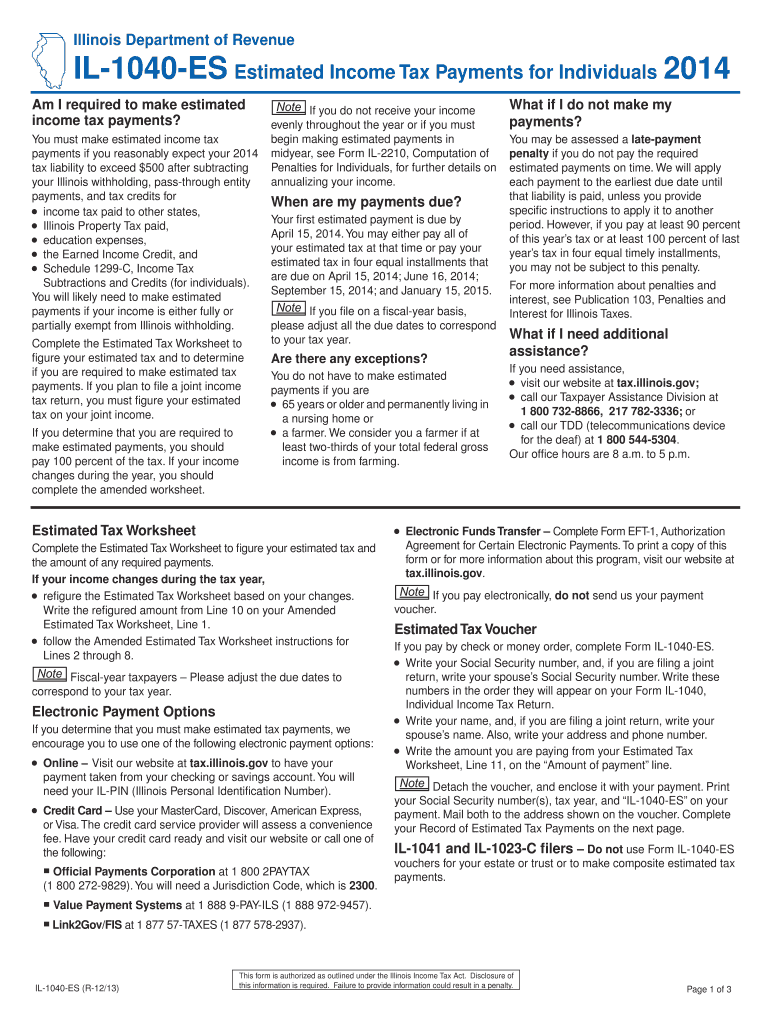





You must make estimated income tax payments if you reasonably expect your 2014 tax liability to exce-2026

Get Form
You must make estimated income tax payments if you reasonably expect your 2014 tax liability to exce Preview on Page 1

Here's how it works

01. Edit your form online
Type text, add images, blackout confidential details, add comments, highlights and more.
02. Sign it in a few clicks
Draw your signature, type it, upload its image, or use your mobile device as a signature pad.
03. Share your form with others
Send it via email, link, or fax. You can also download it, export it or print it out.

Definition & Meaning

Estimated income tax payments involve prepaying a portion of your expected tax liability for the current year to the Internal Revenue Service (IRS). This is crucial if you anticipate owing a significant amount of tax when filing your annual return. The obligation falls on individuals or entities likely to owe taxes beyond what is covered by withholding alone. It ensures that taxpayers meet their tax responsibilities incrementally, reducing the risk of owing a large sum at once.

IRS Guidelines

The IRS establishes clear guidelines indicating when estimated tax payments are necessary. Generally, if you expect to owe at least $1,000 in tax for 2014 after subtracting withholding and credits, it's obligatory to make estimated payments. The IRS Form 1040-ES helps calculate and track these payments. Calculations factor in your expected adjusted gross income, taxable income, taxes, deductions, and credits for the year.

Filing Deadlines / Important Dates

Estimated tax payments for 2014 are divided into four installments. The due dates for each quarter are as follows:

  1. First payment: April 15, 2014
  2. Second payment: June 16, 2014
  3. Third payment: September 15, 2014
  4. Fourth payment: January 15, 2015

Timely payments help prevent penalties for underpayment, which can accrue and increase your liability.

Steps to Complete the Form

Completing the estimated tax payment form involves several key steps:

  1. Estimate your tax liability for the year using your previous year’s taxes as a guide.
  2. Calculate your expected income, deductions, and credits to arrive at your anticipated taxable income.
  3. Determine the amount to pay by using the IRS Form 1040-ES worksheet.
  4. Complete and submit the voucher that accompanies the payment. Each payment requires a separate voucher.

Penalties for Non-Compliance

Failing to make estimated tax payments when required can lead to penalties. The IRS typically imposes a penalty for undue delay unless you meet certain exceptions. These may include circumstances where:

  • You owe less than $1,000 in taxes after withholding and credits.
  • Your total withholding and estimated payments are at least 90% of your tax liability for the year, or 100% of the prior year’s liability, whichever is less.

Important Terms Related to the Form

Understanding key terms is essential:

  • Adjusted Gross Income (AGI): Total income minus specific deductions.
  • Withholding: Tax withheld from salaries, pensions, or other earnings.
  • Quarterly Payments: Payments due four times a year.
  • Safe Harbor Rule: Protects taxpayers from penalties if certain conditions are met.

State-Specific Rules

While federal guidelines are crucial, state-level differences also impact estimated tax payments. Many states have their requirements and forms, which may vary significantly from federal regulations. It is important to check with your specific state’s department of revenue to ensure compliance with local laws affecting your tax obligations.

Required Documents

To ensure accurate reporting and payment:

  • Gather last year’s tax return for reference.
  • Have records of income such as W-2s or 1099 forms.
  • Document any changes in income, deductions, and credits anticipated for 2014.

Digital vs. Paper Version

Taxpayers have the option to submit payments either digitally or on paper. The digital method often involves using the IRS's Electronic Federal Tax Payment System (EFTPS), providing a secure, efficient way to pay. Paper forms, if preferred, require mailing the complete vouchers with the necessary payments to designated IRS addresses.

Software Compatibility

Several tax software programs like TurboTax or QuickBooks facilitate the process of calculating and making estimated tax payments. These programs can streamline the completion of Form 1040-ES, allowing for accurate and hassle-free submission.

See more You must make estimated income tax payments if you reasonably expect your 2014 tax liability to exce versions

We've got more versions of the You must make estimated income tax payments if you reasonably expect your 2014 tax liability to exce form. Select the right You must make estimated income tax payments if you reasonably expect your 2014 tax liability to exce version from the list and start editing it straight away!
Versions Form popularity Fillable & printable
2024 4.4 Satisfied (24 Votes)
2023 4.6 Satisfied (37 Votes)
2022 4.8 Satisfied (96 Votes)
2021 4.1 Satisfied (50 Votes)
2020 4.2 Satisfied (48 Votes)
2019 4.1 Satisfied (60 Votes)
2018 4 Satisfied (51 Votes)
2017 4.4 Satisfied (23 Votes)
2016 4.3 Satisfied (71 Votes)
2014 4 Satisfied (43 Votes)
2013 4 Satisfied (40 Votes)
2012 4 Satisfied (51 Votes)
be ready to get more

Complete this form in 5 minutes or less

Get form

Got questions?

We have answers to the most popular questions from our customers. If you can't find an answer to your question, please contact us.
Contact us
Generally, you must make estimated tax payments if you expect to owe at least $500 ($250 if married/RDP filing separately) in tax for 2025 (after subtracting withholding and credits) and you expect your withholding and credits to be less than the smaller of: 1. 90% of the tax shown on your 2025 tax return; or 2.
Late payment penalties are typically imposed if you dont pay your estimated taxes by the due date. This penalty is currently 0.5% of the amount owed for each month (or partial month) the payment is delinquent, up to a maximum of 25%.
Individuals, including sole proprietors, partners, and S corporation shareholders, generally have to make estimated tax payments if they expect to owe tax of $1,000 or more when their return is filed.
In most cases, to avoid a penalty, you need to make estimated tax payments if you expect to owe $1,000 or more in taxes for the yearover and above the amount withheld from your wages or other income.
If you are in business for yourself, you generally need to make estimated tax payments. Estimated tax is used to pay not only income tax, but other taxes such as self-employment tax and alternative minimum tax. If you dont pay enough tax through withholding and estimated tax payments, you may have to pay a penalty.

Security and compliance

At DocHub, your data security is our priority. We follow HIPAA, SOC2, GDPR, and other standards, so you can work on your documents with confidence.

Learn more
ccpa2
pci-dss
gdpr-compliance
hipaa
soc-compliance

People also ask

Answer: Generally, you must make estimated tax payments for the current tax year if both of the following apply: You expect to owe at least $1,000 in tax for the current tax year after subtracting your withholding and refundable credits.
The IRS will not charge you an underpayment penalty if: You pay at least 90% of the tax you owe for the current year, or 100% of the tax you owed for the previous tax year, or.
An underpayment penalty is a charge the IRS imposes on taxpayers who did not pay all of their estimated income taxes for the year or paid their taxes late. Youll face an underpayment penalty if you: Didnt pay at least 90% of the tax on your current-year return or 100% of the tax shown on the prior years return.

Related links

